FREE! Click here to Join FunTrivia. Thousands of games, quizzes, and lots more!
Quiz about Cold War Basics

Cold War Basics Trivia Quiz


The Cold War was not actually a physical war, but it was one of the most intense battles ever fought. The battle of the super powers, the Soviet Union and the United States, changed international politics forever. Do you remember your Cold War history?

A multiple-choice quiz by GBfan. Estimated time: 2 mins.
  1. Home
  2. »
  3. Quizzes
  4. »
  5. History Trivia
  6. »
  7. War History
  8. »
  9. Cold War

Author
GBfan
Time
2 mins
Type
Multiple Choice
Quiz #
422,540
Updated
Jan 10 26
# Qns
10
Difficulty
Easy
Avg Score
9 / 10
Plays
125
Last 3 plays: JOHNCzee (7/10), dinipie (9/10), ceetee (10/10).
- -
Question 1 of 10
1. Whose doctrine was an eighteen minute speech to Congress in 1947 that played a key role in the start of the Cold War? Hint


Question 2 of 10
2. The Marshall Plan provided financial support to European nations after World War II. What role did George Marshall have in the US government? Hint


Question 3 of 10
3. Which Russian word used in the mid-1980s meant openness?


Question 4 of 10
4. Who was NOT a Soviet Union leader between 1947 and 1989? Hint


Question 5 of 10
5. The 38th Parallel was an important dividing line in which country?


Question 6 of 10
6. When was the Berlin Wall built? Hint


Question 7 of 10
7. Which of these countries did NOT sign the Warsaw Pact pledging allegiance to the Soviet Union? Hint


Question 8 of 10
8. Fat Man and Joe 1 were both key elements of that played a role in the upcoming Cold War. What were they? Hint


Question 9 of 10
9. The emergency communication line between the United States and the Soviet Union was called what color phone? Hint


Question 10 of 10
10. What famous quote did President Ronald Reagan address to Mikhail Gorbachev in 1987? Hint


(Optional) Create a Free FunTrivia ID to save the points you are about to earn:

arrow Select a User ID:
arrow Choose a Password:
arrow Your Email:


Most Recent Scores
Today : JOHNCzee: 7/10
Today : dinipie: 9/10
Today : ceetee: 10/10
Jan 10 2026 : CICELYALASKA: 8/10
Jan 10 2026 : Guest 173: 7/10
Jan 10 2026 : Guest 98: 7/10
Jan 10 2026 : cardsfan_027: 10/10
Jan 10 2026 : Guest 75: 8/10
Jan 10 2026 : Guest 47: 7/10

Quiz Answer Key and Fun Facts
1. Whose doctrine was an eighteen minute speech to Congress in 1947 that played a key role in the start of the Cold War?

Answer: Harry S Truman

Harry S. Truman gave a speech on March 12, 1947, about the United States' new foreign policy after World War II. One key aspect of the speech was the support for European countries against Communist subjugation. The speech has been called the Truman Doctrine. One key area which divided the United States and Russia at the time was the U.S. financially and militarily supporting Turkey and Greece, two countries that Russia was interested in annexing.
2. The Marshall Plan provided financial support to European nations after World War II. What role did George Marshall have in the US government?

Answer: Secretary of State

George Marshall was the Secretary of State of the United States from 1947-1949, and also served as Secretary of the Defense under Truman from 1950-1951. Previously, Marshall was Chief of Staff of the U.S. Army under Franklin D. Roosevelt from 1939-1945.

The Marshall Plan provided over thirteen billion dollars to Western European nations to restore their economy, build up their financial stability, and was used to strengthen their bond with the United States. With these financially strapped European nations becoming stronger and having stable economies and governments, the appeal of Communist ideologies became less appealing.
3. Which Russian word used in the mid-1980s meant openness?

Answer: Glasnost

Mikhail Gorbachev was the Soviet leader from 1985 until 1991. During his era, he introduced the terms "glasnost", meaning openness, and "perestroika", meaning restructuring. The Soviet Union began a period of political freedom, glasnost, with less government censorship and opened up the media to speak more freely on political issues.

At the same time, the government changed their economic structure, perestroika, and allowed more private ownership, decentralized the government control of the economy, and attempted to create a more open market.
4. Who was NOT a Soviet Union leader between 1947 and 1989?

Answer: Boris Yeltsin

Boris Yeltsin became the President of the Russian Federation in 1991. The country was no longer called the Soviet Union when he took office. Four years earlier, Yeltsin was the first person to resign from the Politburo of the Communist Party of the Soviet Union. This set him apart from the traditional Communist pattern, and Yeltsin was perceived as an anti-establishment figure. With the changing political environment of the late 80s, Yeltsin earned the reputation as the leader of the anti-Communist movement.

Khrushchev was their leader from 1953 - 1964. Konstantin Chernenko was the Soviet Union leader from 1984 - 1985 and Mikhail Gorbachev was the last leader of the Soviet Union from 1985 - 1991.
5. The 38th Parallel was an important dividing line in which country?

Answer: Korea

The 38th Parallel was a latitudinal line that also happened to roughly divide the country of Korea in half. After World War II, North Korea became Soviet-controlled and South Korea was U.S.-controlled. In 1949, the U.s removed their troops from South Korea, but continued to support their individual government and offered military protection and a presence against future attacks by North Korea.

The Soviet Union was more hands-on and selected the new leader for North Korea, established a government based on that of the Soviet Union, and, despite pulling their troops, provided weapons to North Korea. The two countries are still divided by a DMZ (Demilitarized Zone), a heavily armed area that separates the two unique countries.
6. When was the Berlin Wall built?

Answer: 1961

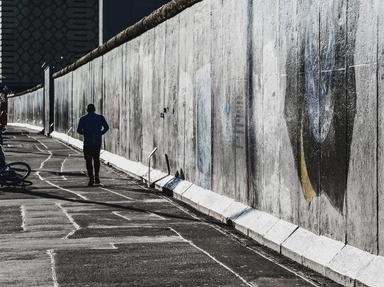
Construction on the Berlin Wall began in late summer of 1961 and continued with different "improvements" through the late 1970s. The chairman of the German Democratic Republic, Walter Ulbricht, signed the order to create a wall to separate Germany into two distinct countries. East Germany held to the Soviet Union Communist system, and the West Germany side did not share that sentiment.

The wall prevented East Germans from easily defecting to the West. On November 9, 1989, the destruction of the Berlin Wall began.

A year later only small remnants of it remained.
7. Which of these countries did NOT sign the Warsaw Pact pledging allegiance to the Soviet Union?

Answer: Italy

The Warsaw Pact was signed in Warsaw, Poland, in 1955, and saw six countries commit military support to the Soviet Union. Albania, Bulgaria, Czechoslovakia, East Germany, Poland, and Romania all agreed to the Warsaw Pact.

In the agreement, the countries banded together and pledged allegiance against any attacks by NATO, and maintained that the Soviet Union would maintain control over the group of nations. Italy was one of the first countries to sign with NATO, the North American Treaty Organization, an organization in opposition to the Warsaw Pact.
8. Fat Man and Joe 1 were both key elements of that played a role in the upcoming Cold War. What were they?

Answer: Nuclear bombs

One of the most dangerous elements of the Cold War was the escalation of nuclear bomb testing and the arms race between the Soviet Union and the United States. Prior to the start of the Cold War in 1947, the United States had dropped an atomic bomb nicknamed Fat Man on Japan in 1945 to bring World War II to a close.

The Soviet Union followed with atomic bomb testing in 1949 in Kazakhstan. Their bomb was styled after the U.S. bomb and called Joe 1 in honor of Joseph Stalin.
9. The emergency communication line between the United States and the Soviet Union was called what color phone?

Answer: Red

The Red Phone was the name given to the direct communication line between the two super powers. While many imagined it was an actual red colored telephone, we have learned that it was a secure teletype system, similar to a fax or email system today. The direct messages were carried over a transatlantic cable link and established after the Cuban Missile Crisis.
10. What famous quote did President Ronald Reagan address to Mikhail Gorbachev in 1987?

Answer: Tear down this wall

In a speech at the Brandenburg Gate in 1987, President Reagan declared, "General Secretary Gorbachev, if you seek peace, prosperity for the Soviet Union and Eastern Europe, and liberalization, come here to this gate! Mr. Gorbachev, open this gate! Mr. Gorbachev, tear down this wall!"

On November 9th, 1989, East Germans were now free to travel to West Germany and the Berlin Wall was destroyed in 1990. Symbolically the collapse of the wall opened the gates to unity. Economically, Germany united into one country and Eastern European nations were free to trade with the rest of Europe.
Source: Author GBfan

This quiz was reviewed by FunTrivia editor ponycargirl before going online.
Any errors found in FunTrivia content are routinely corrected through our feedback system.
1/11/2026, Copyright 2026 FunTrivia, Inc. - Report an Error / Contact Us