FREE! Click here to Join FunTrivia. Thousands of games, quizzes, and lots more!
Quiz about Native American Homelands

Native American Homelands Trivia Quiz

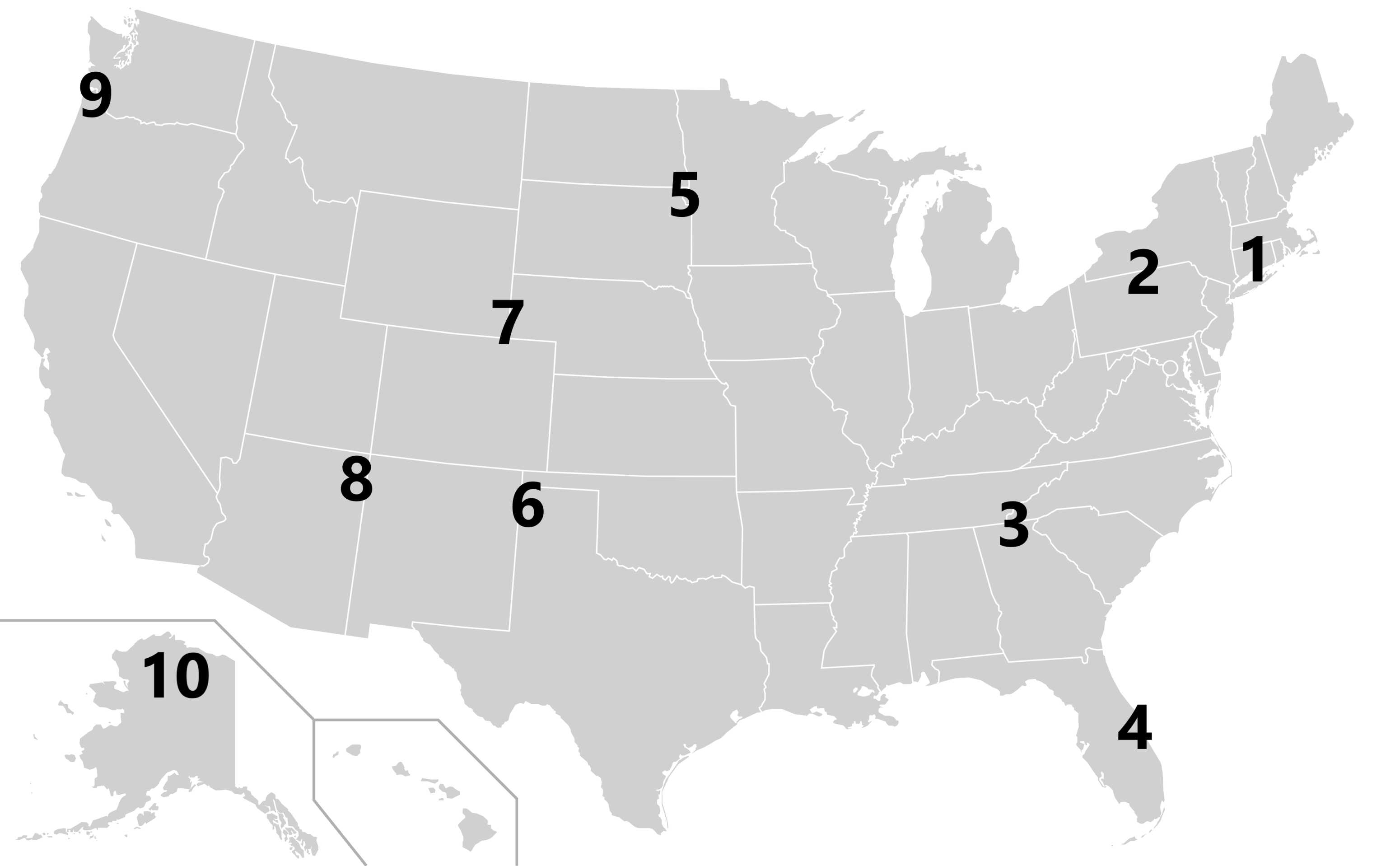
Label the Native American Regions (U.S.)

Before the colonization of North America, Native American peoples developed diverse systems of trade, diplomacy, and governance. This list is far from comprehensive, but we'll take a look at ten of the most well-known Indigenous nations and tribes.
This is a renovated/adopted version of an old quiz by author maddogmorgan

A label quiz by trident. Estimated time: 3 mins.
  1. Home
  2. »
  3. Quizzes
  4. »
  5. History Trivia
  6. »
  7. U.S. History
  8. »
  9. Native American

Author
trident
Time
3 mins
Type
Label Quiz
Quiz #
86,150
Updated
Jun 07 26
# Qns
10
Difficulty
Easy
Avg Score
9 / 10
Plays
60
Last 3 plays: Guest 166 (2/10), RJOhio (10/10), Guest 130 (10/10).
Note: The numbers in this quiz indicate a generalized location for each homeland.
Click on image to zoom
Chinook Navajo Iroquois Pequot Seminole Sioux Inupiat (Inuit) Cherokee Cheyenne Comanche
* Drag / drop or click on the choices above to move them to the answer list.
View Image Attributions for This Quiz
1.   
2.   
3.   
4.   
5.   
6.   
7.   
8.   
9.   
10.   

Most Recent Scores
Today : Guest 166: 2/10
Today : RJOhio: 10/10
Today : Guest 130: 10/10
Today : Guest 174: 10/10
Today : Guest 98: 10/10
Today : Guest 24: 2/10
Today : Guest 172: 8/10
Today : Guest 170: 7/10
Today : Guest 174: 10/10

Quiz Answer Key and Fun Facts
1. Pequot

Now associated mainly with southeastern Connecticut, the Pequot lived in villages near rivers and coastal trade routes. They spoke an Algonquian language and had close connections to the land around the Thames and Mystic rivers. The Pequot survived the initial smallpox outbreaks spread by Europeans in the 1610s. By the 1630s, a separate epidemic had severely reduced their numbers.

In 1636, Native people believed to have been allied with the Narragansett killed Puritan trader John Oldham and several others aboard his boat. This incident, along with earlier tensions over trade and regional power, helped lead to the Pequot War (1636-1638) with the colonies of Massachusetts Bay, Plymouth, and Connecticut. The conflict devastated the tribe, with many of its members killed or captured and sold into slavery, some sent as far as Bermuda. The remaining Pequot were driven from their homeland and banned from re-forming as a unified people. By 1910, the Pequot population had diminished to an official census population of only 66. The tribe has since rebuilt.
2. Iroquois

The Haudenosaunee, also known as the Iroquois Confederacy, were historically centered in what is now New York State. Their influence extended through parts of the Great Lakes, the St. Lawrence Valley, present-day Ontario and Quebec, and areas south toward Pennsylvania. The confederacy originally included the Mohawk, Oneida, Onondaga, Cayuga, and Seneca. The Tuscarora joined in 1722.

The confederacy was founded under the Great Law of Peace, which united the nations under a shared council while allowing each to keep its own identity. They were important trade and diplomatic partners with the Dutch, the French, the British, and later the Americans, but these relationships also drew them into various conflicts, such as the Beaver Wars, the French and Indian War, and the American Revolution. During this last conflict, the member nations became divided between British and American alliances, weakening the entire confederacy.

Haudenosaunee communities were known for their longhouses, where related families from the same matrilineal clan lived together, with clan membership passed through the mother's line. Lacrosse also has deep roots among the Haudenosaunee, who traditionally played it on open fields with handmade wooden sticks and leather balls. The game, more violent in its past iterations, helped prepare young men for the demands of war.
3. Cherokee

If we look to the southeastern United States, we'll find the homelands of the Cherokee, especially in parts of present-day Tennessee, North Carolina, South Carolina, Georgia, Alabama, and Virginia. Many of their towns were built along river valleys. By the early 1700s, the Cherokee were involved in trade with British colonists, especially through the deerskin trade.

In the 1700s and early 1800s, they fought in several conflicts connected to European and American expansion, including the Cherokee-American wars that took place from 1776 to 1794. The conflict led to the destruction of many Cherokee towns and forced the tribe to give up more land in later treaties. After the Indian Removal Act of 1830, most Cherokee were forced west to Indian Territory during the Trail of Tears in 1838-1839. Some remained in the Southeast, especially in western North Carolina. Today, there are three federally recognized Cherokee tribes in Oklahoma and North Carolina, and these communities have set up Cherokee-language immersion schools and adult language programs to train new fluent speakers.
4. Seminole

The Seminole formed in the 1700s from Creek people who moved south from present-day Georgia and Alabama to Florida, along with other Native people and a number of Africans who had escaped slavery. While their villages were located in northern Florida at first, many Seminole communities were forced to move deeper and deeper into central and southern Florida.

The Seminole traded with Spanish, British, and American settlers, but U.S. expansion into Florida led to repeated conflict. After the Indian Removal Act of 1830, the United States tried to force the Seminole west to Indian Territory. This led to the Second Seminole War, fought from 1835 to 1842. The war caused the removal of many Seminole people, but several hundred remained in Florida, some fleeing to the Everglades.

Seminole communities became known for building chickee houses, open-sided wooden homes with raised floors and palmetto-thatched roofs, which worked well in the wet climate of southern Florida. The Seminole Tribe of Florida is now federally recognized and describes itself as the only tribe in the United States that never signed a peace treaty with the U.S. government.
5. Sioux

The Sioux are made up of three main groups: the Eastern Dakota, the Western Dakota, and the Lakota. They were historically connected to the woodlands and prairies of present-day Minnesota and the eastern Dakotas, and many Lakota later moved west onto the northern Great Plains. Their area of influence included parts of present-day North Dakota, South Dakota, Nebraska, Montana, Wyoming, and Minnesota.

The Sioux were trading with French fur traders by the late 1600s. After horses were brought to the North American continent, Lakota hunters became known for hunting bison on horseback and using the hides for tipis and clothing. However, their later history was shaped by conflict with U.S. expansion onto the Plains. The Fort Laramie Treaty of 1868 recognized the Black Hills as part of the Great Sioux Reservation, but gold seekers entered the Black Hills in the 1870s after gold was found there. This helped lead to the Great Sioux War of 1876-1877, in which Lakota, Northern Cheyenne, and Arapaho fighters defeated U.S. troops at the Battle of the Little Bighorn. The war ended with U.S. control over the Black Hills and further pressure on Sioux lands.
6. Comanche

Within the southern Great Plains, in an area often called "Comancheria" by Spanish and Mexican officials, one could find the Comanche. This area included much of present-day northwestern Texas, eastern New Mexico, southeastern Colorado, southwestern Kansas, and western Oklahoma. The Comanche had earlier connections to Shoshone peoples farther north and west, but by the 1700s they had become a powerful Plains people.

After acquiring horses, the Comanche became skilled mounted hunters and fighters. They hunted bison, moved camps with horse-drawn travois, and measured wealth partly by the size of a family's horse herd. They traded with Spanish, Mexican, French, and American settlers, but they also raided settlements for horses, livestock, and captives. By the 1800s, their control of the southern Plains made travel and settlement dangerous for outsiders entering Comanche territory.

U.S. expansion, the destruction of bison herds, and a number of army campaigns weakened Comanche independence in the late 1800s. During the Red River War of 1874-1875, the U.S. Army attacked Comanche and other Native American groups on the southern Plains, forcing many onto reservations in Indian Territory. The last major Comanche group surrendered at Fort Sill in 1875. Today, the Comanche Nation is federally recognized and headquartered in Lawton, Oklahoma, where it operates its own tribal government.
7. Cheyenne

Earlier homelands for the Cheyenne were located near the upper Mississippi River and Minnesota River, but in the 1700s and 1800s, the Cheyenne had mostly moved west onto the Great Plains, where they became closely connected to present-day Wyoming, Montana, Colorado, the western Dakotas, and Oklahoma. By the 1800s, the Cheyenne had separated into Northern Cheyenne and Southern Cheyenne groups.

Similar to other Plains tribes, they became skilled bison hunters and lived in tipis. They formed a close alliance with the Arapaho around 1811, and the Arapaho aided them across several conflicts. The Cheyenne traded with American settlers and officials, but U.S. expansion onto the Plains led to repeated skirmishes. In 1864, U.S. soldiers attacked a Cheyenne and Arapaho village at Sand Creek in Colorado, killing many people, including women, children, and elders. The Cheyenne later fought alongside other Native American groups in struggles against U.S. forces, including Red Cloud's War and the Great Sioux War of 1876. Cheyenne fighters joined Lakota and Arapaho fighters at the Battle of the Little Bighorn, where they defeated U.S. troops in 1876. Today, the Northern Cheyenne Tribe is based in Montana, and many Southern Cheyenne citizens belong to the Cheyenne and Arapaho Tribes in Oklahoma.
8. Navajo

The Navajo, who call themselves Diné, are historically connected to the Four Corners region of the Southwest. Their homeland included parts of present-day Arizona, New Mexico, Utah, and Colorado, with an early center in Dinétah in northwestern New Mexico. Spanish colonists entered the region in the 1500s and 1600s, and the Navajo later traded and fought with Spanish, Mexican, and American settlers.

In the 1800s, conflict with the United States increased as American soldiers and settlers moved farther into Navajo lands. In 1864, U.S. forces under Kit Carson forced thousands of Navajo people to walk to Bosque Redondo in eastern New Mexico, an event remembered as the Long Walk. The imprisonment there lasted until the Treaty of 1868 allowed the Navajo to return to part of their homeland.

Navajo communities became known for sheep herding, weaving, and silverwork. During World War II, Navajo Marines used the Navajo language to create a military code that Japanese forces did not break. Today, the Navajo Nation has the largest reservation in the United States, extending across Arizona, New Mexico, and Utah.
9. Chinook

With villages situated near major river and coastal trade routes, the Chinook homeland was located along the lower Columbia River and the Pacific coast of present-day Washington and Oregon. They became important traders, interacting with other Native groups and later with European/American traders and explorers, including members of the Lewis and Clark Expedition in 1805. Chinook Jargon, a trade language using various Native American languages along with French and English, developed in the Pacific Northwest and helped people from different groups communicate. In 1851, several Chinook groups signed treaties at Tansy Point, but the U.S. Senate did not ratify them, leaving the promised reservation lands unsecured.

The Chinook were not known for extended military conflicts against U.S. forces; however, they were affected by disease, loss of land, and a series of unratified treaties with the U.S. government.
10. Inupiat (Inuit)

The Inupiat are also referred to as the Alaskan Inuit. Their homelands include the Arctic coast of Alaska, the North Slope, the Kotzebue Sound region, and areas near the Bering Strait. Coastal Inupiat communities relied heavily on harvesting bowhead whales, seals, and fish, while inland Inupiat communities hunted caribou and other land animals.

The Inupiat had increasing contact with outsiders in the 1800s, especially through commercial whaling and mission schools. After the United States purchased Alaska from Russia in 1867, government schools became one of the main ways federal authority reached Inupiat communities. Outside diseases and permanent settlements changed daily life, but many Inupiat families continued subsistence hunting and fishing.

Inupiat communities developed tools and building methods suited to Arctic conditions, such as skin-covered boats for hunting on the water and semi-underground houses for protection from cold weather. Bowhead whaling remains important in several coastal villages, where the meat and blubber are shared through community rules.
Source: Author trident

This quiz was reviewed by FunTrivia editor gtho4 before going online.
Any errors found in FunTrivia content are routinely corrected through our feedback system.
6/7/2026, Copyright 2026 FunTrivia, Inc. - Report an Error / Contact Us