FREE! Click here to Join FunTrivia. Thousands of games, quizzes, and lots more!
Quiz about The Ayutthaya Kingdom 13511767

The Ayutthaya Kingdom (1351-1767) Quiz


This is a quiz about the Ayutthaya Kingdom (1351-1767), a powerful, prosperous, cosmopolitan state located in modern day Thailand. Have fun!

A photo quiz by NeuralSpicy. Estimated time: 2 mins.
  1. Home
  2. »
  3. Quizzes
  4. »
  5. History Trivia
  6. »
  7. Asian
  8. »
  9. Thailand

Author
NeuralSpicy
Time
2 mins
Type
Photo Quiz
Quiz #
425,077
Updated
Aug 02 26
# Qns
10
Difficulty
New Game
Avg Score
9 / 10
Plays
8
Last 3 plays: Dizart (10/10), Guest 68 (10/10), boombaby (10/10).
-
Question 1 of 10
1. What was the name of the capital city of the Ayutthaya Kingdom? Hint


Question 2 of 10
2. What name did the founder of the Ayutthaya Kingdom take after he established it in 1351? Hint


Question 3 of 10
3. What important economic activity helped make the Ayutthaya Kingdom wealthy? Hint


Question 4 of 10
4. Which religion was followed by most people in the Ayutthaya Kingdom? Hint


Question 5 of 10
5. Which Khmer capital city was captured by Ayutthayan forces in 1431, leading to Ayutthaya growing in power and influence? Hint


Question 6 of 10
6. In the early sixteenth century, merchants from which country became the first Europeans to establish formal relations with the Ayutthaya kingdom? Hint


Question 7 of 10
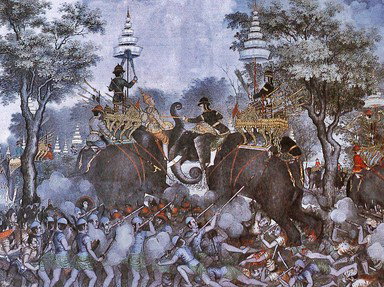
7. Which Ayutthayan ruler is remembered for an elephant-back duel during a war for independence in 1593? Hint


Question 8 of 10
8. What precious metal was widely used in Ayutthaya's international trade? Hint


Question 9 of 10
9. During the reign of which Ayutthayan king did diplomatic relations with the court of Louis XIV of France thrive? Hint


Question 10 of 10
10. The Ayutthaya kingdom came to an end in 1767 when its capital was destroyed by the army of which neighboring state? Hint


(Optional) Create a Free FunTrivia ID to save the points you are about to earn:

arrow Select a User ID:
arrow Choose a Password:
arrow Your Email:


View Image Attributions for This Quiz

Most Recent Scores
Today : Dizart: 10/10
Today : Guest 68: 10/10
Today : boombaby: 10/10
Today : Rumpo: 10/10
Today : xchasbox: 9/10
Today : Guest 77: 6/10
Today : marianjoy: 10/10
Today : bernie73: 7/10

Quiz Answer Key and Fun Facts
1. What was the name of the capital city of the Ayutthaya Kingdom?

Answer: Ayutthaya

The name of the capital city is the same as the name of the kingdom, because I am either a benevolent or fiendish quiz writer depending on whether you answered it correctly. The city was founded in 1351 by King U Thong, better known by the title he assumed later (we'll get to that in the next question).

The city quickly grew into one of Asia's great trading capitals, and Europeans would come to think of it as one of the three great powers of the region. Merchants from Japan, Persia, India, Portugal, the Netherlands, France, and China all established communities there. It was a very cosmopolitan place for its time. Elaborate court ceremonies. Busy markets. Foreign visitors. Remarkable wealth.
2. What name did the founder of the Ayutthaya Kingdom take after he established it in 1351?

Answer: Ramathibodi I

The founder of the Ayutthaya Kingdom is generally identified as U Thong, who took the title Ramathibodi I when he established the kingdom in 1351. Little is known for certain about his early life. Various traditions have him coming out of one area or another or even from Chinese merchant communities. Regardless of his background, his new kingdom was perfectly located near the Gulf of Thailand, giving it easy access to both river routes and international sea trade. Its location is one of the big reasons it became one of the dominant powers of the region.

A king's regnal name mattered a lot in Ayutthaya. It symbolized authority, legitimacy, and his place in a dynastic tradition. Ramathibodi I was the one who set the stage for a kingdom that would go on for more than four centuries, with dozens of rulers following in his footsteps.
3. What important economic activity helped make the Ayutthaya Kingdom wealthy?

Answer: International trade

Ayutthaya's prosperity was fueled by international trade. Founded near the mouth of the Chao Phraya River, the kingdom occupied an excellent position between the Indian Ocean and the South China Sea. Ships would arrive carrying merchants from China, Japan, India, Persia, Portugal, the Netherlands, and many other lands.

They traded for rice, deer hides, sappanwood, ivory, tin, and other forest goods, while bringing silver, silk, porcelain, textiles, and luxury goods in return. The royal court of Ayutthaya collected customs duties and maintained monopolies over especially valuable exports, making them a major source of revenue for the kingdom.
4. Which religion was followed by most people in the Ayutthaya Kingdom?

Answer: Theravada Buddhism

Theravada Buddhism was a part of everyday life in the Ayutthaya Kingdom over the four centuries of its existence. Kings made themselves out as defenders and patrons of the faith and sponsored glorious temples, monasteries, and ceremonies across their sphere of influence. Monks were highly respected religious leaders as well as educators and keepers of the knowledge.

Even so, Ayutthaya was certainly not isolated or intolerant. Quite the opposite. The kingdom welcomed merchants and diplomats from across Asia and Europe, so Buddhist temples existed alongside mosques, Christian churches, and more.

The Hindu religion also mixed with politics in interesting ways. The royal court incorporated many customs and ceremonies derived from Hindu traditions. This is especially true when it came to coronation rituals, with Brahmins often conducting important state ceremonies.
5. Which Khmer capital city was captured by Ayutthayan forces in 1431, leading to Ayutthaya growing in power and influence?

Answer: Angkor

Ayutthayan forces captured Angkor in 1431 during a period of poor relations with the Khmer Empire. We're not really sure how permanent the occupation was or to what extent the city was abandoned. We do know that Angkor remained inhabited, just on a much smaller scale, and its temples (Angkor Wat pictured) continued to bring in Buddhist pilgrims.

The siege of Angkor did not end the Khmer Empire, but their royal court eventually relocated farther south, while Ayutthaya became one of the great powers in mainland Southeast Asia.
6. In the early sixteenth century, merchants from which country became the first Europeans to establish formal relations with the Ayutthaya kingdom?

Answer: Portugal

Merchants from Portugal became the first Europeans to establish formal relations with the kingdom after the Portuguese conquest of Malacca in 1511 (pictured). A short time after that conflict, an envoy reached Ayutthaya, and friendly ties developed. The Siamese court granted the Portuguese permission to trade and settle, leading them to become important partners in commerce and military affairs.

They brought matchlock firearms and new military techniques. Meanwhile Ayutthaya offered access to markets for spices, forest goods, and various luxuries.

It was a practical arrangement. Everybody gained, and the goods flowed.
7. Which Ayutthayan ruler is remembered for an elephant-back duel during a war for independence in 1593?

Answer: Naresuan

King Naresuan is a much-celebrated figure in Thailand, and the elephant-back duel of 1593 is one of his great legends. According to Thai tradition, Naresuan challenged the Burmese crown prince, Mingyi Swa, to single combat while both rode war elephants during the Battle of Nong Sarai. The duel ended with Naresuan killing the prince. The victory became a symbol of Siamese independence after years of Burmese domination.

But did it happen? A lot of the details of the battle and the duel are questionable. Surviving Thai and Burmese accounts disagree on the facts. However, Naresuan's role in restoring Ayutthaya's independence is well established.
8. What precious metal was widely used in Ayutthaya's international trade?

Answer: Silver

Silver was the lifeblood of Ayutthaya's overseas commerce. The kingdom exported products like rice, deer hides, sappanwood, and tin. Meanwhile merchants paid for much of this with silver brought from abroad. Large quantities arrived from Japanese silver mines during the 16th and early 17th centuries.

More came later from other trading networks linked to China and Europe. It wasn't just a pretty precious metal, either. Silver functioned as an important medium of exchange in regional commerce and helped connect Ayutthaya to a network of markets through Asia and Europe.
9. During the reign of which Ayutthayan king did diplomatic relations with the court of Louis XIV of France thrive?

Answer: Narai

King Narai turned Ayutthaya into one of the more internationally connected courts in Asia during the 17th century. He reigned from 1656 to 1688 and oversaw the exchanging of embassies with Louis XIV's France. If that wasn't enough, he established diplomatic and commercial ties with Persia, China, Japan, the Dutch Republic, and England.

French ambassadors such as Chevalier de Chaumont visited Ayutthaya, and Siamese envoys traveled all the way to Versailles in 1686. Their arrival caused quite a sensation at the time. Their elegant robes and exotic gifts, the elaborate ceremonies, and more all fascinated the French court, which kept meticulous documentation of the visits.
10. The Ayutthaya kingdom came to an end in 1767 when its capital was destroyed by the army of which neighboring state?

Answer: Konbaung Burma

The Ayutthaya Kingdom came to an end in 1767 when the armies of the Konbaung Dynasty of Burma captured and destroyed its capital after a long siege. The city was burned and looted, and palaces and temples were wrecked. Countless works of art, historical records, and religious texts were lost forever. It remains one of the defining events in Thai history.

Although the kingdom collapsed, Burmese control was very brief. Ayutthayan General Taksin rallied surviving forces, expelled the Burmese garrisons, and established a new capital at Thonburi later in the same year. Just fifteen years later, King Rama I founded Bangkok across the Chao Phraya River, marking the beginning of the Chakri dynasty that still reigns today.
Source: Author NeuralSpicy

This quiz was reviewed by FunTrivia editor ponycargirl before going online.
Any errors found in FunTrivia content are routinely corrected through our feedback system.
8/2/2026, Copyright 2026 FunTrivia, Inc. - Report an Error / Contact Us