FREE! Click here to Join FunTrivia. Thousands of games, quizzes, and lots more!
There Rides a Peace Train Trivia Quiz
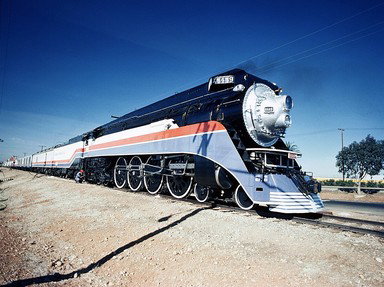
Just before the U.S. Bicentennial, it seemed that the country was too embroiled in controversy-Vietnam and Watergate-to celebrate. Then Ross Rowland Jr. proposed that a special train should tour the country, showing over 500 historic American artifacts.
A collection quiz
by ponycargirl.
Estimated time: 3 mins.
Last 3 plays: Catreona (10/10), HBSpud (10/10), andymuenz (10/10).
Your task is to choose ten of the artifacts that were showcased on the American Freedom Train Exhibition from 1975-1976.
There are 10 correct entries. Get 3 incorrect and the game ends.
McIntosh ComputerGeorge III CrownHank Aaron 714th Homer BatMoon Rock"Back To The Future" DeLoreanJudy Garland "Wizard of Oz" DressFreedom Bell ReplicaSpace Shuttle Replica1904 Oldsmobile RunaboutOriginal Magna CartaEmancipation ProclamationMartin Luther King Jr RobesGeorge Washington Annotated ConstitutionFirst Working Light BulbWillard's "The Spirit of '76"
Left click to select the correct answers. Right click if using a keyboard to cross out things you know are incorrect to help you narrow things down.
Ross Rowland Jr. founded Floor Broker Associates Inc. in 1966, and had a very successful career as a commodities trader. He was also a train enthusiast who worked to restore and show steam locomotives. In 1970 he founded the American Freedom Train Foundation, a non profit organization, to commemorate the U.S. Bicentennial. He planned to drive a steam locomotive with twenty-five cars full of American artifacts across the United States. Over its twenty-one month tour, the train traveled 25,000 miles to 138 cities and hosted seven million paid visitors. An estimated 40 million viewers viewed the train from the tracks, as some of the cars were built with more windows to show larger pieces of history.
While it was decided that the U.S. Constitution was just too precious to make the Freedom Train circuit, George Washington's annotated copy was included. Given to the President during his first term year in office, the document is bound and displays his signature on the title page. Historians believe the annotations were made in preparation for his State of the Union Speech in 1790. Interestingly, next to the sentence that states the president "shall take care of the laws be faithfully executed", he wrote the word "required".
In 1863 President Abraham Lincoln issued the Emancipation Proclamation, which permanently freed all people held as slaves in the South. It was, however, a military order, which meant that an act of Congress would be necessary to end slavery - and that is what the Thirteenth Amendment did in 1865. The copy of the Emancipation Proclamation on the Freedom Train was not the final draft. Also included in the exhibition were a copy of the Gettysburg Address and Lincoln's stovepipe hat.
Archibald Willard was an American artist who lived from 1836-1918. He was inspired to create "The Spirit of '76" after attending a holiday parade. The work, also known as "Yankee Doodle", was displayed at the Centennial Exposition in Philadelphia, Pennsylvania, in 1876. It was not an immediate success. Some people thought the scene of the three subjects in the painting, two drummers and a fifer marching across a battle field, was too depressing and even cartoon-like. Willard pushed on, however, making at least four different variations of the painting, using his father and other people he knew as models. Today the picture is considered to be Willard's most famous work.
Thomas Edison's first working light bulb had its trial run on October 21, 1879. He created a carbonized cotton thread filament in a high-vacuum glass bulb that remain lit for 14 hours. The invention was publicly demonstrated in December of that year after Edison received a patent; it became more feasible for widespread use a few years later when his research team found that a carbonized bamboo filament would burn for 1200 hours.
The Olds Runabout, also called the Curved Dash Olds, was the first automobile mass produced using interchangeable parts in the United States - long before Henry Ford did it! Inspired by a sleigh, the car had a single-cylinder engine, tiller steering, and wooden body; it cost just $650. While it was first produced in 1901, the 1904 Model C of the car, which had a larger engine, was on the Freedom Train. The car, nicknamed The Old Scout, was featured because it had won the first transcontinental car race in 1905. For the 1975-76 journey it was housed in a modified baggage car that had large viewing windows on each side.
Originally sponsors of the American Legion for the United States Bicentennial hoped to organize a nation wide campaign where children would donate their copper pennies that would be used to forged the replica. While that never happened, the replica was made in the Netherlands in 1975; the United States did not have a foundry large enough. Measuring 7.5 feet (2.3 meters) high and 8.5 feet (2.6 meters) in diameter, and weighing in at 16,830 pounds (7634 kilograms), the replica, which was 80% copper and 20% tin, was twice the size of the original Liberty Bell.
Also on board the Freedom Train was a Lunar Rover test unit, lunar module mock up, a spacesuit worn by Alan Shepard Jr., and a moon rock. While the term moon rock can refer to a rock that was collected on the moon or one from the moon that fell to the earth as a meteorite, the one in the exhibit was collected on the moon. It was collected by the crew of Apollo 16 during their April 1972 mission from an area called the Descartes Highlands.
Organizers of the American Freedom Train Exhibition chose a wide variety of cultural artifacts that represented many areas of American life. Judy Garland's blue gingham dress that was worn when she played Dorothy in "The Wizard of Oz" (1939) was part of the rolling exhibit. The movie was considered to be an important part of American cinema with its use of sepia scenes that symbolized life in Kansas and Technicolor to symbolize life in Oz. Judy Garland had also been a very popular American actress.
The personal robes of Dr. Martin Luther King Jr. were included in the exhibit, along with his pulpit and Bible, to honor his contribution to civil rights in the United States. His leadership of the Montgomery Bus Boycott in 1955, which led to his organization of nonviolent protests in the South, and his marches in Washington, D.C. (1963) and Selma to Montgomery (1965), helped to outlaw the discrimination and segregation that Black Americans faced. In 1964 he won the Nobel Peace Prize.
And what was more American than baseball - at least in 1975? Hank Aaron had just broke Babe Ruth's 714 home run record in 1974 to become the new home run king. The bat he used to hit the record breaking home run was shown on the Freedom Train, along with the ball. Other sports memorabilia displayed included bats used by Lou Gehrig and Joe DiMaggio, Joe Frazier's boxing trunks, and replicas of Jesse Owens four 1936 Olympic gold medals.
As far as the incorrect answers are concerned, the crown of George III and original copy of the Magna Carta are important pieces of English history that are carefully stored and guarded there. During the Bicentennial a delegation brought an original copy of the 1215 document that was displayed in the Rotuna of the U.S. Capitol for a year before being returned. There is a later 1297 copy of the Magna Carta that was purchased by auction by a private citizen who placed it on loan in the National Archives in 2007. The other incorrect choices - Space Shuttle Replica, McIntosh Computer, and "Back To The Future" DeLorean are all 1980s cultural icons.
This quiz was reviewed by FunTrivia editor gtho4 before going online.
Any errors found in FunTrivia content are routinely corrected through our feedback system.