FREE! Click here to Join FunTrivia. Thousands of games, quizzes, and lots more!
Quiz about Yemen Blessed or Cursed

Yemen: Blessed or Cursed? Trivia Quiz


Surprising as it may sound, the war-torn modern country of Yemen was once known as Arabia Felix, or Happy Arabia. This quiz will serve as an introduction to the long and troubled history of this ancient land.

A photo quiz by LadyNym. Estimated time: 3 mins.
  1. Home
  2. »
  3. Quizzes
  4. »
  5. History Trivia
  6. »
  7. Asian

Author
LadyNym
Time
3 mins
Type
Photo Quiz
Quiz #
426,262
Updated
Nov 14 26
# Qns
10
Difficulty
New Game
Plays
5
Last 3 plays: Guest 94 (8/10), bernie73 (5/10), kickaha49 (10/10).
-
Question 1 of 10
1. The Kingdom of Saba that flourished in present-day Yemen over 3,000 years ago owed its vast wealth to the trading of what luxury good, mentioned in the Bible as a valuable gift? Hint


Question 2 of 10
2. The Himyarite Kingdom came to rule most of South Arabia from the late 1st century BC to the early 6th century AD. Though the Himyarites originally followed the indigenous polytheistic religion, they eventually adopted what major religion, also of Middle Eastern origin?

Answer: (7 letters - star)
Question 3 of 10
3. Many regional dynasties flourished in Yemen after it embraced Islam in the 7th century AD. The last queen of the Sulayhid Dynasty, who ruled between 1067 and 1138, is a revered figure in the history of the country. What was her name? Hint


Question 4 of 10
4. In the 16th century, what powerful empire set its sights on Yemen, seeking to control access to the Red Sea and eventually conquering the southern part of the country? Hint


Question 5 of 10
5. In 1849 the British occupied the port of Aden on the gulf of the same name, which remained in their possession until 1967. Why was Aden so important to them?


Question 6 of 10
6. After World War I, the Mutawakkilite Kingdom of Yemen emerged in the north of the country. What European power, with colonies in Eritrea and Somaliland, was the first to recognize the new King of Yemen after several years of war against the British? Hint


Question 7 of 10
7. In the 1960s, Yemen split into two states, North Yemen and South Yemen. What was distinctive about South Yemen's form of government?


Question 8 of 10
8. After over two decades, in 1990, North and South Yemen unified into the Republic of Yemen. What historic city, a UNESCO World Heritage Site, became its capital? Hint


Question 9 of 10
9. Officially known as Ansar Allah, the Houthis are a Shia Islamist organization that have been in control of part of Yemen since 2014. They belong to the Axis of Resistance, a coalition backed by what large West Asian nation? Hint


Question 10 of 10
10. In October 2026, the Houthis launched a series of missile attacks against various targets in the Arabian Peninsula. Between 6 and 12 October, 18 people were killed in a series of attacks on the international airport of what capital of a neighbouring country? Hint


(Optional) Create a Free FunTrivia ID to save the points you are about to earn:

arrow Select a User ID:
arrow Choose a Password:
arrow Your Email:


View Image Attributions for This Quiz

Most Recent Scores
Today : Guest 94: 8/10
Today : bernie73: 5/10
Today : kickaha49: 10/10
Today : kino76: 10/10
Today : reedy: 10/10

Quiz Answer Key and Fun Facts
1. The Kingdom of Saba that flourished in present-day Yemen over 3,000 years ago owed its vast wealth to the trading of what luxury good, mentioned in the Bible as a valuable gift?

Answer: frankincense

With its strategic location at the crossroads of Africa and Asia, Yemen has been inhabited for over 7,000 years, witnessing the rise and fall of many civilizations. In the Hellenistic era, several geographers described the region as "Eudaimon Arabia", translated in Latin as Arabia Felix (happy Arabia), as it was greener and more fertile than the rest of the Arabian Peninsula. One of the proposed etymologies for the name Yemen is the Arabic word "yumn", meaning blessed or prosperous.

Established around the 11th century BC (possibly even earlier), the Kingdom of Saba (or Sheba) was the most prominent of the tribal kingdoms of South Arabia. It was located in present-day central Yemen, with its capital at Ma'rib. The Great Dam of Ma'rib (shown in the photo), one of the greatest feats of engineering of the ancient world and a UNESCO World Heritage Site, was built around 940 BC to capture the rains that fell on the nearby mountains and provide water to irrigate the lands around the city. The rulers of Saba were given the title of "Mukarrib" (federator). The kingdom was known in the ancient world for seafaring and commerce, in particular the trade of frankincense and myrrh, the aromatic resins of two trees native to the Arabian Peninsula, as well as spices coming from India and beyond.

The Kingdom of Saba is mentioned in the Hebrew Bible (1 Kings and 2 Chronicles) with reference to the visit of its Queen to Solomon, bringing many gifts of spices, gold and gemstones - proof of the kingdom's reputation for great wealth.
2. The Himyarite Kingdom came to rule most of South Arabia from the late 1st century BC to the early 6th century AD. Though the Himyarites originally followed the indigenous polytheistic religion, they eventually adopted what major religion, also of Middle Eastern origin?

Answer: Judaism

Himyar was one of the tribal kingdoms of South Arabia, based in the southern highlands of present-day Yemen. Around 25 BC, taking advantage of the chaos that followed the failed Roman expedition to Arabia Felix commanded by Augustus, the Himyarites conquered the Kingdom of Saba. By the late 3rd century BC, they had annexed the other kingdoms of the region and consolidated their rule.

For several centuries Himyarites worshipped a pantheon of deities that included the sun goddess Shams, the patron deity of the kingdom. In the late 4th century AD, during the reign of Malkikarib Yuhamin, Judaism was adopted as the state religion, though the kingdom's ruling class may have started converting much earlier. However, the form of Judaism adopted by the Himyarites had some peculiarities: the supreme deity was addressed as Rahmanan (The Merciful), and the religion itself is sometimes referred to as Rahmanism. Some Himyarite kings persecuted Christians, but Christianity spread in the kingdom and was eventually embraced by its rulers. In 530, the Ethiopian (and Christian) Kingdom of Aksum conquered Himyar - only to be conquered by the Sasanian Empire a few decades later.

The bronze statue in the photo depicts Himyarite king Dhamar Ali Yahbur, who ruled in the 2nd century AD.
3. Many regional dynasties flourished in Yemen after it embraced Islam in the 7th century AD. The last queen of the Sulayhid Dynasty, who ruled between 1067 and 1138, is a revered figure in the history of the country. What was her name?

Answer: Arwa

Yemen became part of the Muslim world around 630 AD, during Muhammad's lifetime. Though nominally a province of the Sasanian Empire, most of Yemen's territory was ruled by multiple tribal rulers often at odds with each other. The spread of Islam put an end to this chaotic situation, and the country became part of the Islamic empire. Since the foundation of the Rashidun Caliphate by Abu Bakr, Muhammad's father-in-law, in 632, Yemen experienced the rule of a succession of Islamic caliphates and regional dynasties that lasted for nearly a millennium.

The Sulayhid Dynasty was founded around 1040 in the northern highlands of Yemen. Born in 1048, Arwa al-Sulayhi was the dynasty's last ruler. She married twice and was co-ruler with both her husbands before she became the first queen regnant in the Muslim world, ruling alone for about 40 years. An intelligent, highly educated woman, Arwa was a wise and brave ruler (even leading her troops into battle at one time) who strengthened the kingdom's economy and its cultural and religious institutions. She died in 1138 at the age of 90, leaving no heirs.

The photo shows the courtyard and one of the two minarets of Queen Arwa Mosque in Jibla, the mountain city that became the queen's capital in 1067. Arwa (whose name is believed to mean "female ibex" in Arabic) is buried there: her tomb is a major pilgrimage site. In Yemeni tradition, she is often referred to as "the junior Queen of Sheba".

Theodora was the name of several Byzantine empresses, while Boudicca (queen of the Iceni) and Zenobia (queen of Palmyra) are known as enemies of the Roman Empire.
4. In the 16th century, what powerful empire set its sights on Yemen, seeking to control access to the Red Sea and eventually conquering the southern part of the country?

Answer: Ottoman Empire

Between 1229 and 1454, Yemen knew a long period of peace and prosperity under the rule of the Rasulid dynasty, widely regarded as one of the greatest native Yemeni states. The Rasulids were then replaced by a local clan, the Tahirids, who eventually proved too weak to withstand the increasing attacks by foreign powers, in particular Portugal and Egypt. However, in 1517 Egypt was conquered by the Ottoman Empire, which a couple of decades later decided to conquer Yemen to counteract Portuguese influence in the Indian Ocean and the Red Sea.

The Ottoman military expedition launched from Egypt managed to take control of much of Yemen's coastal region, including the ports of Aden and Mokha. However, they were met from fierce opposition by the Zaydis, a Shia Islamic group that originated in northern Yemen in the 9th century. The Ottomans lost thousands of soldiers in their attempts to hold on to their conquests, spending decades engaged in conflict with the Zaydi rebels. By the mid-1630s, the Turks had lost all their territories in Yemen. They would return over 200 years later, taking advantage of the chaotic situation within the Zaydi imamate.

The building shown in a 1926 photo is the al-Bakiriyya Mosque in Sana'a, built in the 1590s by Hasan Pasha, the Ottoman governor of Yemen. The shape of its dome is typical of Ottoman architecture.
5. In 1849 the British occupied the port of Aden on the gulf of the same name, which remained in their possession until 1967. Why was Aden so important to them?

Answer: it made an ideal coaling station

With the expansion of the British Empire in the Indian subcontinent and beyond, maritime trade between Europe and Asia was very intense. Though steamships for transoceanic crossings were introduced in the 1830s, none of them were able to carry enough coal to complete a voyage of thousands of nautical miles and have enough space left for commercial cargo. About 700 tons of coal were needed for a round trip from Suez to Bombay.

Due to its strategic position on Yemen's southern coast, near the entrance of the Bab el-Mandab strait, Aden was an ideal coaling station for steamers travelling to and from India. In 1839, the British first tried to reach an agreement with the Sultanate of Lahej, of which Aden was part at that time, then occupied the port and forced the Sultan to accept their "protection", though giving him financial compensation for his loss. They also established treaties with neighbouring tribal entities. In 1850, Aden was declared a free zone and began to attract immigrants from Asia and East Africa, as well as Europeans.

The Aden Protectorate included also the Hadhramaut region of southeastern Yemen; Aden and its hinterland became a Crown Colony in 1937. Both the protectorate and the colony officially ceased to exist in 1963, after a period of great instability. The British left Aden for good in 1967.

The hub for the coffee trade was the port of Mokha on the Red Sea, which was not under British control. Yemen held a global monopoly on the coffee trade from the 16th to the early 18th century.
6. After World War I, the Mutawakkilite Kingdom of Yemen emerged in the north of the country. What European power, with colonies in Eritrea and Somaliland, was the first to recognize the new King of Yemen after several years of war against the British?

Answer: Italy

In 1849, ten years after the British annexation of Aden, the Ottomans returned to the Tihama, the coastal region of Yemen along the Red Sea. After they managed to conquer the northern highlands, in 1872, the region became a vilayet (province) of the Ottoman Empire. However, the situation was rarely peaceful because of constant efforts by the Zaydi imamate to undermine Ottoman rule. The Anglo-Ottoman border agreement of 1905 divided the country into north and south.

With the dissolution of the Ottoman Empire at the end of WWI, the Zaydis saw their opportunity to reestablish their rule over the north and move against the British-held south. They were led by Imam Yahya Muhammad Hamid ed-Din (in the photo), a charismatic figure who proved to be a capable (albeit isolationist) ruler and managed to pacify a country torn by decades of strife. Imam Yahya was proclaimed King of Yemen on 17 November 1918, a few days after the end of the Ottoman Empire had been announced. The first Western power to recognize his role was the Italian Empire, which at the ruled Eritrea and Somaliland across the Red Sea. The Italians hoped to bring Yemen into their sphere of influence to counteract British dominance in the region. Imam Yahya in turn hoped to gain their help in retaking Aden from the British - who were understandably alarmed by the Imam's plans.

The Italo-Yemeni Treaty signed in 1926 marked the beginning of diplomatic relations between the two countries; it was renewed in 1837 after the Italian invasion of Ethiopia.
7. In the 1960s, Yemen split into two states, North Yemen and South Yemen. What was distinctive about South Yemen's form of government?

Answer: it was the only communist state in the Middle East

After Imam Yahya's assassination in 1948, his son and successor, Imam Ahmad, opened Yemen to the outside world. The influence of the Soviet Union became especially relevant, as the superpower began to send arms and military advisers to Yemen. There was also a vocal faction that advocated for the modernization of the Mutawakkilite monarchy. When Imam Muhammad al-Badr was deposed by revolutionary republicans in 1662, the North Yemen Civil War erupted between the royalists, supported by Saudi Arabia and Britain, and the republicans, supported by Egypt. The conflict, which lasted six years, saw the victory of the republicans and the creation of the Yemen Arab Republic (North Yemen) in 1968.

In the south of the country, vacated by the British in 1967, the state of South Yemen emerged, later to be known as People's Democratic Republic of Yemen (whose flag is shown in the photo). As its name implies, it was a one-party, communist state informed by Marxist-Leninist ideals - the only one in the Middle East and the Arab world. Though obviously a totalitarian state, South Yemen was distinguished by progressive policies that improved its people's standards of living - in particular literacy and women's role in society.

The two Yemeni states had an uneasy relationship that often led to open conflict, though there were also those who sought unification. However, it was the discovery of oil deposits near the border between the two countries, following a brief civil war in South Yemen in 1968, which hastened the reunification process.
8. After over two decades, in 1990, North and South Yemen unified into the Republic of Yemen. What historic city, a UNESCO World Heritage Site, became its capital?

Answer: Sana'a

In November 1989, the presidents of North Yemen (Ali Abdullah Saleh) and South Yemen (Ali Salem al-Beidh) accepted a draft constitution for a unified Yemen, which included a demilitarized border and free border passage based on a national ID card. The Republic of Yemen was declared on 22 May 1990. Saleh became president (head of state) and al-Beidh prime minister (head of government). The unity constitution was ratified by the people in a referendum held in May 1991: the document established democratic principles (free elections, multiparty system), as well as equality under the law and respect of basic human rights.

The ancient city of Sana'a in northern Yemen, which had been the capital of many of the polities that existed in the country's territory since antiquity, was chosen as seat of government for the unified state. Located in the northern highlands, Sana'a is one of the world's highest capital cities. Its Old Town, with its unique architecture, was designated as a UNESCO World Heritage Site in 1986.

Sadly, the newly unified nation soon relapsed into conflict and chaos, with another civil war erupting in 1994. When it ended, various institutional reforms were implemented, such as the direct election of the President.
9. Officially known as Ansar Allah, the Houthis are a Shia Islamist organization that have been in control of part of Yemen since 2014. They belong to the Axis of Resistance, a coalition backed by what large West Asian nation?

Answer: Iran

The 21st century brought more unrest to Yemen with the rise of al-Qaeda and the aftermath of the September 11 attacks. In 2004 a Shia insurgent group known as the Houthis revolted against the government in northern Yemen on claims of discrimination. The political situation in the country further deteriorated, compounded by a series of drone attacks by the US between 2009 and 2011 because of a perceived terror threat.

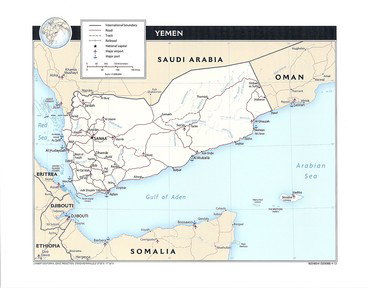
In 2011 President Ali Abdullah Saleh, who had ruled Yemen for over 20 years, was ousted by a revolution. Things came to a head in 2014, when Houthi fighters captured Sana's, the country's capital, eventually proclaiming themselves in control of the government. President Abdrabbuh Mansur Hadi, who had replaced Saleh in 2012, was forced to resign: though placed under house arrest, he managed to flee to his hometown of Aden, which he declared Yemen's temporary capital. The photo illustrates the current political division of Yemen between the northwest, controlled by the Houthis, and the rest of the country, controlled by the Government of Yemen.

The Houthis are a political and paramilitary organization led by members of the al-Houthi family of northern Yemen, with historic connections to the Zaydis. Backed by Iran, which provides financial, military and logistical aid, the group is part of the Axis of Resistance, an informal coalition of Shia Islamist organizations (also including Lebanon's Hezbollah) that opposes the influence of the US, Israel, Saudi Arabia and the United Arab Emirates in the Middle East.
10. In October 2026, the Houthis launched a series of missile attacks against various targets in the Arabian Peninsula. Between 6 and 12 October, 18 people were killed in a series of attacks on the international airport of what capital of a neighbouring country?

Answer: Riyadh

In the years that followed the Houthi takeover of northwestern Yemen, the country suffered through a cholera outbreak that caused thousands of deaths between 2016 and 2021, as well as an ongoing food insecurity crisis. This dire situation took a turn for the worse in February 2026 with the start of the war waged by the US and their allies against Iran. The Houthis had been involved in active conflict with Saudi Arabia since the end of 2025, and the Saudis' participation in the war as an ally of the US exacerbated the hostilities.

The Houthis officially entered the war by firing missiles against Israel in March 2026. Later in the year their attention shifted to the strait of Bab el-Mandab, a crucial maritime chokepoint that connects the Gulf of Aden with the Red Sea, threatening to blockade any Saudi ships that tried to pass through the strait. The tension between Yemen and Saudi Arabia escalated in October 2026, when the Houthis started launching missiles and drones at civilian targets. The airport of the Saudi capital of Riyadh, King Khalid International Airport, was attacked four times between 6 and 12 October: in the worst of these attacks, on 11 October, 12 people were killed (two more dying later from their injuries) and 308 were injured. A total of 23 people died in these attacks, which were also directed at two other Saudi airports.

The photo shows a view of Riyadh's business district, dominated by the distinctive silhouette of the Kingdom Centre. King Khalid Airport lies 35 km (22 mi) north of the city. Yemen shares a border with Saudi Arabia but not with the other countries (Kuwait, Qatar and the UAE) whose capitals are listed as wrong answers.
Source: Author LadyNym

This quiz was reviewed by FunTrivia editor trident before going online.
Any errors found in FunTrivia content are routinely corrected through our feedback system.
11/14/2026, Copyright 2026 FunTrivia, Inc. - Report an Error / Contact Us