FREE! Click here to Join FunTrivia. Thousands of games, quizzes, and lots more!
Quiz about Party Planning

Party Planning Trivia Quiz

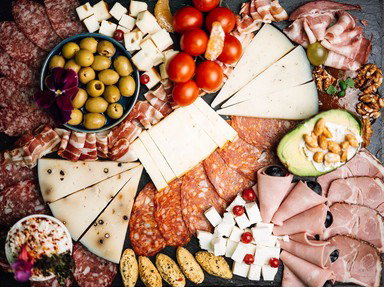
Nibbles for all

My party needs a generous supply of food and drink, which will be set up as a self-serve display. Can you group the items on my pre-party shopping list so that I can collect each batch from the same shop (or section of the supermarket)?

by looney_tunes. Estimated time: 3 mins.
  1. Home
  2. »
  3. Quizzes
  4. »
  5. Hobbies Trivia
  6. »
  7. Food & Drink
  8. »
  9. Mixed Food and Drink

Author
looney_tunes
Time
3 mins
Type
Quiz #
426,376
Updated
Nov 15 26
# Qns
15
Difficulty
Very Easy
Avg Score
14 / 15
Plays
21
Last 3 plays: PurpleComet (9/15), Guest 96 (15/15), Guest 107 (15/15).
Work out how to connect the items in batches of three that would all be found in the same shop or section of the supermarket.
???
???
???
???
???

Riesling Brie Syrah Pecans Pistachios Cherries Stilton Grapes Prosciutto Dates Champagne Salami Pâté Edam Cashews

* Drag / drop or click on the choices above to move them to the correct mystery boxes.


Most Recent Scores
Today : PurpleComet: 9/15
Today : Guest 96: 15/15
Today : Guest 107: 15/15
Today : mjgrimsey: 15/15
Today : Guest 73: 15/15
Today : Guest 95: 15/15
Today : psnz: 15/15
Today : Guest 73: 15/15
Today : bernie73: 15/15

Quiz Answer Key and Fun Facts
1. Edam

Answer: Cheese

Edam is one of the most famous of the cheeses produced in the Netherlands. It is a cow's milk cheese named after the town of Edam in the province of North Holland, where it was first produced. It is mild in flavour, with a texture that starts semi-soft, then harden as it ages. The red wax coating on the flattened sphere of the cheese makes it easy to spot on the dairy shelf.

The Edam, my chosen firm cheese for the party, will pair nicely with any of the wines and fruits on my planned platter, and there will be crackers for those who want something on which to balance it on the way to their mouths.
2. Stilton

Answer: Cheese

A cheese platter needs a blue cheese for variety, and today I have chosen a British one, Stilton. More precisely, it will be a blue Stilton, as there is also a white Stilton. Both of them are cow's milk cheeses with a crumbly texture, and by law must have been produced in one of three English counties: Derbyshire, Leicestershire or Nottinghamshire. It is interesting to note that the village of Stilton, from which the cheese takes its name, is in Cambridgeshire, so cheese produced in Stilton cannot be sold as Stilton cheese.

Stilton must (according to its protected designation of origin (PDO) description) be produced unpressed in a cylindrical block that forms its own crust. If you look at the crust on your slice or wedge of blue Stilton, you will see the needle marks from the process of injecting Penicillium roqueforti to produce the blue veins radiating from the centre. White Stilton, of course, lacks the holes and the blue veins!
3. Brie

Answer: Cheese

Like Edam, and unlike Stilton, Brie cheese is considered a style, and does not need to be produced in the French region where it originated. It is a soft cow's milk cheese, creamy in colour with a white mould rind, which is usually eaten. It is usually presented as a wedge cut from a wheel of cheese that is between 20 and 40 cm in diameter, with a depth of around 5 cm. The size of the wedge is one of the ways you can tell you are about to grab some brie, rather than the similar camembert, which is produced in much smaller wheels which are often served whole to have each individual carve out their own wedge.

Even those of us who enjoy cheese on its own find a cracker or some bread useful when eating brie, to keep from having it drip everywhere between plate and mouth.
4. Pâté

Answer: Charcuterie

Charcuterie is a French term used to describe a wide range of processed meat products. Pâté means paste, so could refer to almost any kind of meat (or, for the vegetarians, mushrooms) that have been pureed and mixed with flavourings. When you just say pâté, the chances are you mean some form of poultry is involved. Chicken livers and duck or goose livers are both popular.

While some consider foie gras to be the supreme pâté, the fact that it is produced by force feeding the duck or goose to produce a liver that is ten times the normal size makes me uncomfortable about offering it to my guests, even if it is smoother and more luxurious than the brandy port and sage chicken liver pâté I plan to offer, which sources its livers as a byproduct of the chicken industry. That industry, of course, has its own ethical issues, but at least the birds are not made to increase their suffering just to provide their livers.
5. Salami

Answer: Charcuterie

Salami is a term referring to any of a large variety of sausage products that are fermented then air-dried, giving a product that last well, even without refrigeration. Traditionally the meat is pork, but halal and kosher salami usually uses beef; innovative chefs may experiment with venison or poultry - the sky's the limit, really.

Preparation of salami involved mixing the minced meat with flavouring ingredients (typically including garlic, salt and pepper), placing the mixture into a casing which is allowed it to ferment for a day or more before it is then hung to cure. Different styles of salami involve not only different flavouring ingredients, but also specific conditions for the fermentation and curing stages. I plan to use Hungarian salami, which is smoked before fermentation. A local producer offers mild and spicy (with chili added) varieties, so we will have some of each.
6. Prosciutto

Answer: Charcuterie

Prosciutto is simply the Italian word for ham, but in English-speaking countries it is usually used to refer specifically to a ham which has been dry-cured, without any cooking or smoking. This is more fully named prosciutto crudo, because its meat has been dried but not cooked. The most famous example is Prosciutto di Parma, which must come from Emilia-Romagna. According to its protected designation of origin (PDO) description of the requirements, it must be made from the hind leg of a pig, and use only that meat, lard and salt in production. The processing takes between two and three years.

If we can find Prosciutto di Parma, we will serve it, despite the increased cost of having to get it imported. If not, there are a lot of good local producers of prosciutto - or we could even settle for another pork product, such as some hickory-smoked ham.
7. Grapes

Answer: Fruit

Some fruit provides variety to a food display, and grapes are nicely suited to the party intention that everyone helps themselves to samples in a progressive manner. Grapes come in bunches, which can either be presented as one large bunch from which individual grapes can be pulled off, or as pre-divided small clusters which can just be picked up.

We may have several varieties of grape, for their visual impact, as pale green sultanas and crimson emperor grapes make a nice contrast with each other. Both of them are seedless varieties, which means nobody will need to deal with the issue of the seed - to swallow or not to swallow can be a confronting decision at a party.
8. Cherries

Answer: Fruit

Since this party is being planned for the Christmas season, cherries will be at their peak here in Australia. Specifically, I want a cultivar of the sweet cherry (Prunus avium), as the sour cherry is lovely for cooking, but not to everyone's taste as a raw fruit to munch on. Different varieties come into season at different times, so I will just choose the one that has the best-looking fruits - and which is also likely to be the least expensive.

Cherries usually come in clusters (usually two or three) on long stems which are not eaten. Like most members of the Prunus genus, they are drupes, which means they have a stone or pit in their centre - also not eaten. Like other fruits in this genus (apricots, peaches and plums), the pit contains a chemical called amygdalin, which produces cyanide when digested. There's not much in one cherry pit, but still ...
9. Dates

Answer: Fruit

The fruit of the date palm, Phoenix dactylifera, is oval in shape, about 2-3 cm long with a skin that is a shade of brown - how dark depends on the cultivar. Dates contain about 65% sugar by mass - so they are very sweet! Partially dried dates are sometimes given a glucose glaze that hardens to provide a bit of a crunch as you eat them.

Dates can be bought whole or pitted - with the central stone removed. Pitted dates may be stuffed with a nut (an almond fits in the space neatly) or a soft material like tahini or cream cheese. Devils on horseback is a party favourite in which a pitted date is stuffed (possibly with a walnut or a bit of blue cheese) before being wrapped in bacon and grilled or baked. The origin of the name is very unclear, but possibly related to the similarly named angels on horseback, in which the bacon is wrapped around an oyster.
10. Pecans

Answer: Nuts

The pecan is the nut of a tree native to the southern parts of the United States and northern Mexico. It is biologically considered a drupe rather than a nut, but in food classifications it is considered a nut. The smooth hard shell holds two halves, connected at one end by a thin bit of flesh, that resemble a sleek walnut. They have a sweet, rich flavour that is popular in such applications as pecan pie or butter pecan ice cream. The nut itself can be eaten fresh or roasted.

For ease of eating in a party buffet, we will be buying shelled pecan halves, rather than asking the guests to crack them out of their shell. In a more relaxed setting, such as sitting around in the evening watching television, the nutcracker can be fun to use.
11. Pistachios

Answer: Nuts

Pistachios are a green-kerneled nut with central Asian origins. The pistachios of my youth were dyed red to conceal any damage to the shell that occurred during harvesting. This made it really hard to sneak one when nobody was looking, as the bright red fingers and lips were a dead giveaway! In the 21st century you will mostly see them in their natural light brown shell, if they have not been removed from it completely.

Like the other nuts here, they are considered a nut in cuisine, but a drupe by botanists. Pistacia vera has been selectively bred to produce nuts that spontaneously pop open when ripe, meaning that the two halves of the shell are easily removed with the fingers. The purplish skin that encases the green kernel can be eaten, but is often discarded if the kernels are to be used in cooking, to preserve the green colour.
12. Cashews

Answer: Nuts

The cashew comes from an evergreen South American tree. It is found as a pseudocarp - a small piece protruding from the apparent fruit, which is called a cashew apple. The true fruit is inside that protrusion, a kidney-shaped seed that is (once again) considered a fruit by cooks, a drupe in botanical terms.

In 2025, the Botanical Special Garden Wandsbek in Hamburg, Germany selected the cashew as the Poisonous Plant of the Year, because the shell contains chemicals (primarily one called cardol) that are highly irritating to human skin. Removing the shell greatly reduces their presence, but the nut itself does contain some, which is why it is often recommended that raw cashews not be eaten. Steaming or roasting them reduces the cardol to definitely safe levels. Mine will be roasted and salted.
13. Riesling

Answer: Wine

Reisling is a white wine made from Reisling grapes, first cultivated along the Rhine. The character of the wine is heavily dependent on the climate where the grapes grew. For example, Australian Reislings have more citrusy flavour when young than is the case for German Reislings, and tend to be oilier in mouthfeel.

The wine tends to have more body than many other white wines, so often accompanies not only the traditional white meats (poultry, pork and fish), but also spicy Asian foods. Hence its place on my party sideboard, which has a number of items in the meat and cheese range that are traditionally paired with a red wine.
14. Syrah

Answer: Wine

Syrah (called Shiraz in Australia and South Africa) is a red wine made from a grape variety that originated in southern France. This origin was only determined from genetic analysis in 1999. Before that, a number of origins had been proposed, including the Iranian city of Shiraz

Cool climate Syrah wines are sharper than those produced from grapes grown in a warmer climate, which are more full bodied, with less tannin. If an oenophile is describing a Syrah, they are likely to refer to its peppery or licorice notes. The wine's strong flavours mean it benefits from lengthy aging - some vintages recommend up to 15 years in the bottle.
15. Champagne

Answer: Wine

What would the party be without a sparkling wine? Since Champagne now has a protected designation of origin (PDO), I am either going to have to pay for imported fizz, or use the casual approach of calling any sparkling wine champagne. Proper champagne has a musty overtone that makes it quite identifiable when compared to the lighter sparkling wines that Australians used to buy in bottles marked as Australian Champagne.

Sparkling wines wary in sweetness, so the label often includes one of the officially approved words to convey how much sugar the wine contains. In order from the driest to the sweetest, they are Brut natural, Extra brut, Brut, Extra dry or sec, Dry or sec, Demi-sec, and Doux (which has more than 50 g of sugar per litre). Large-scale wine dealers usually do not stock the extremes on the scale, so we will be looking for something labelled Brut.
Source: Author looney_tunes

This quiz was reviewed by FunTrivia editor Bruyere before going online.
Any errors found in FunTrivia content are routinely corrected through our feedback system.
11/15/2026, Copyright 2026 FunTrivia, Inc. - Report an Error / Contact Us