FREE! Click here to Join FunTrivia. Thousands of games, quizzes, and lots more!
Quiz about Art Works by Leonardo da Vinci Part 2

Art Works by Leonardo da Vinci (Part 2) Quiz


10 of these are art works by the world's greatest genius Leonardo Da Vinci that are all either unquestionably his or widely accepted by scholars as being his, or are works that he painted in collaboration with others. 5 of these he had no part in.

A collection quiz by Billkozy. Estimated time: 3 mins.
  1. Home
  2. »
  3. Quizzes
  4. »
  5. Humanities Trivia
  6. »
  7. Individual Artists
  8. »
  9. Leonardo da Vinci

Author
Billkozy
Time
3 mins
Type
Quiz #
425,815
Updated
Oct 05 26
# Qns
10
Difficulty
New Game
Avg Score
8 / 10
Plays
17
Last 3 plays: cardsfan_027 (10/10), Guest 216 (4/10), Guest 99 (8/10).
10 of these 15 works of art were painted by Leonardo da Vinci. Choose those 10 paintings.
There are 10 correct entries. Get 3 incorrect and the game ends.
The Adoration of the Magi The Calling of Saint Matthew La Scapigliata The Lady with Dishevelled Hair The Last Supper La Belle Ferronnire The Virgin and Child with Saint Anne Ognissanti Maest Virgin and Child Enthroned Education of the Virgin Ginevra de' Benci Madonna of the Yarnwinder Madonna and Child Enthroned The Virgin of The Rocks Saint John The Baptist Sala delle Asse La Donna Velata

Left click to select the correct answers.
Right click if using a keyboard to cross out things you know are incorrect to help you narrow things down.

Most Recent Scores
Today : cardsfan_027: 10/10
Today : Guest 216: 4/10
Today : Guest 99: 8/10
Today : Guest 97: 6/10
Today : Guest 113: 4/10
Today : chang50: 7/10
Today : miranda101: 10/10
Today : Guest 71: 6/10
Today : Guest 174: 5/10

Quiz Answer Key and Fun Facts
Answer:

Here are the works of art that are indeed the works of the world genius, Leonardo da Vinci:

Painted around 1474-78 when da Vinci was in his early twenties, "Ginevra de' Benci" is one of his earliest portraits. It portrays a young Florentine noblewoman named Ginevra de' Benci who was about 16 years old at the time; it was possibly painted to commemorate her marriage to the merchant Luigi Niccolini. What's distinctive about this da Vinci painting, is that it is the only one of Leonardo's that is in the Americas, residing at the National Gallery of Art in Washington, D.C. The Gallery mentions that the portrait shows his experimental handling of layered oil paint to create soft transitions in skin, hair, and atmosphere.

Despite being an unfinished work, "The Adoration of the Magi" is one of Leonardo da Vinci's most notable paintings, painted around 1481-1482 and on display in the Uffizi Gallery in Florence. The painting depicts the well-known biblical Adoration of the Magi story, from the New Testament's Matthew 2:1-12, in which the three Magi arrived in Bethlehem to worship the baby Jesus and present three gifts: gold, frankincense, and myrrh. Mary and the Jesus are in the center, surrounded by at least two dozen people, with The Magi kneeling in the foreground, offering their gifts. Leonardo had left the project early, however, to enter the service of Ludovico Sforza, so the monks who commissioned the painting passed the assignment on to Filippino Lippi who painted his own version.

There are two surviving versions of da Vinci's "The Virgin of the Rocks", one in Paris and one in London. The first version, now in the Louvre, was painted around 1483-1486, and there was a dispute over payment between Leonardo and the Confraternity of the Immaculate Conception in Milan. It was then sold to a private buyer, and Leonardo eventually painted a second version, that he worked on from 1491 to 1508, and it resides in London's National Gallery. The painting depicts The Virgin Mary, the infant Jesus, the infant John the Baptist, and an angel, all positioned in a natural landscape of rocks, water and plants.

"La Belle Ferronnière" is a Milanese court portrait traditionally attributed to Leonardo da Vinci, also now in the Louvre, depicting an unidentified woman from the waist up, turned partly to her left and looking out toward the viewer with an alert looking expression. The portrait is dated to about 1490-97, and the Louvre explains that in spite of the title, the woman was probably not actually known as "La Belle Ferronnière"; the title arose from an error due to there being another painting in the Louvre that genuinely depicted a woman known as "La Belle Ferronnière", reputed to be a mistress of King Francis I of France. In the 19th-century artist Jean-Auguste-Dominique Ingres, made a drawing of da Vinci's painting, and when he labeled his drawing, he accidentally wrote the name of the other painting on it, calling this woman "La Belle Ferronnière." People who saw Ingres's drawing of da Vinci's painting labeled as "La Belle Ferronnière" assumed that was who da Vinci painted in his portrait, and so the name stuck. The Louvre's catalog entry explains that da Vinci's portrait is of an unknown woman, and the error of her being called "La Belle Ferronnière" "derives from a mistake by the painter Ingres" in the 19th century.

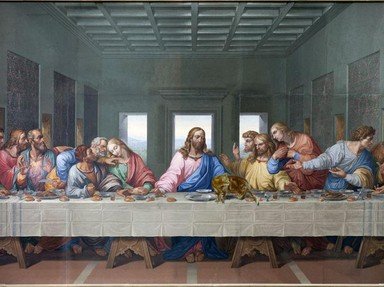
One of the most famous paintings in history, Leonardo da Vinci's "The Last Supper" depicts the moment immediately after Jesus announces, "One of you will betray me" and the reactions of the disciples--some with shock, some with denial, and some with confusion. The drama of the encounter is captured by da Vinci, as opposed to the communion within the group. Jesus is at the center, while the 12 disciples are arranged in four groups of three. Da Vinci painted it on the wall of the dining hall in the Convent of Santa Maria delle Grazie in Milan, Italy, around 1495-1498. It's a much larger work than many people might suspect, at 15 feet by 29 feet. Over the centuries the painting has suffered a lot of damage and repainting, but is still viewable, via advanced bookings.

The "Sala delle Asse" (Room of the Wooden Planks) is one of Leonardo da Vinci's lesser-known works. It is a very large mural in Milan's Sforza Castle that was lost for centuries and has only recently been worked on for full restoration. Ludovico Sforza, an Italian nobleman who ruled as the Duke of Milan, commissioned da Vinci to decorate a room in the castle around 1498, shortly after Leonardo finished "The Last Supper." He painted a giant pergola with sixteen mulberry trees with its branches and leaves spreading out widely across the walls and ceiling. When the French invaded Milan in 1499, Ludovico fled and Leonardo eventually left also, leaving the mural unfinished. The "Sala delle Asse" has been closed during restoration, but was briefly opened to the public in 2026 during the Milan Winter Olympics.

"Madonna of the Yarnwinder" aka "Madonna of the Spindles" is da Vinci's composition of the Virgin Mary and infant Jesus around an ordinary object - a wooden yarnwinder whose four spokes form a cross. The infant Christ reaches for it as if drawn to the destiny of his future crucifixion, while in a subtly depicted gesture, Mary's hand tentatively looks like it might be considering stopping him. The date of the painting is uncertain, but an April 14, 1501 letter from Fra Pietro da Novellara to Isabella d'Este relates that the work was being made by da Vinci for Florimond Robertet, a French minister and diplomat.

Leonardo da Vinci's "The Virgin and Child with Saint Anne", often called "The Saint Anne", can be seen at The Louvre, where it is dated broadly to about 1503-1519. The painting depicts three generations: Saint Anne (the Virgin Mary's mother), the Virgin Mary, and the infant Jesus. Da Vinci did work on it over many years and apparently left parts of it unfinished when he died in 1519.

"La Scapigliata" ("The Lady with Disheveled Hair" or "The Disheveled One") is another unfinished work of art attributed to Leonardo da Vinci, dated around 1506-1508, according to most sources. He painted it in oil, umber, and white lead pigments on a small poplar wood panel measuring 24.6 cm × 21.0 cm (9.7 in × 8.3 in). It is a close-up depiction that shows a young woman's head facing slightly downward, her eyelids lowered, and with a faint, restrained smile. Long curly hair falls around her face. The woman is unidentified, but the painting can be seen in the Galleria Nazionale di Parma, in Italy.

Many believe that "Saint John the Baptist" is the final completed painting by Leonardo da Vinci, sometime between 1513 and 1516 in oil on a walnut wood panel. The Renaissance master's piece is also in the permanent collection of the Louvre. Here, da Vinci depicts John the Baptist as a youthful figure with long, golden curly hair and smiling enigmatically as he points upward to the heavens.

And these are the paintings that are not attributed to Leonardo da Vinci:

"The Calling of Saint Matthew" was painted between 1599 and 1600, by Caravaggio.

"Raphael painted "La Donna Velata" - also called "La Velata" or "Woman with a Veil" - around 1512-1515.

"Education of the Virgin" is by Bartolomé Esteban Murillo, dated to around 1655 or circa 1665.

Hans Memling painted four different versions of "Madonna and Child Enthroned". One (circa 1480) is in Florence, another (circa 1492-1494) is in Granada, another (circa 1480-1490) is in Berlin, and still another (circa 1465-1470) is in Kansas City, Missouri.

"The Ognissanti Maestà" (also known as "Virgin and Child Enthroned") was painted by Giotto di Bondone, generally dated c. 1300-1310.
Source: Author Billkozy

This quiz was reviewed by FunTrivia editor looney_tunes before going online.
Any errors found in FunTrivia content are routinely corrected through our feedback system.
10/5/2026, Copyright 2026 FunTrivia, Inc. - Report an Error / Contact Us