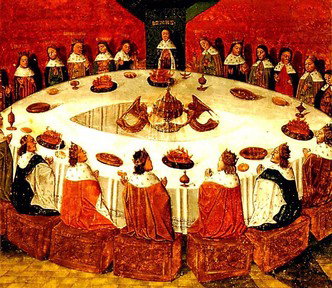
Typically anywhere from 100-300 Knights of the Round Table are listed by medieval and later authors. Your task today is to choose just ten of the knights who were said to have joined into a brotherhood with King Arthur around the legendary Round Table.
There are 10 correct entries. Get 3 incorrect and the game ends.
The legend of King Arthur has served as the inspiration for writers since the Middle Ages. He was featured in a collection of stories that together were known as the Matter of Britain; these stories focused on the prehistoric Celtic leaders of the island. Arthur has been portrayed by many as the king who defeated the Anglo-Saxons when they invaded Britain in the fifth and sixth centuries AD. Afterwards he was said to have established a vast kingdom called Logres, which he ruled with wisdom and virtue from his castle and royal court, Camelot. Of course, Arthur needed knights to help him protect his realm, so he established the Knights of the Round Table.
The table was round so that everyone who sat at it had an equal position. There was no head at the table, and Arthur hoped that this type of arrangement would do away with any petty jealousies and quarreling concerning which of the highest ranking knights were seated closest to the King. Arthur's knights took vows of chivalry, very much like the oaths taken by other medieval knights. They swore to uphold honor, defend the weak, and behave with loyalty to their King. Because his knights were from all over his vast realm, Arthur hoped that his use of the Round Table would serve to unify them.
Probably the most famous knight of the Round Table, Sir Lancelot, was a very talented swordsman who came to Camelot when he was a young man. For several years he was a loyal knight, earning great notoriety throughout the kingdom and quickly becoming known as Arthur's closest friend and greatest warrior. His affair with Queen Guinevere, King Arthur's wife, however, tore the kingdom apart and eventually led to its collapse. Lancelot was introduced in "Lancelot, le Chevalier de la charrette" in the 1100s. It was mostly written by the French poet Chrétien de Troyes, but Godefroi de Leigni finished the story after de Troyes refused to continue with the theme suggested by his patron, Marie de Champagne. He did not wish to shame his hero by having him forget his vows of chivalry and engage in an adulterous affair.
Galahad was the son of Lancelot and Elaine of Corbenic, who had disguised herself as Guinevere to trick him into fathering a child. He was brought up in a abbey and was known for his religious nature. As a young man he came to Camelot and performed quite a miraculous feat. He went to the Round Table and sat in the Siege Perilous, which was a special chair always left empty for the knight who would succeed in finding the Holy Grail. Only that knight could sit in the chair without dying instantly. By living to tell what he had done, Galahad proved that finding the Holy Grail would be his destiny. Although the legend of the purest, most perfect knight was first told by unnamed French authors, Thomas Malory included his story in "Le Morte d'Arthur" in 1585.
The story of "Sir Gawain and the Green Knight" was written in the 1300s; the manuscript still exists, and was written by an unknown author who is commonly known as the Gawain Poet. When a Green Knight appeared at the New Year celebration in Camelot, Gawain took up his challenge: he struck the Green Knight with his axe with the understanding that the Green Knight would return in a year and a day to return the blow. After waiting almost a year, Gawain went in search for the Green Knight and stopped at a castle for shelter. The Lord of the castle made a similar deal, however, this time the Lord would go hunting, and at the end of the day the two men would exchange what they won. After the Lord's wife tried unsuccessfully to seduce Gawain, he did trade her kisses with the Lord, but when she gave him a magical green sash for protection the next day, he kept it a secret. Well, it turned out that the Lord of the castle was the Green Knight. When he reappeared at Camelot, Gawain kept the terms of their bargain, allowing the Green Knight to strike him with his axe, which he did, but he only inflicted a small wound. Gawain's dishonesty at the Lord's castle was brought to light, and, ashamed at what he had done, Gawain wore the sash as a symbol of his shame. The Knights of the Round Table, however, believed that Gawain was brave for keeping his bargain with the Green Knight and began wearing sashes to honor his virtue.
Chrétien de Troyes was writing the poem "Perceval, the Story of the Grail" when he died in 1190. Consequently, many other writers took up the story and finished it. Perceval was raised by his mother, who kept him rather isolated from the world because she didn't want him to become a knight. When he encountered some knights in the woods, he was totally enthralled by them and left his mother, who died from grief, to go to Camelot. Because of his upbringing, Perceval was rather backwards, and it took some time for him to learn to fight and quit asking foolish questions. During his travels, he came to a rather mysterious castle of the Fisher King, who was hurt. Keeping to himself as he was taught, Perceval failed to ask the question about the jeweled dish and the lance that was dripping blood, which would have magically healed the Fisher King. He stayed at the castle and woke up the next day only to find out the Fisher's King's castle and land were deserted. Rebuked for his silence, and realizing how his actions had affected his mother, Perceval then spent years in the desolate land in search of Grail Castle to right his wrong. This is where the story by Chrétien de Troyes ended and other writers took over. Some had him succeed in curing the Fisher King, and becoming the King of the Grail.
While Sir Bors may not seem as famous as some of the other Knights of the Round Table, he was one of the three who completed the Quest for the Holy Grail. The first cousin of Lancelot, Bors was taken to Camelot by the Lady of the Lake after he and his brother Lionel were taken captive in war. They were trained in the matters of chivalry along with their cousin, and eventually Bors went on to free his father's kingdom and rule it as the king. Because Bors was able to withstand the spiritual tests that were required, he was allowed to see the Holy Grail firsthand; he is the only one to survive the ordeal and return to Camelot. He was known for his bravery, faith, and loyalty. While probably taking information from earlier legends, Thomas Mallory wrote about Bors in his "Le Morte d'Arthur", which is considered to be the best source of information about the knight's exploits.
In approximately 1170 Chrétien de Troyes wrote "Erec et Enide", which is believed to be one of the oldest surviving Arthurian legends. It was a story of love, a knight's pride, and redemption. Erec, who was also known as Geraint, won the hand of a poor Earl's daughter in a tournament and married her. He took her to Camelot and they lived there until he inherited his father's kingdom. There, madly in love with his wife and living a good life, he abandoned his knightly pursuits. Word got around that he was enchanted by his wife and he lost his reputation as a fine fighter. In order to regain it, he took his wife on a dangerous journey and told her that she could not talk to him along the way. He did not listen to her warnings about bandits and other hostiles, but successfully battled his way through each confrontation and regained his reputation. Geraint finally realized how much his wife loved him as he lay dying from a seemingly fatal wound; he was revived and asked for her forgiveness.
Welsh myths told that Bedivere was King Arthur's most loyal knight, and Thomas Mallory continued that theme in "Le Morte d'Arthur". According to Welsh tradition, in addition to his handsomeness and stealth, Bedivere only had one arm. Nevertheless, he was a lethal warrior and the most constant companion of the King, keeping tabs over the King's household and serving as the marshal of the Knights of the Round Table. Bedivere was present at the Battle of Camlann where Arthur received a mortal wound. Before his death, Arthur told Bedivere to throw Excalibur into the nearby lake, but Bedivere wasn't sure that Camelot should lose such a valuable weapon. He lied to Arthur twice before ultimately carrying out his wishes, returning Excalibur to the Lady of the Lake, and taking Arthur to the lake's shore to the waiting barge to Avalon. Bedivere spent the remainder of his days living as a hermit and serving the Church, the only one of King Arthur's knights to survive the battle.
Poor Sir Tristan! He was known for his harp playing, wood crafting, and falconry skill. After leaving his home in Cornwall as a knight-errant, he was made a brother of the Round Table. While on a trip to Ireland to escort his uncle's bride, Isolde, to Cornwall, the couple accidentally drank the love potion that was meant for Isolde and his uncle; Isolde married the uncle and Tristan married another, but were bound by the love potion to an adulteress affair with Tristan. When Tristan was gravely wounded he asked that Isolde come to heal him. His jealous wife responded that Isolde would not come, and Tristan died of a broken heart. Isolde died soon after. Watch out for those magic love potions!
Some stories said that Sir Kay was the son of Sir Ector, and that he and Arthur were raised together as foster brothers; ultimately Kay became one of the founding Knights of the Round Table. In the Welsh "Mabinogi", Kay was portrayed as being a fierce warrior with magical abilities. He was said to have held his breath for nine days and grown himself as tall as a tree. Appointed as High Seneschal when Arthur became king, he was the chief administrator of the castle and court. According to Thomas Mallory's "Le Morte d'Arthur", Kay, who was a bit of a bully, was the knight who had forgotten to bring his sword to the tournament. Arthur was sent to get it and ended up pulling the sword from the stone.
While there are other Knights of the Round Table that were perhaps more worthy of mention than Mordred, his inclusion is due because he was credited with bringing an end to Camelot. Around 1136, Geoffrey of Monmouth wrote "Historia Regum Britanniae", and told that Mordred was Arthur's nephew; over three hundred years later Thomas Malory wrote that Mordred was the son of Morgan Le Fay and Arthur, conceived when Arthur did not know that Morgan was his half-sister. When Merlin told Arthur that the child would bring about the downfall of Camelot, Arthur ordered that all children born of a certain time should be set to sea on a ship. Somehow Mordred survived and was rescued. Even though he was never fully accepted by the order, he became a Knight of the Round Table; while he appeared to be loyal, he actually sought power. While Arthur was away fighting he trusted Mordred with the safe-keeping of his kingdom, but instead Mordred took the throne of Camelot. When Arthur returned, both men killed each other at the Battle of Camlann. Nearly all the Knights of the Round Table were killed in the fighting, and Camelot ceased to exist. Arthur never truly died, however; it was said he would return when his kingdom needed him.
The incorrect answers are all Paladins, the elite knights of Charlemagne.
This quiz was reviewed by FunTrivia editor looney_tunes before going online.
Any errors found in FunTrivia content are routinely corrected through our feedback system.