FREE! Click here to Join FunTrivia. Thousands of games, quizzes, and lots more!
Quiz about Books About Books

Books About Books Trivia Quiz

Fictional Works Within Fiction

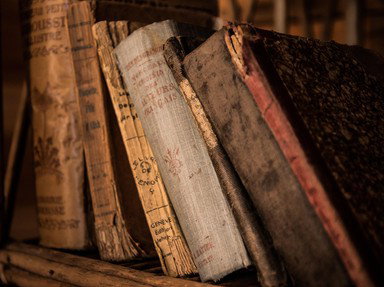
These ten authors invented books, poems, and stories... well, inside their own books! Let's get recursive! (Minor spoilers throughout.)

A multiple-choice quiz by trident. Estimated time: 3 mins.
  1. Home
  2. »
  3. Quizzes
  4. »
  5. Literature Trivia
  6. »
  7. Mixed Literature
  8. »
  9. Specific Subjects & Themes

Author
trident
Time
3 mins
Type
Multiple Choice
Quiz #
424,365
Updated
May 29 26
# Qns
10
Difficulty
New Game
Plays
11
Last 3 plays: Guest 74 (10/10), Guest 99 (8/10), lethisen250582 (10/10).
-
Question 1 of 10
1. A wizard reads from the "Book of Mazarbul," an account of a dwarven expedition to Moria that ended in slaughter. Then a horde of orcs attacks his crew. In which fantasy novel does this occur? Hint


Question 2 of 10
2. In which George Orwell novel does the protagonist read a supposed revolutionary book called "The Theory and Practice of Oligarchical Collectivism," attributed to Emmanuel Goldstein? Hint


Question 3 of 10
3. Which 1973 novel written by William Goldman is presented as "the good parts" of the full version by the imaginary author S. Morgenstern? Hint


Question 4 of 10
4. In a conversation between the two brothers Ivan and Alexei, which novel by Fyodor Dostoevsky features Ivan's prose poem "The Grand Inquisitor," in which Jesus returns to Earth during the Spanish Inquisition? Hint


Question 5 of 10
5. "The Clue of the Candle Wax," "The Death in the Drain Pipe," and "The Affair of the Second Goldfish" were all imaginary novels attributed to Ariadne Oliver, a fictional crime novelist from the mind of which mystery writer? Hint


Question 6 of 10
6. One of six interconnected narratives, "Half-Lives: The First Luisa Rey Mystery" is an imaginary thriller in what 2004 science fiction novel? Hint


Question 7 of 10
7. Which early 20th-century horror author devised the "Necronomicon," a tome of forbidden knowledge associated with the Great Old Ones and other cosmic entities? Hint


Question 8 of 10
8. Written by Mikhail Bulgakov under Soviet rule, which novel features a protagonist who has written a manuscript about Pontius Pilate that forms a major part of the novel itself? Hint


Question 9 of 10
9. Which Argentinian author wrote a short story collection titled "The Book of Sand," which has a short story titled "The Book of Sand," which is about a fictional book with infinite pages called "The Book of Sand"? Hint


Question 10 of 10
10. Which author created the recurring fictional character Kilgore Trout, a struggling science fiction novelist whose works include "The Gospel from Outer Space"? Hint


(Optional) Create a Free FunTrivia ID to save the points you are about to earn:

arrow Select a User ID:
arrow Choose a Password:
arrow Your Email:


Most Recent Scores
Today : Guest 74: 10/10
Today : Guest 99: 8/10
Today : lethisen250582: 10/10
Today : xchasbox: 10/10
Today : Caseena: 9/10
Today : bruins1956: 6/10
Today : Aph1976: 5/10
Today : MargW: 8/10
Today : Guest 75: 5/10

Quiz Answer Key and Fun Facts
1. A wizard reads from the "Book of Mazarbul," an account of a dwarven expedition to Moria that ended in slaughter. Then a horde of orcs attacks his crew. In which fantasy novel does this occur?

Answer: The Fellowship of the Ring

In "The Fellowship of the Ring," the group that ventures forth to destroy the One Ring is forced to take the path through the Mines of Moria after failing to cross the stormy mountain pass above. There they find the Chamber of Mazarbul, where Balin's tomb stands, and Gandalf discovers the damaged "Book of Mazarbul." Gandalf reads from it, though it has been severely damaged, before giving it to Gimli to keep.

Though Tolkien created facsimile pages from the fictional book, they were not included in the original publication because of production costs. The final page of the fictional book ends on an ominous note, hurriedly scrawled with:

"we cannot get out: the end comes soon we hear drums drums in the deep. They are coming"
2. In which George Orwell novel does the protagonist read a supposed revolutionary book called "The Theory and Practice of Oligarchical Collectivism," attributed to Emmanuel Goldstein?

Answer: Nineteen Eighty-Four

Little can be trusted as authentic in the dystopian world in which Winston Smith lives. In his attempts to make contact and ally himself with a rebellious faction, he reads parts of what he believes is a political screed against the government written by a character called Emmanuel Goldstein. It lays out the ways in which the Party in Oceania controls its citizens. Interestingly, the reader also reads text from the imaginary book itself within the pages of "Nineteen Eighty-Four."

Yet the book is a fabrication created by the Inner Party. Goldstein's actual existence is left uncertain, and the man who gave Winston the book, O'Brien, had been working for the government the entire time.
3. Which 1973 novel written by William Goldman is presented as "the good parts" of the full version by the imaginary author S. Morgenstern?

Answer: The Princess Bride

An example of metafiction, "The Princess Bride" presents itself as an abridged version of a longer book by a fictional author with all the boring political parts cut out. The "original" book was a bitter satire against government and society, perhaps something akin to a work by Jonathan Swift.

But, as the author would learn in this whole fictional scenario, when the author's father read it to him as a boy, his father had removed all the boring parts and read only the fun, interesting bits. Suddenly, the author realized why his own son had quit the book after one chapter. He decided he would publish another version of the book with much of the political satire taken out. What was left was whimsical, but the reader can surely see the satirical tone pop in and out of the novel.
4. In a conversation between the two brothers Ivan and Alexei, which novel by Fyodor Dostoevsky features Ivan's prose poem "The Grand Inquisitor," in which Jesus returns to Earth during the Spanish Inquisition?

Answer: The Brothers Karamazov

In Ivan's work, he tells the story of Jesus coming to Seville, Spain, at the height of the Spanish Inquisition. Jesus performs miracles among the people, and they praise and celebrate him. The grand inquisitor, perhaps unsurprisingly, comes to the city and arrests Jesus.

During a long interrogation, the grand inquisitor both preaches to Jesus about how the Church is doing his work and questions him on why he would not accept the Devil's temptations in the desert if they would benefit men and convince them to follow Jesus. Jesus stays quiet throughout the ordeal, and in the end, he kisses the grand inquisitor, who releases Jesus and lets him wander into the city's dark alleyways.

After the story is told, Alexei kisses his brother in the same manner as in the story, to which Ivan replies, "That's plagiarism! But thank you."
5. "The Clue of the Candle Wax," "The Death in the Drain Pipe," and "The Affair of the Second Goldfish" were all imaginary novels attributed to Ariadne Oliver, a fictional crime novelist from the mind of which mystery writer?

Answer: Agatha Christie

Ariadne Oliver appears in numerous books in the Poirot canon, where her crime novelist's knowledge occasionally helps the Belgian detective. Her most famous creation is the Finnish detective Sven Hjerson, but this is not a point of joy for Ariadne. She knows little about Finnish culture, so any books she writes with her most famous character become extra stressful as a result.

There is evidence that Ariadne Oliver takes on the role of a self-insert for Agatha Christie here: the novelist laments making similar factual errors in her earlier books, such as the incorrect length of a blowpipe. The title of one of Oliver's books, "The Body in the Library," would later become one of Christie's titles.
6. One of six interconnected narratives, "Half-Lives: The First Luisa Rey Mystery" is an imaginary thriller in what 2004 science fiction novel?

Answer: Cloud Atlas

David Mitchell's "Cloud Atlas" includes many fictitious works: Adam Ewing's nineteenth-century journal, Robert Frobisher's letters to Rufus Sixsmith, the thriller novel mentioned in the question, the film "The Ghastly Ordeal of Timothy Cavendish," a futuristic recording called an "orison," and Sonmi's revolutionary "Declarations." The latter becomes sacred text for the Valley Folk, who live in a post-apocalyptic Hawaii timeline.

The narratives start at the beginning chronologically in the mid-nineteenth century, then advance until they reach post-apocalyptic Hawaii. However, once that future story is told, the narratives then work in reverse order until we are back in Adam Ewing's world of sailing ships. Within each iteration, the stories overlap, and "Half-Lives: The First Luisa Rey Mystery" was written in the 1970s timeline. Timothy Cavendish, who is located in the early 21st century, reads it.
7. Which early 20th-century horror author devised the "Necronomicon," a tome of forbidden knowledge associated with the Great Old Ones and other cosmic entities?

Answer: H. P. Lovecraft

With its first mention in the 1924 short story "The Hound," the fictional grimoire has taken on a life of its own. Within Lovecraft's mythos, this mysterious spell book was written by the character Abdul Alhazred, who worshipped the cosmic entities Yog-Sothoth and Cthulhu. Lovecraft even created a fictitious history of the "Necronomicon," leading some to seek out the tome in real life.

And if you were wondering about the name itself, Lovecraft said that it came to him in a dream and later offered a Greek-derived explanation for it, though scholars have since stated that the word itself is not particularly well-crafted in that language. Nonetheless, the name has become forever attached to the genres of cosmic horror and weird fiction, as well as to horror lovers worldwide.
8. Written by Mikhail Bulgakov under Soviet rule, which novel features a protagonist who has written a manuscript about Pontius Pilate that forms a major part of the novel itself?

Answer: The Master and Margarita

In "The Master and Margarita," the Pontius Pilate storyline is connected to a manuscript written by the Master, who depicts Pilate's troubled role in the trial and execution of Yeshua (Jesus). These chapters run alongside the novel's main plot, in which the mysterious Woland, a supernatural figure often interpreted as the Devil, arrives in Moscow with a bizarre entourage.

His companions include Behemoth, a giant talking black cat known for causing chaos and mischief, as well as several other magical assistants who expose hypocrisy and corruption. As the novel unfolds, the Master's manuscript ties the ancient story of Pilate and Yeshua to the strange, satirical events unfolding in Soviet Moscow.
9. Which Argentinian author wrote a short story collection titled "The Book of Sand," which has a short story titled "The Book of Sand," which is about a fictional book with infinite pages called "The Book of Sand"?

Answer: Jorge Luis Borges

If you were perhaps intrigued by the concept of a book with infinite pages, you would be in good company with the narrator of the story, who is unnamed. He purchases "The Book of Sand" from a traveling Bible seller for a not insignificant sum, then immediately starts poring over its pages. He becomes obsessed with the book, spending day and night turning its pages and never seeing the same thing twice.

Yet the narrator soon comes to realize that the book is actually something to be feared and considers burning it. However, what kind of smoke and ash would a book with infinite pages produce? The narrator wisely abandons that plan, instead hiding the book among the shelves of the National Library in Buenos Aires, or as he puts it: "the best place to hide a leaf is in a forest."
10. Which author created the recurring fictional character Kilgore Trout, a struggling science fiction novelist whose works include "The Gospel from Outer Space"?

Answer: Kurt Vonnegut

Kilgore Trout appears in several of Kurt Vonnegut's novels, including "God Bless You, Mr. Rosewater," "Breakfast of Champions," "Timequake," and "Slaughterhouse-Five." Appearing in this last novel, "The Gospel from Outer Space" is one of Trout's books. It imagines an alien studying Christianity and concluding that the crucifixion encouraged people to mistreat society's powerless as the lesson was only learned because Jesus appeared to be important and well-connected (as the son of God).

The alien then rewrites the story so that Jesus is a nobody who is adopted by God only after the crucifixion, making the lesson that harming even the lowliest person could have serious consequences. In this version, "just before the nobody died, the heavens opened up, and there was thunder and lightning. The voice of God came crashing down."

Vonnegut later acknowledged that Trout's name was a playful reference to fellow science fiction writer Theodore Sturgeon, since both last names are types of fish.
Source: Author trident

This quiz was reviewed by FunTrivia editor LeoDaVinci before going online.
Any errors found in FunTrivia content are routinely corrected through our feedback system.
5/29/2026, Copyright 2026 FunTrivia, Inc. - Report an Error / Contact Us