FREE! Click here to Join FunTrivia. Thousands of games, quizzes, and lots more!
Quiz about Living Life in Peace

Living Life in Peace Trivia Quiz

Nobel Peace Laureates (1901-1907)

Do you know the names and accomplishments of the first ten recipients of the Nobel Peace Prize? If so, come on in! This is the quiz for you. If not, come in anyway! You might learn something. As always, have fun!

A photo quiz by NeuralSpicy. Estimated time: 3 mins.
  1. Home
  2. »
  3. Quizzes
  4. »
  5. People Trivia
  6. »
  7. Mixed People
  8. »
  9. Nobel Prize Winners

Author
NeuralSpicy
Time
3 mins
Type
Photo Quiz
Quiz #
425,384
Updated
Aug 27 26
# Qns
10
Difficulty
New Game
Avg Score
8 / 10
Plays
16
Last 3 plays: Guest 69 (6/10), xchasbox (10/10), masfon (9/10).
-
Question 1 of 10
1. In 1901, the first year the Nobel Peace Prize was awarded, there were two winners. What Swiss co-founder of the International Committee of the Red Cross shared the prize "for his humanitarian efforts to help wounded soldiers and create international understanding"? Hint


photo quiz
Question 2 of 10
2. The second recipient of the 1901 Nobel Peace Prize was this whiskered French economist, who won "for his lifelong work for international peace conferences, diplomacy and arbitration." Which co-founder of the Inter-Parliamentary Union are we looking for? Hint


photo quiz
Question 3 of 10
3. Switzerland's own Élie Ducommun shared the Nobel Peace Prize in 1902 "for his untiring and skillful directorship" of which organization based in Bern? Hint


photo quiz
Question 4 of 10
4. In 1902, Élie Ducommun shared the Nobel Peace Prize with Charles Albert Gobat, pictured here after spending hours getting his moustache just so. He was recognized particularly "for his eminently practical administration of the Inter-Parliamentary Union." From which country did Gobat hail? Hint


photo quiz
Question 5 of 10
5. The 1903 Nobel Peace Prize went to an Englishman. He was a sitting member of Parliament, with a strong devotion to international arbitration. What was his name? Hint


photo quiz
Question 6 of 10
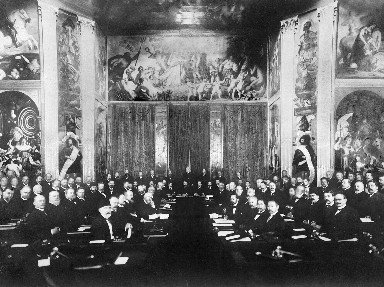
6. The Institute of International Law received the Nobel Peace Prize in 1904 for its work on promoting international law and arbitration, especially for its work at the Hague Peace Conference of 1899. Where was the Institute of International Law founded? Hint


photo quiz
Question 7 of 10
7. In 1905, a woman took home the Nobel Peace Prize for the first time. She was an Austrian peace activist, founder of the Austrian Peace Society, and author of 1889's "Lay Down Your Arms." What was her name? Hint


photo quiz
Question 8 of 10
8. Sitting U.S. President Theodore Roosevelt won the Nobel Peace Prize in 1906 for his role in ending which conflict? Hint


photo quiz
Question 9 of 10
9. Italian journalist and pacifist Ernesto Teodoro Moneta was one of two to take home the Nobel Peace Prize in 1907. What paradoxical term has often been used to describe him? Hint


photo quiz
Question 10 of 10
10. Ernesto Teodoro Moneta wasn't the only person to receive a Nobel Peace Prize in 1907. The other winner, a French lawyer who shared his name with the founder of an automobile company, received the prize "for his decisive influence upon the conduct and outcome of the Hague and Geneva Conferences". What was his name? Hint


photo quiz

(Optional) Create a Free FunTrivia ID to save the points you are about to earn:

arrow Select a User ID:
arrow Choose a Password:
arrow Your Email:


View Image Attributions for This Quiz

Most Recent Scores
Today : Guest 69: 6/10
Today : xchasbox: 10/10
Today : masfon: 9/10
Today : parrotman2006: 7/10
Today : mulder100: 8/10
Today : Guest 92: 9/10
Today : bernie73: 7/10
Today : Baldfroggie: 9/10
Today : PhNurse: 10/10

Quiz Answer Key and Fun Facts
1. In 1901, the first year the Nobel Peace Prize was awarded, there were two winners. What Swiss co-founder of the International Committee of the Red Cross shared the prize "for his humanitarian efforts to help wounded soldiers and create international understanding"?

Answer: Henry Dunant

Henry Dunant's half of the 1901 Nobel Peace Prize shone a well-deserved light on his work helping wounded soldiers and advocating for international humanitarian law. He was inspired by seeing first-hand the horrible toll of war after the 1859 Battle of Solferino in northern Italy, where tens of thousands of soldiers were killed and wounded.

Dunant worked to organize local civilians to care for the wounded soldiers regardless of which army they had fought for. His experience led him to write "A Memory of Solferino" in 1862. Dunant's ideas led to the creation of the International Committee of the Red Cross in 1863 and later to the adoption of the first Geneva Convention in 1864.
2. The second recipient of the 1901 Nobel Peace Prize was this whiskered French economist, who won "for his lifelong work for international peace conferences, diplomacy and arbitration." Which co-founder of the Inter-Parliamentary Union are we looking for?

Answer: Frédéric Passy

Frédéric Passy spent a good half century fighting for peaceful ways to settle disputes between nations. His interest in peace began during the Crimean War, and in 1867 he founded the International and Permanent League of Peace. It was France's first peace society. He was also a strong advocate of free trade, believing that commercial ties between independent nations could make war a less appealing option.

Later, Passy became involved in promoting international arbitration and established what became the Inter-Parliamentary Union in 1889. He served as one of its leaders, while continuing to campaign for arbitration as a more productive alternative to armed conflict
3. Switzerland's own Élie Ducommun shared the Nobel Peace Prize in 1902 "for his untiring and skillful directorship" of which organization based in Bern?

Answer: International Peace Bureau

Élie Ducommun was French-Swiss and was born in Geneva in 1833. He worked as a tutor, language teacher, journalist, and translator getting involved in the international peace movement. In 1867, he helped found the League of Peace and Freedom. In 1891, he became the honorary secretary-general of the International Peace Bureau in Bern.

Ducommun's big thing was promoting international arbitration and helping to organize peace congresses. He believed that nations could settle disputes without reaching immediately for the deadly and rather expensive solution of sending the country to war. He also believed that modern communications could help bring people together, clearly not predicting the advent of social media. He remained director of the International Peace Bureau until his death in 1906.
4. In 1902, Élie Ducommun shared the Nobel Peace Prize with Charles Albert Gobat, pictured here after spending hours getting his moustache just so. He was recognized particularly "for his eminently practical administration of the Inter-Parliamentary Union." From which country did Gobat hail?

Answer: Switzerland

Like Ducommun, Charles Albert Gobat was Swiss. He was born in Tramelan in the canton of Bern in 1843. He was trained as a lawyer but soon found himself in politics. He served in the Bernese cantonal government and the Swiss National Council.

His work in international peace organizations eventually brought him to the Inter-Parliamentary Union, where he became secretary-general of its Bureau. The Nobel Committee recognized Gobat's work for administering the organization and for his endeavors to promote international arbitration.
5. The 1903 Nobel Peace Prize went to an Englishman. He was a sitting member of Parliament, with a strong devotion to international arbitration. What was his name?

Answer: Randal Cremer

William Randal Cremer, who went by Randal Cremer, won the 1903 Nobel Peace Prize for his much-respected work promoting peace and international arbitration. He was a British Member of Parliament and served as secretary of the International Arbitration League. His colleagues nicknamed him the "Member of Arbitration", which sounds right.

Cremer came from a working-class background, trained as a carpenter, and became involved in the trade union and peace movements before entering Parliament. His interest in arbitration helped contribute to the establishment of the Permanent Court of Arbitration at The Hague in 1899. Cremer donated most of his Nobel prize money to the International Arbitration League, which seems a particularly Cremer-ish thing to do.
6. The Institute of International Law received the Nobel Peace Prize in 1904 for its work on promoting international law and arbitration, especially for its work at the Hague Peace Conference of 1899. Where was the Institute of International Law founded?

Answer: Belgium

The Institute of International Law was founded on September 8, 1873, at the Town Hall in Ghent, Belgium. Eleven big-name international lawyers from multiple countries gathered there to create an independent organization with the mission to establish and implement international law.

Belgian lawyer Gustave Rolin-Jaequemyns (pictured here) was one of the main figures behind this herculean effort. The Institute was awarded the 1904 Nobel Peace Prize for its efforts to develop peaceful relations between nations and make the laws of war more humane.
7. In 1905, a woman took home the Nobel Peace Prize for the first time. She was an Austrian peace activist, founder of the Austrian Peace Society, and author of 1889's "Lay Down Your Arms." What was her name?

Answer: Bertha von Suttner

Bertha von Suttner became the first woman to win the Nobel Peace Prize when she received the 1905 prize "for her sincerity in advocating the ideals of peace". She was born in Prague in 1843 and became one of the top figures in the international peace movement.

Her 1889 anti-war novel "Lay Down Your Arms" was extremely influential, and in 1891 she founded the Austrian Peace Society. She also served as vice president of the Permanent International Peace Bureau.
8. Sitting U.S. President Theodore Roosevelt won the Nobel Peace Prize in 1906 for his role in ending which conflict?

Answer: Russo-Japanese War

Theodore Roosevelt was awarded the 1906 Nobel Peace Prize for helping to bring the Russo-Japanese War of 1904-1905 to an end. That conflict pitted the Russian Empire against the Empire of Japan, largely over - you guessed it - Korea and Manchuria.
Roosevelt invited representatives of both countries to Portsmouth, New Hampshire in 1905. The result was that the Treaty of Portsmouth formally ended the war.
9. Italian journalist and pacifist Ernesto Teodoro Moneta was one of two to take home the Nobel Peace Prize in 1907. What paradoxical term has often been used to describe him?

Answer: Militant pacifist

Moneta's life makes "militant pacifist" a strange but fitting description. As a young man, he was deeply involved in Italy's struggle for independence and fought alongside revolutionary Giuseppe Garibaldi during the 1860 Expedition of the Thousand. His experiences of warfare, particularly the horrors he witnessed at the Battle of Custoza in 1866, turned him toward pacifism. He later became a leading figure in the Italian peace movement and founded the Lombard Union for Peace and Arbitration.
10. Ernesto Teodoro Moneta wasn't the only person to receive a Nobel Peace Prize in 1907. The other winner, a French lawyer who shared his name with the founder of an automobile company, received the prize "for his decisive influence upon the conduct and outcome of the Hague and Geneva Conferences". What was his name?

Answer: Louis Renault

Louis Renault (no relation to the industrialist Louis Renault) was a French jurist and professor of international law. He shared the 1907 Nobel Peace Prize with Ernesto Teodoro Moneta, our friend the "militant pacifist". Renault served as an adviser to the French government on international law and foreign policy, and he represented France at several international conferences.

The Nobel Committee recognized him for his role at the Hague Peace Conferences of 1899 and 1907, where he helped develop rules governing relations between states and how warfare should be conducted.
Source: Author NeuralSpicy

This quiz was reviewed by FunTrivia editor ponycargirl before going online.
Any errors found in FunTrivia content are routinely corrected through our feedback system.
8/27/2026, Copyright 2026 FunTrivia, Inc. - Report an Error / Contact Us