Your task is simple, from the following list, select 10 items that are connected to Hanukkah. If you choose three wrong answers, you're out!
There are 10 correct entries. Get 3 incorrect and the game ends.
Esther Pomegranate Bikkurim Kol Nidre Judas MaccabeusSufganiyah The Exodus Miracle of the cruse of oil KislevNisan Ma'oz Tzur Hanukkiah Latke Dreidel Sukkah Hasmonean revolt Mattathias Bonfire
Left click to select the correct answers. Right click if using a keyboard to cross out things you know are incorrect to help you narrow things down.
Quiz Answer Key and Fun Facts
Answer:
Hanukkah is a holiday established by the Jewish sages (rabbis) to commemorate the victory of the Hasmoneans (Jewish royal dynasty) in their revolt against the Greeks during the Second Temple period. It symbolizes the purification of the Temple by the Hasmoneans and its rededication. The name comes from the Hebrew phrase Hanukat HaMikdash, meaning the ceremonial dedication of the Temple, held after its reconquest and purification by the Maccabees.
Kislev is the Hebrew month in which Hanukkah is celebrated. According to Chazal, who often count the months of the Hebrew calendar from Tishrei, Kislev is considered the third month. Hanukkah is an eight-day festival that begins on the 25th of Kislev and is marked by thanksgiving and joy in commemoration of the renewal of the sacred service in the Temple and the miracle of the oil jug.
The events leading up to the Hasmonean Revolt took place toward the end of the Second Temple period, during the rule of the Seleucid Empire over much of the Middle East. King Antiochus IV Epiphanes, a Seleucid ruler, attempted to impose Hellenistic culture and religious practices on the Jewish population. He outlawed key Jewish observances such as circumcision, sabbath observance, and the study of Torah, and compelled Jews to take part in pagan rituals. Antiochus also desecrated the Temple in Jerusalem by erecting an altar - traditionally associated with Zeus - an act that deeply outraged the Jewish people and helped spark the revolt.
The revolt began with Mattathias, a kohen (a religious figure of the highest status among the people of Israel, similar to a priest) from the town of Modi'in, who was known for his unwavering commitment to Jewish law. When royal emissaries arrived in Modi'in and demanded that the inhabitants take part in pagan sacrifices, Mattathias openly refused. He then called on others to rise up against the decree, marking the beginning of the Hasmonean Revolt.
Mattathias and his five sons - Yohanan, Shimon, Eleazar, Jonathan, and Judah, later known as Judah Maccabee - led the resistance. Though vastly outnumbered and facing well-trained Seleucid forces, the Jewish fighters achieved a series of surprising victories. One of the most significant was the Battle of Emmaus, fought in the Shephelah region (geographical area in Israel), which dealt a major blow to the Seleucid army and paved the way for the recapture of Jerusalem and the restoration of Jewish control over the Temple.
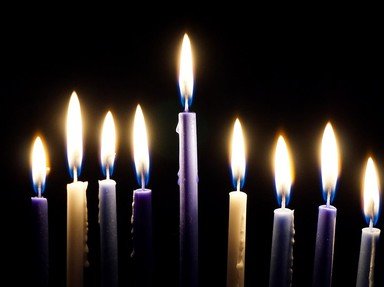
When the Hasmoneans sought to resume the Temple, they did not have enough pure olive oil, sealed with the seal of the High Priest, to light the menorah that burned in the Temple. Finally, a jug was found that contained enough oil to light the menorah for only one day, but miraculously the oil lasted for eight full days. Hence the custom of lighting candles on Hanukkah. A hanukkiah is a special candelabrum used to light the Hanukkah candles. It has eight branches for the candles and an additional branch for lighting them, called the shamash (meaning "helper" or "attendant").
"Ma'oz Tzur Yeshuati" is a Hanukkah piyyut (a Jewish sacred song) recited after lighting the candles. The custom originates in Ashkenazi practice, but today the piyyut has also been adopted by various Sephardic and Mizrahi communities. It belongs to the category of songs of redemption, as it addresses different historical periods in Jewish history and describes the redemption that occurred in each of them.
The dreidel is a traditional children's game associated with Hanukkah. In Israel, the four Hebrew letters nun, gimel, he, and pe are inscribed on the dreidel, forming the phrase Nes Gadol Haya Po ("A great miracle happened here"). Outside of Israel, the letters nun, gimel, he, and shin are used, forming the phrase Nes Gadol Haya Sham ("A great miracle happened there"). The game is believed to have originated from a European spinning-top lottery game played by children in German-speaking regions from the 16th century, both Jewish and non-Jewish. Jewish communities in Europe adopted the game, and over time it became associated with Hanukkah. Since children often had more free time during the holiday, the dreidel became a popular pastime and an enduring symbol of the festival and its miracles.
Finally, no holiday is complete without delicious food. During Hanukkah, it is customary to eat foods rich in oil to commemorate the miracle of the jug of oil that lasted eight days. The main dishes include sufganiyah, a round, soft, and puffy doughnut, deep-fried and usually filled with jam and dusted with powdered sugar, and latke, a fried potato pancake (sometimes made with other ingredients such as squash or sweet potatoes).
Wrong answers:
Nisan is a month in the Hebrew calendar during which the holiday of Passover is celebrated.
Esther was the wife of the Persian king Ahasuerus and is described in the Book of Esther as someone who, through her wisdom and courage, succeeded in overturning Haman's decree to kill all the Jews.
A sukkah is a temporary structure used by Jews to observe the commandments of the holiday of Sukkot. It commemorates the sukkot in which G-d made the Israelites live after they left Egypt.
Bonfire: Many people light bonfires on the night of Lag BaOmer. The origin of this custom is unclear, but there are several explanations for it, one of which is to symbolize illuminating the world by revealing the inner dimension of the Torah, with the bonfire serving as a kind of large "soul candle."
The Exodus is the story of the Israelites' departure from Egypt, from slavery to freedom. The holiday of Passover is celebrated to commemorate this event.
Pomegranate is a traditional food on Rosh Hashanah (Jewish new year).
Bikkurim: During the Temple period, it was commanded to bring the first fruits (bikkurim) of the Seven Species to the Temple priests. The period for bringing the bikkurim extended from the festival of Shavuot (the harvest) until the festival of Sukkot (the ingathering).
Kol Nidre is the prayer that opens Yom Kippur and annuls personal vows.
This quiz was reviewed by FunTrivia editor looney_tunes before going online.
Any errors found in FunTrivia content are routinely corrected through our feedback system.