FREE! Click here to Join FunTrivia. Thousands of games, quizzes, and lots more!
Quiz about Jewels of Jewish Life

Jewels of Jewish Life Trivia Quiz

Objects of Jewish Life

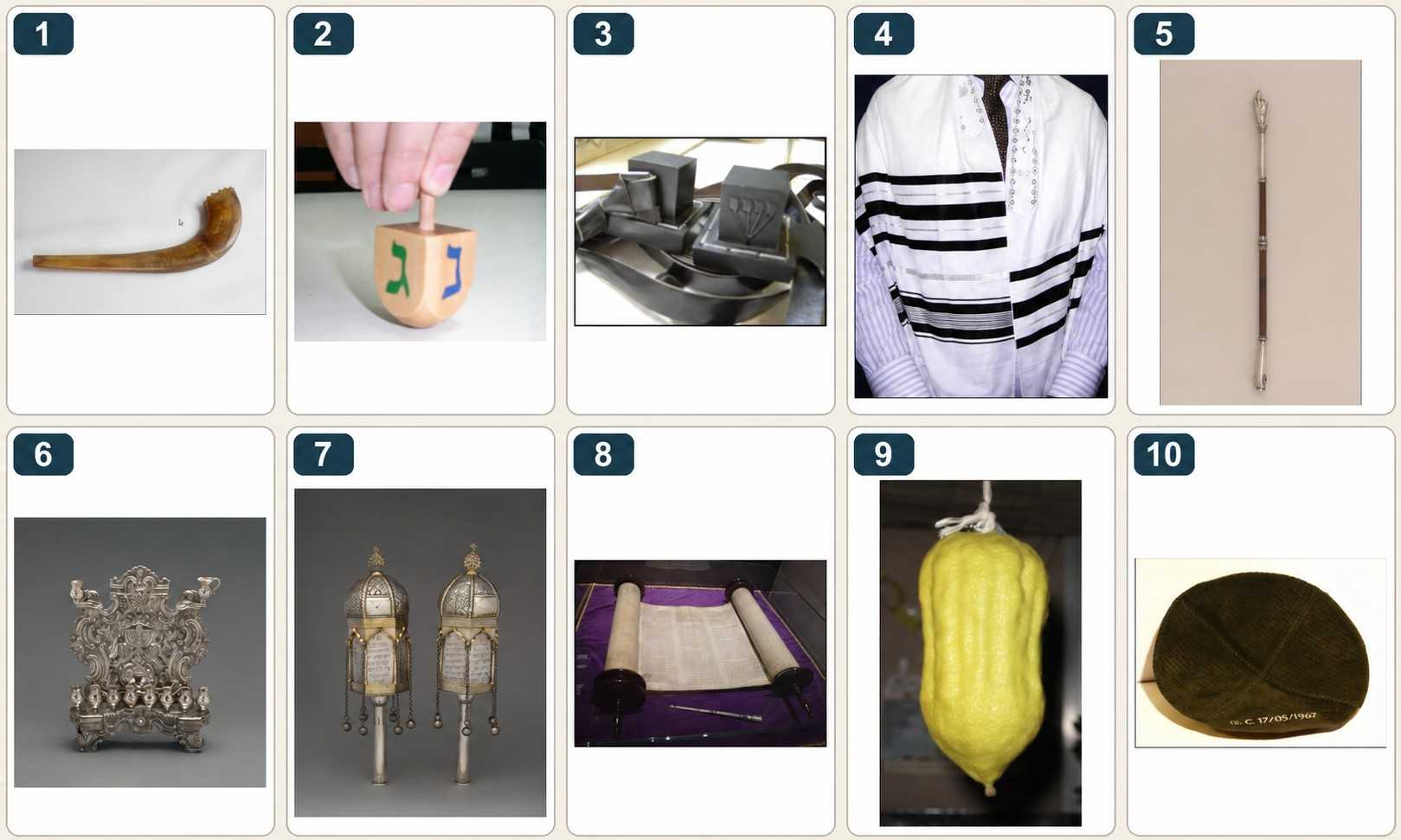
Not every jewel sparkles. These ten objects hold a special place in Jewish worship, festivals and everyday traditions. Match their names to the pictures and discover what makes each one meaningful.

A label quiz by SCIENCEKING_00. Estimated time: 3 mins.
  1. Home
  2. »
  3. Quizzes
  4. »
  5. Religion Trivia
  6. »
  7. Judaism
  8. »
  9. Traditions

Time
3 mins
Type
Label Quiz
Quiz #
426,355
Updated
Nov 09 26
# Qns
10
Difficulty
New Game
Plays
8
Last 3 plays: Guest 76 (6/10), Guest 195 (6/10), Guest 104 (10/10).
Match each name to its numbered photograph. The clues describe how the objects are used. Each answer is used once.
Click on image to zoom
Kippah Etrog Tefillin Tallit Hanukkah lamp Torah scroll Dreidel Shofar Torah finials Yad
* Drag / drop or click on the choices above to move them to the answer list.
View Image Attributions for This Quiz
1. Horn sounded at the Jewish New Year  
2. Spinning top used in a Hanukkah game  
3. Two leather boxes worn on the head and arm during weekday prayer  
4. Prayer shawl worn around the shoulders  
5. Helps a reader keep their place without touching the sacred text  
6. Holds the lights kindled during an eight-night festival  
7. Paired ornaments placed on the upper ends of a scroll's wooden rollers  
8. Read aloud during synagogue services  
9. Citron used with palm, myrtle, and willow at Sukkot  
10. Small cap worn as a sign of religious respect  

Most Recent Scores
Today : Guest 76: 6/10
Today : Guest 195: 6/10
Today : Guest 104: 10/10
Today : xchasbox: 10/10
Today : Guest 167: 6/10
Today : bernie73: 8/10
Today : FrappMaster: 10/10
Today : Upstart3: 8/10

Quiz Answer Key and Fun Facts
1. Shofar

A shofar is a wind instrument made from an animal horn, often a ram's horn. It is sounded during Rosh Hashanah, the Jewish New Year, and at the end of Yom Kippur, the Day of Atonement. The player blows through the narrow end to produce its calls. In Jewish tradition, its sound encourages people to reflect on their actions and turn towards a better way of living.
2. Dreidel

A dreidel is a four-sided spinning top used in a Hanukkah game. "Dreidel" is a Yiddish word; its Hebrew name is sevivon. The Hebrew letters on its sides tell players whether to take counters from the shared pot, add one, or do nothing.

Hanukkah celebrates the rededication of the Temple in Jerusalem. According to Jewish tradition, enough oil for just one day kept the Temple lamp burning for eight days. Outside Israel, the letters on the top also stand for a Hebrew phrase meaning "a great miracle happened there". Many dreidels used in Israel replace the final letter so the phrase ends with "here" instead. "Here" means the land of Israel, where the Hanukkah story took place.
3. Tefillin

Tefillin are a pair of small black leather boxes containing passages from the Torah written on parchment. One is fastened to the upper arm, with its strap wound around the arm and hand; the other is placed on the head. They are traditionally worn during weekday morning prayers, except on major Jewish holidays.

In Jewish teaching, their position is a reminder to serve God through thought, feeling and action. The head box has four compartments for the passages, while the arm box holds them together in one compartment.
4. Tallit

A tallit is a Jewish prayer shawl worn around the shoulders. It has specially tied fringes, called tzitzit, at its four corners. These serve as a reminder of the commandments in Jewish tradition. Many shawls have stripes, but their colours and designs vary. The fringes have a religious purpose; the pattern of stripes is not what makes a garment a tallit.
5. Yad

A yad is a pointer used when reading from a Torah scroll. Its name means "hand" in Hebrew, and many examples end in a tiny hand shape. It helps the reader keep their place without following the words with a bare finger. This also reduces direct handling of the parchment. Some pointers are plain, while others, like the silver-and-wood example shown here, are carefully decorated.
6. Hanukkah lamp

A Hanukkah lamp, also called a hanukkiah, holds eight festival lights and usually a separate helper light called the shamash. The shamash is used to light the candles. One more festival light is lit on each successive evening of Hanukkah. Lamps may burn oil or hold candles, and their shapes vary.

The pictured silver example has a row of oil cups. The seven-branched menorah associated with the ancient Temple in Jerusalem is a different kind of lamp.
7. Torah finials

These ornaments are Torah finials, often called rimonim. They fit onto the upper ends of the wooden rollers of a Torah scroll and are removed when needed for reading. Rimonim means "pomegranates" in Hebrew, a name linked to a traditional shape of these ornaments.

Not every pair looks like fruit: some resemble towers or crowns. The pictured silver pair, made in Tiflis in 1895, has small hanging bells.
8. Torah scroll

A Torah scroll contains the Five Books of Moses, from Genesis through Deuteronomy, written in Hebrew. A trained scribe, called a sofer, writes the text by hand on parchment sheets that are joined together. The wooden rollers allow the reader to reach a passage without folding the material into pages. Torah scrolls are used for public readings in synagogue services.

They are treated with great care and are normally kept in a special cabinet called the Ark.
9. Etrog

An etrog is a citron, a citrus fruit used during the Jewish festival of Sukkot. Together with a palm branch, myrtle and willow, it forms the Four Species used in the festival ritual. It may look like a large, bumpy lemon, but a citron is a different kind of citrus fruit. Etrogim, the plural of etrog, can vary in shape. The long yellow example in the photograph is a Moroccan citron.
10. Kippah

A kippah is a small cap worn as a Jewish head covering. It is also called a yarmulke, a word from Yiddish. Wearing one can express respect for God and a sense of Jewish identity. Customs differ: some people wear a head covering throughout the day, while others put one on for prayer or religious occasions. Kippot, the plural of kippah, come in a range of materials, colours and patterns.
Source: Author SCIENCEKING_00

This quiz was reviewed by FunTrivia editor looney_tunes before going online.
Any errors found in FunTrivia content are routinely corrected through our feedback system.
11/9/2026, Copyright 2026 FunTrivia, Inc. - Report an Error / Contact Us