FREE! Click here to Join FunTrivia. Thousands of games, quizzes, and lots more!
Everyone Loves a Good Horse Race! Quiz
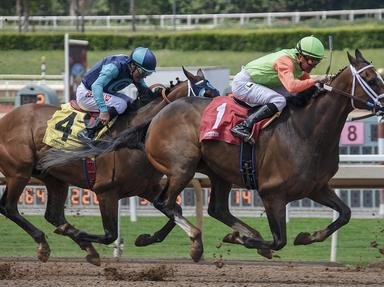
Horse racing is a popular sport with origins that date back thousands of years to ancient Egypt and Mesopotamia. While it was nicknamed the Sport of Kings in the early 1600s due royal patronage and the expense involved, it is still popular worldwide.
A label quiz
by ponycargirl.
Estimated time: 3 mins.
Last 3 plays: TurkishLizzy (10/10), PosterMeerkat (8/10), linkan (8/10).
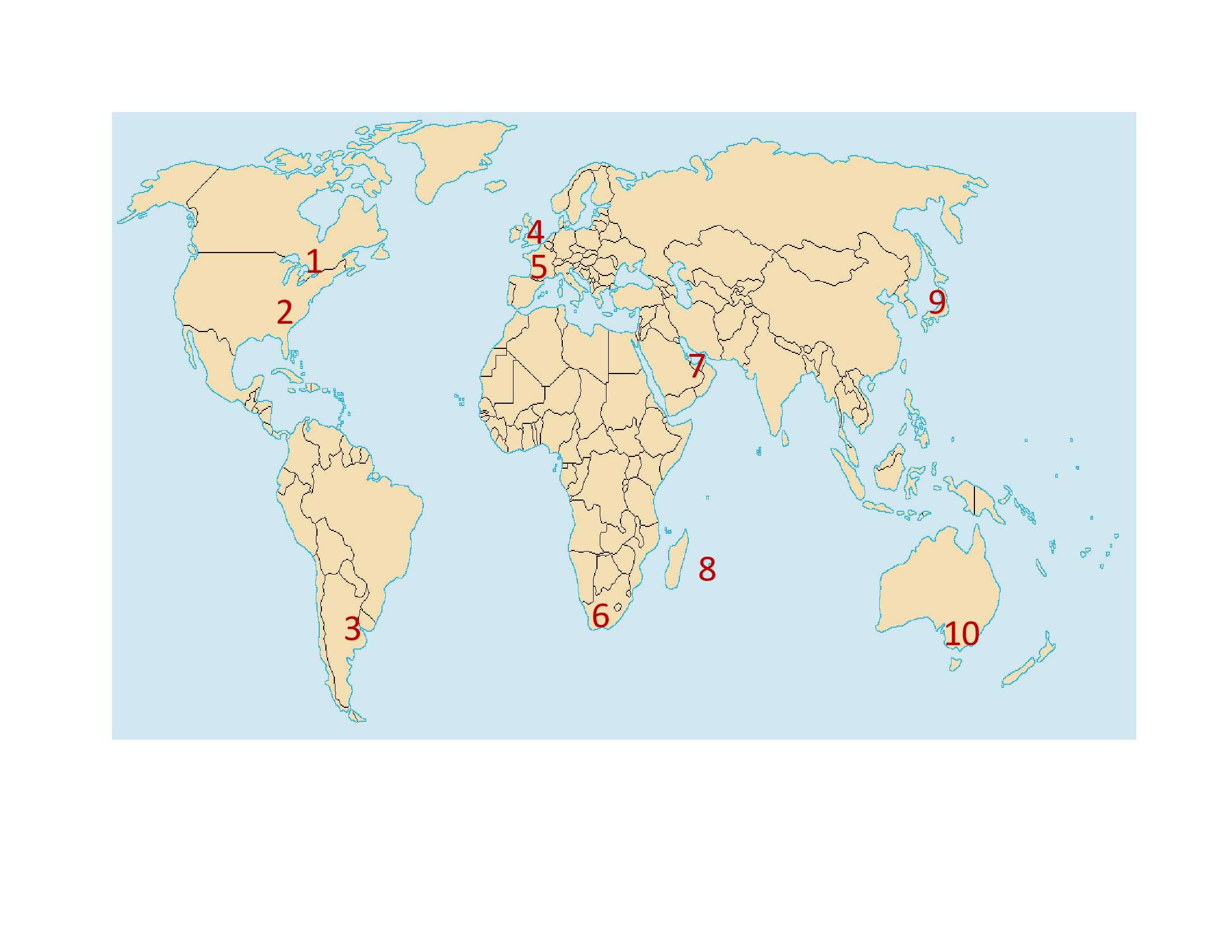
See if you can match each horse race with its numbered location on the map!
Click on image to zoom
Maiden CupDubai World CupDerby StakesDurban JulyPrix de L'Arc de TriompheKing's PlateMelbourne CupGran Premio Carlos PellegriniKentucky DerbyJapan Cup* Drag / drop or click on the choices above to move them to the answer list. View Image Attributions for This Quiz
The oldest Thoroughbred horse race in Canada, and the most continuously run race in North America, the King's Plate was originally called the Queen's Plate (1860-1901). This was because Queen Victoria of England provided the first plate, which was really a gold cup. The name of the race is changed according to the monarch; it was once again called the Queen's Plate from 1952-2022 during the reign of Queen Elizabeth II, and renamed in 2022 when King Charles III became the race's patron.
Run at Woodbine Racetrack in Etobicoke, Ontario, near Toronto, the race is the first in the Canadian Triple Crown, which also includes the Prince of Wales Stakes and the Breeders' Stakes. Although the qualifications for the race have changed over time, currently no more than seventeen three-year old Thoroughbred horses bred in Canada are chosen to run the 1.25 miles (2000 meters) race.
Fun Fact: All of the races featured in this quiz are flat races. Flat racing is considered to be the most popular form of horse racing worldwide.
2. Kentucky Derby
Called the "most exciting two minutes in sports", the Kentucky Derby takes place the first Saturday in May at the Churchill Downs dirt racetrack in Louisville, Kentucky. The Kentucky Derby, first run in 1875, was originally organized by Col. Meriwether Lewis Clark Jr., the grandson of the famous William Clark of the Lewis and Clark Expedition. He had visited some races in Europe, and wanted to create the same type of racing atmosphere in the USA. It is the first race of the Triple Crown, which also includes the Preakness Stakes and the Belmont Stakes.
Horses that compete in the Kentucky Derby must be three year old Thoroughbreds, and must earn enough points in the preparatory races in order to qualify. A maximum number of twenty horses can enter the race. Like the King's Plate, the race covers 1.25 miles (2000 meters).
Fun Fact: In flat racing the horses compete on a somewhat level course with no obstacles.
3. Gran Premio Carlos Pellegrini
The most renowned horse race in Argentina, the Gran Premio Carlos Pellegrini was first run in 1887, when it was called the Gran Premio Internacional. Also called the South American Breeders' Cup, the race is open to Thoroughbreds that are three years and older. It is the fourth race in the Argentinian Quadruple Crown, and the turf race is typically run in December at the Hipódromo de San Isidro racecourse in Buenos Aires.
The distance of the race has changed over time. Currently it is approximately 1.5 miles (2400 meters). Up to twenty horses may be chosen to participate based on their previous performances. The winner of the race automatically goes on to participate in the Breeders' Cup Turf, a yearly race that is held at different race tracks in the United States or Canada.
Fun Fact: Flat racing tracks are typically oval in shape.
4. Derby Stakes
Established in 1780 by Edward Smith-Stanley, the 12th Earl of Derby, the Derby Stakes, also called the Epsom Derby, is part of the British Triple Crown. The Earl gave his name to many subsequent prestigious horse races that also became known as Derbies. Unlike most other flat Thoroughbred horse races, the course features a climb and a downhill run, as well as the Tattenham Corner, which is a sharp, downhill bend.
Horses only have one opportunity to show their stamina, mental quickness, and speed at this race; it is for three year old colts and fillies; no geldings are allowed. Run over approximately 1.5 miles (2400 meters) on a turf track at the Epsom Downs Racecourse, the race is often called the Blue Riband of the Turf. Riband is an old name for a ribbon.
Fun fact: Flat racing tests speed, endurance, and stamina rather than speed alone.
5. Prix de L'Arc de Triomphe
Named after France's Arc de Triomphe, which was built by Napoleon after his victory at Austerlitz, the Prix de L'Arc de Triomphe was first run in 1920. The Arc, as it is often called, is known as the richest flat Thoroughbred race in Europe. The Prix de L'Arc de Triomphe is run at Longchamp Racecourse in Paris on a turf surface. Open to three-years-old and up (no geldings), the race is 2400 meters (1.5 miles) in length. It has been sponsored by Qatar since 2008.
Fun Fact: A Thoroughbred is a breed of horse that was created for racing. All Thoroughbreds can trace their lineage to one of three stallions brought to England in the 1600s and 1700s and mostly English mares.
6. Durban July
The Durban July race, which is run in South Africa, has frequently changed names since its inception in 1897. Typically called the July, its name was originally Durban Turf Club Handicap, and the 2026 race is the Hollywoodbets Durban July; the name changes according to the race's branding and sponsorship. Thoroughbreds that are three years old and up are eligible to compete in the race. Held at the Greyville Racecourse in Durban, KwaZulu-Natal, the Durban July race is 2200 meters long (1.4 miles). Participants are chosen by a panel based on their performances in certain races during the current racing season. They also must appear at public gallups in order to showcase their fitness.
Fun Fact: While Thoroughbreds are mostly used for racing, they can also be used for fox hunting, show jumping, polo, and a variety of other riding events.
7. Dubai World Cup
Held since 1996, the Dubai World Cup is the newest race featured in this quiz. It was established by Sheikh Mohammed bin Rashid Al Maktoum, who is the current ruler of the United Arab Emirates. Four year olds Thoroughbreds from the northern hemisphere and three year olds from the southern hemisphere compete for what is usually twelve spots on the race course; only nine horses were chosen for the 2026 race based on their high performance in other races. Run on a dirt track at Meydan Racecourse in Dubai, the race is 2000 meters (1.25 miles), and is well known for being one of the richest horse races in the world. Since 2019 there has been a US$12 million purse.
Fun Fact: The surface of the flat racing course may be dirt, turf, or synthetic; the experiment with synthetic turf at the Meydan Racecourse, however, proved unsuccessful due to its high maintenance cost and unpopularity with some participants.
8. Maiden Cup
Yes, the small island of Mauritius is there, off the coast of Africa, by Number 8 on the map. Established in 1843, the Maiden Cup is held in Port Louis at the Champ de Mars Racecourse, which is believed to be the oldest in the southern hemisphere. It is a turf track with an uphill incline in the home stretch. The race is considered to be the Mauritian equivalent of the Epsom Derby in England.
It was originally held as a maiden race for horses who had never won a race in Maritius. In 1983 it became a stayer's (longer) race at 2,400 meters (1.5 miles). Horses that are three years and older may participate; eleven are chosen based on their past performances in other races. Known for huge crowds and passionate fans, the Maiden Cup typically called the day when "Mauritius holds its breath".
Fun Fact: Thoroughbreds in the northern hemisphere are considered to be a year old on January 1 each year. In the southern hemisphere they have their first birthday on August 1. This is done to help standardize the sport.
9. Japan Cup
A race that is typically dominated by Japanese horses, the Japan Cup was founded in 1981 by the Japan Racing Association in order to give local horses a chance to compete, develop a race that was the same quality as international races, and promote international good will. Although fourteen of the first twenty-five races were won by international horses, Japanese horses won nineteen in a row before that record was broken in 2025.
Eighteen horses run 1.5 miles (2400 meters) on the turf at the Tokyo Racecourse in Fuchu. The race is for three year olds and up; as many as ten foreign-trained horses are allowed. Typically held in November, the Japan Cup is considered to be the grand finale race of the season. The racecourse holds a record 230,000 spectators - as opposed to Churchill Downs in the United States which holds only 165,000.
Fun Fact: The term thoroughbred is also used for a purebred horse of any breed.
10. Melbourne Cup
"The race that stops the nation" was first run in 1861; it has been a public holiday since 1876, in the state of Victoria. Australian horses that win - like Phar Lap - are considered to be national heroes. Archer, the horse that won the race in 1861 and 1862, is said to have walked over 800 kilometers to Melbourne before the race because there wasn't a boat available to bring him.
Twenty-four Thoroughbred horses, three year olds and up, are chosen for the race, the longest in this quiz, at 3200 meters (2 miles). It is a handicap race, where horse's weight is assigned based on ability, age, and prior performances, and run on turf at the Flemington Racecourse.
Fun Fact: Handicapped races are believed to even the possibility for any of the competitors to win. They are thought to make the races more competitive, and, to some, more exciting.
This quiz was reviewed by FunTrivia editor gtho4 before going online.
Any errors found in FunTrivia content are routinely corrected through our feedback system.