FREE! Click here to Join FunTrivia. Thousands of games, quizzes, and lots more!
Quiz about The Basketball Court

The Basketball Court Trivia Quiz


From the floor to the high-stakes terminology of the pros, do you know your way around the hardwood? Test your knowledge of the court and see if you can identify the spots where legends are made!

A label quiz by LeoDaVinci. Estimated time: 3 mins.
  1. Home
  2. »
  3. Quizzes
  4. »
  5. Sports Trivia
  6. »
  7. Basketball

Author
LeoDaVinci
Time
3 mins
Type
Label Quiz
Quiz #
423,976
Updated
Apr 28 26
# Qns
10
Difficulty
Average
Avg Score
8 / 10
Plays
15
Last 3 plays: GoodwinPD (10/10), xchasbox (10/10), bernie73 (8/10).
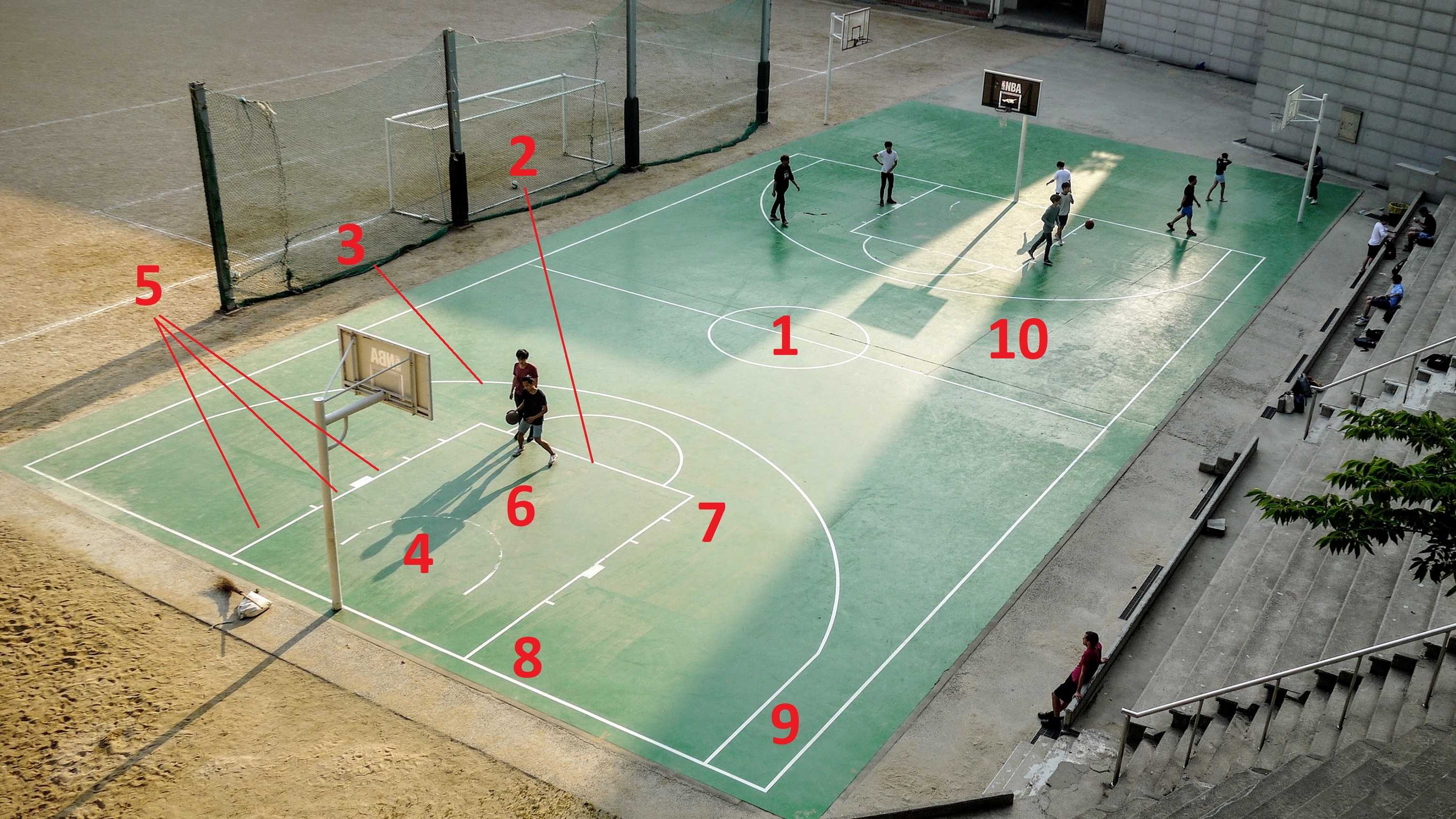
Identify the different areas of the court. Some basketball gameplay knowledge is needed.
Click on image to zoom
Blocks Key Wing Center Circle Three-point Line Backcourt Restricted Area Low Post Free-throw Line Elbow
* Drag / drop or click on the choices above to move them to the answer list.
View Image Attributions for This Quiz
1.   
2.   
3.   
4.   
5.   
6.   
7.   
8.   
9.   
10.   

Most Recent Scores
Today : GoodwinPD: 10/10
Today : xchasbox: 10/10
Today : bernie73: 8/10
Today : Taltarzac: 5/10
Today : feuematt1: 6/10
Today : Guest 45: 7/10
Today : quizzer74: 3/10
Today : yosoyfiesta: 8/10
Today : Rizeeve: 10/10

Quiz Answer Key and Fun Facts
1. Center Circle

The center circle is the literal heart of the basketball court; every game begins there with a jump ball. Located exactly at midcourt, this 12-foot diameter ring serves as the neutral ground for the opening tip-off. Only the two opposing centers are permitted inside the circle during the throw. Teammates must remain outside the perimeter until the ball is touched and attempt to grab the opening tip.

Beyond its functional role in starting play and overtime, the center circle is often the visual centerpiece of an arena, typically featuring a vibrant team logo or mascot at center court. In NBA courts, a massive screen can be found directly above it.
2. Free-throw Line

The free-throw line, sometimes jokingly called the charity stripe, is located 15 feet from the net and the backboard. It marks the boundary line where a player stands to take uncontested shots following a foul committed on that player while in the act of shooting (or, if their team has reached bonus shots).

It is a fundamental part of the court's geometry. The line is part of the free-throw circle, which has a 12-foot diameter. Interestingly, while the shooter must stay behind the line until the ball hits the rim, teammates and opponents line up along the key, in the blocks, to try for the rebound.

It can be a place of intense pressure, especially during the closing seconds of a game. NBA backboards are made of clear plexiglass and the home fans sitting behind the basket are encouraged to make distracting movements. However, some players have great success from behind the line, shooting with over 90% accuracy to earn their team the "free" points.
3. Three-point Line

The three-point line is the large arc that separates two-point field goals from the coveted three-pointers. In the NBA, the distance is 23 feet, 9 inches from the basket, though it narrows to 22 feet in the corners. Introduced to the NBA in 1979, the arc revolutionized the game by rewarding long-distance accuracy and stretching the defense. If you watch the modern game, the three-point line is basically everything; it creates more space for drives to the rim and allows teams to stage massive scoring comebacks through beyond the arc shooting.
4. Restricted Area

This tiny semi-circle under the basket has completely changed how defenders play, and is located directly under the basket. It has a radius of 4 feet in the NBA. Its primary purpose is to distinguish between a block and a charge. If a defensive player is standing inside this arc when they collide with an airborne offensive player, they cannot draw a charging foul, even if their feet are perfectly set. This prevents defenders from simply camping under the rim to wait for a collision. This was previously deemed a major safety concern.

The NBA introduced the restricted area for the 1997-98 season to reward aggressive drives to the hoop and increase scoring. It was a direct response to a style of play where defenders would stand directly under the hoop to force collisions, often leading to dangerous falls. By creating this no-charge zone, the league forced defenders to meet offensive players further out, making the game safer and more fluid.
5. Blocks

The blocks are the thick, painted rectangles located on the edges of the key, just a few feet from the baseline. Originally designed to help officials and players manage positioning during free throws, this is where bigs fight to set up near the basket.

In a live game, establishing position on the block is a goal for many centers and power forwards. By planting their feet here, outside the key, offensive players gain a physical advantage, making it easier to receive a pass and score near the rim while keeping the defender pinned behind them. During free throws, the blocks provide the baseline for player alignment. Two defenders take the spots closest to the basket, while teammates of the shooter line up in the spaces above. One final defender lines up at the top block to guard the shooter.
6. Key

The key, also known as the paint, is the rectangular area extending from the baseline to the free-throw line. It earned its nickname because it is traditionally painted a different color than the rest of the court to help officials track three-second violations, rules which prevent players from camping out near or under the basket for too long.

The paint is probably the most contested real estate on the floor. It is the site of high-percentage layups, dunks, and fierce rebounding battles. Defenses collapse on the paint to protect the rim, while offenses strive to penetrate the paint to either score directly or draw defenders away from outside shooters. It's a key location for high-percentage shots.

In the past, the key was narrower and shaped like an old-fashioned keyhole, which is how it got its name.
7. Elbow

The coaches' favorite, the elbow, is the spot on the court where the free-throw line meets the side of the key. It's often referred to as the high post. Each half-court has two elbows, creating a high-leverage area for both offense and defense.

On offense, the elbow is a favorite catch-and-shoot spot for big players. It is a starting location for the 'horns' set, where big players set up allowing the point guard a multitude of options. From here, you can do pretty much anything: drive, shoot, or pick apart the defense. Defensively, protecting the elbows is a common coaching mantra to prevent easy penetration into the heart of the paint.
8. Low Post

The low post is the area on the side of the lane closest to the basket, typically centered around the blocks. This is the primary territory for the larger players, typically the center and the power forward, who play with their backs to the hoop. From here, players use strength and footwork for high-percentage shots like hook shots or layups, or a dunk if you can evade your defender. Because of its proximity to the rim, the low post is a strategic focal point; a dominant post player often draws double teams, forcing the defense to collapse and leaving outside shooters open on the perimeter.
9. Wing

The wing is the area of the court located along the three-point arc, situated between the corner and the top of the key. This is where shooters make their money by leveraging those tighter angles. It's also a perimeter location where a player is more likely to be given distance from the defender, allowing for a bit of space to shoot or to choose to drive.

In offensive sets, the wing is a critical floor-spacing position. If a defender leaves their opponent on the wing to help in the paint, it often results in a wide-open long-distance shot. Many legendary scorers have earned their status because of their skill shooting from the wing.
10. Backcourt

On the court, the backcourt refers to the half of the court your team is defending. Once your offense moves the ball across the midcourt line into the frontcourt, you cannot return the ball to the backcourt. If you do so, this results in a violation.

Tactically, the backcourt is where defenders perform a full-court press, where defenders try to harass the offense for the entire 94-foot length of the hardwood to force a turnover or an eight-second violation. Effective, but also exhausting to sustain for an entire game.
Source: Author LeoDaVinci

This quiz was reviewed by FunTrivia editor gtho4 before going online.
Any errors found in FunTrivia content are routinely corrected through our feedback system.
Related Quizzes
1. For All NBA Fans Average
2. You Pick 'Em Average
3. The NBA Average
4. Mixed Basketball Average
5. Mixed NBA Basketball #2 Average
6. To The Max Easier
7. Mixed NBA Basketball #3 Average
8. NBA Quickie Average
9. NBA Mixed Average
10. Random NBA Average
11. NBA Facts Average
12. NBA Knowledge Average

4/28/2026, Copyright 2026 FunTrivia, Inc. - Report an Error / Contact Us