FREE! Click here to Join FunTrivia. Thousands of games, quizzes, and lots more!
Nostalgia Time: Anatomy of an Arcade Game Quiz
Back in the '80s I could often be found hanging out with my peers at the local arcade in my small home town. Times were simpler then. Maybe this will help my son understand why I'm so awful at modern gaming systems.
A label quiz
by stephgm67.
Estimated time: 3 mins.
CabinetCoin slotMarqueeAction buttonStart buttonsJoystickSpeakerScreenCoin returnControl panel* Drag / drop or click on the choices above to move them to the answer list. View Image Attributions for This Quiz
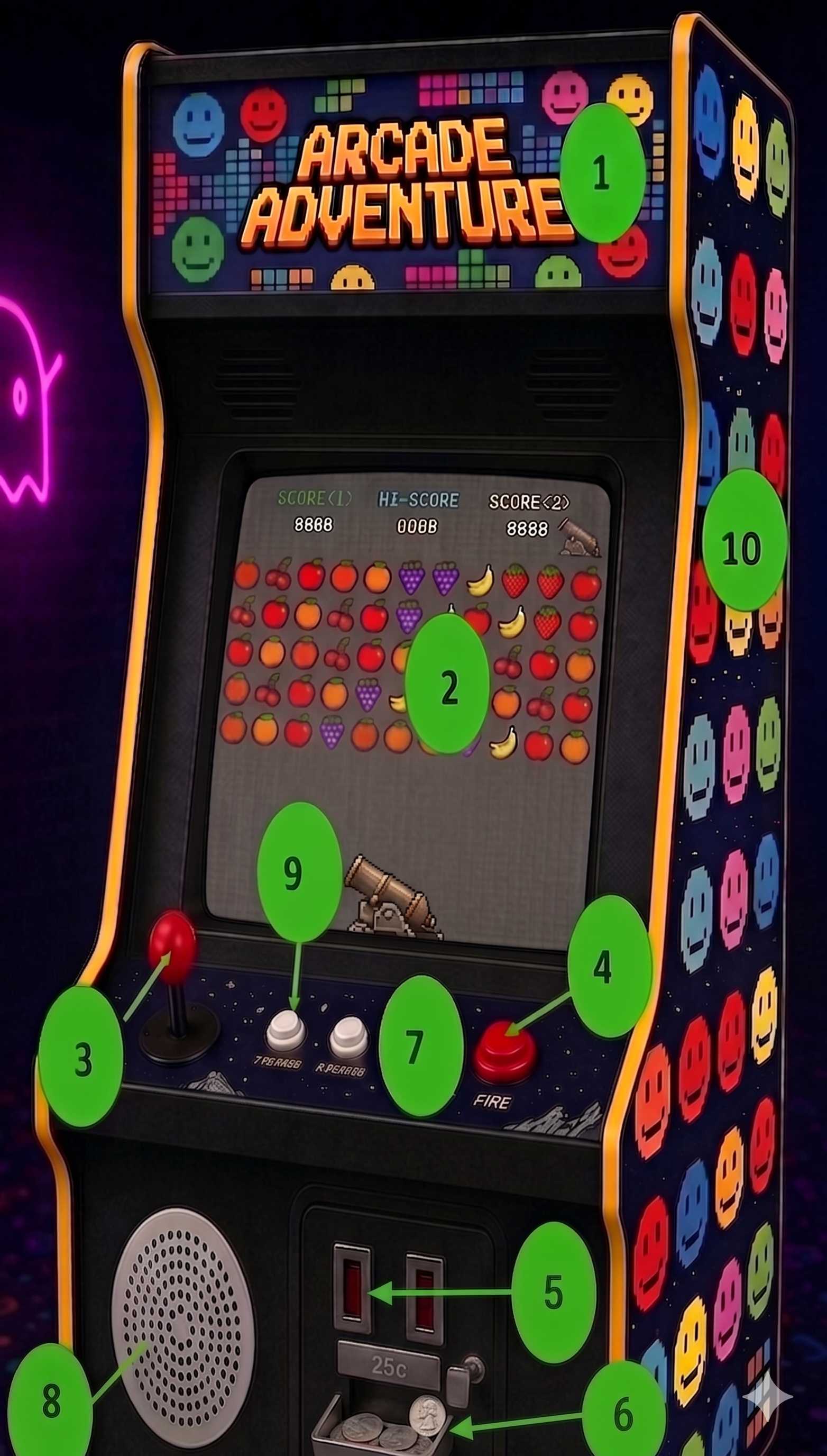
Sitting proudly at the very top of the game, the marquee is the glowing signboard designed to grab your attention from across a crowded, noisy arcade. Back in the day, this was the game's primary advertisement, practically shouting "Play me!" with its stylish graphics. For anyone (like my son) raised on modern consoles where games are selected from a silent digital dashboard, the marquee represents a wildly different era of gaming.
Instead of clicking an icon on a sleek user interface, players like myself were lured over by actual physical neon and glowing plastic. And no downloading involved.
2. Screen
The screen is the glowing heart of the machine where the action actually happens. To anyone who grew up swapping out modern Nintendo Switch cartridges or downloading terabytes of data onto a flat-screen TV, this piece of tech is probably hilarious. It was a massive, heavy glass tube that hummed with static electricity and gave off a distinct warmth if you stood too close.
Instead of crisp, smooth pixels, this screen relied on scanlines and a slight curve to warp reality, proving that you didn't need millions of colors and things like virtual reality or 3D images to have a "blast".
3. Joystick
The joystick was the ultimate tool in many of the arcade games like the one pictured. To a generation raised on Nintendo controllers featuring twin analog sticks, four trigger buttons, and a (too me) complex set of combinations, this lone stick with a red ball looks beautifully primitive.
The great part was you simply slammed it left or you slammed it right with pure, unadulterated wrist action. Built like a tank to survive the antics of us teenagers back in the day, this mechanical stick clicked loudly with every movement, offering a tactile, physical workout that a modern, ergonomic gamepad just can't duplicate in my opnion.
4. Action button
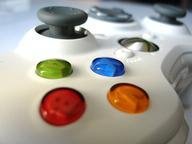
The action button (conveniently labeled "FIRE") was the one and only action needed in the game. My son always wondered why I could not get accustomed to his gaming controls with their complex button layouts requiring claw grips and combinations of X, Y, A, B, bumpers, and triggers.
This photo should help explain it. There was no crouching, sprinting, or inventory management; you pressed the button, and a pixel flew upward. It was designed for maximum durability and rapid-fire button pushing, ensuring that the only thing standing between victory and a "Game Over" screen was the sheer speed and stamina of your one finger.
5. Coin slot
Down on the lower half of the arcade game is the coin slot, the gatekeeper of the entire experience. To a modern gamer used to digital storefronts, subscription passes, or buying a game once and playing it forever, the coin slot represents a brutal, real time financial reality.
This was a purely physical transaction. You dropped your cold, hard quarter into that glowing orange slot, listened for the satisfying clink-clank as it cleared the mechanism, and instantly bought yourself some game time (often in the form of multiple lives).
It turned gaming into a high stakes sport where your playtime was directly tied to how many coins you brought to the arcade.
6. Coin return
Located toward the very bottom of the machine is the coin return. This is the arcade equivalent of a slot machine's payout tray. In today's gaming landscape, if a game rejects your digital payment (or your mother's payment not that I'm bitter) or experiences a glitch, you get a frustrating error code or an automated support ticket. Back then, you hopefully got your coin back.
The return was the place where bent quarters were unceremoniously spit back out, but more importantly, it was the focus of a classic arcade ritual of blindly diving your fingers into the plastic flap just in case a previous player forgot their change. For those of you that remember, it was the same case as a pay phone coin return.
7. Control panel
Spanning the middle section of the unit is the control panel, the physical dashboard where your hands do all the work. If you hand a modern controller to a group of friends, everyone goes and retreats to their own corner of the couch or room to play. The arcade control panel, however, was a shared piece of real estate that forced you to stand shoulder-to-shoulder with another player (if you were lucky enough to have a friend play a two-player game with you).
There were no wireless signals or personal boundaries here; just a sturdy, cigarette burn resistant (cigarette smoking was allowed in the arcade) slab of wood and metal where accidental elbow bumps and intense, shared adrenaline were all part of the local multiplayer experience.
8. Speaker
Positioned on the lower part of the unit is the speaker, the acoustic powerhouse responsible for the game's iconic soundtrack. Today's games wrap you in immersive, multi-channel audio through sleek wireless headsets or high-tech soundbars. Arcade speakers, on the other hand, were all about raw volume.
This single, metal-grilled mono speaker didn't care about subtle audio design; its job was to blast piercing electronic chirps, deep bass thuds, and other sound effects (like an alien nose) loud enough to cut through a chaotic room full of other loud machines.
It provided the ultimate auditory peer pressure, announcing your high-score run, or your embarrassing defeat, to the entire room.
9. Start buttons
Found right in the center of the unit are the start buttons (divided on this pictured example into 1-Player and 2-Player options). For a modern gaming player, pressing "Start" or "+" simply pauses the game, opens up an inventory menu, or lets you tweak your audio settings.
In the retro arcade world, these buttons had absolutely no pause functionality whatsoever. Once you pressed them, you were locked into the game. Their sole purpose was to officially commit your freshly deposited coins into actual gameplay, triggering that classic intro music many of us remember.
10. Cabinet
Tying the whole machine together is the cabinet itself, decorated with vibrant art to draw you into its world. In today's gaming ecosystem, a gaming system is designed to be as small, sleek, and portable as possible (my son carried his everywhere). The arcade cabinet was the exact opposite: a massive and heavy unit made of particle board, vinyl, and molding that took up real estate in the arcade.
It didn't just hold the game; it was the game, serving as a towering piece of functional neon art that turned playing a video game into a grand, physical event.
This quiz was reviewed by FunTrivia editor kyleisalive before going online.
Any errors found in FunTrivia content are routinely corrected through our feedback system.