FREE! Click here to Join FunTrivia. Thousands of games, quizzes, and lots more!
Lawmakers in Relief Trivia Quiz
The chamber in which the US House of Representatives sits has 23 relief portraits of famous lawmakers on its walls. Can you place names to these 12 faces?
Sir William BlackstoneThomas JeffersonSuleiman the MagnificentPope Gregory IXGeorge MasonMosesLycurgusMaimonidesEdward I of EnglandHammurabiSimon de MontfortJustinian I
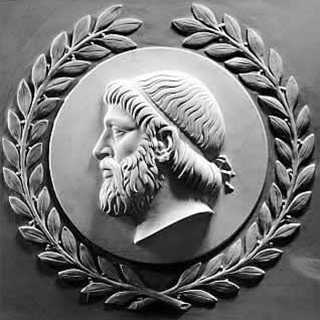
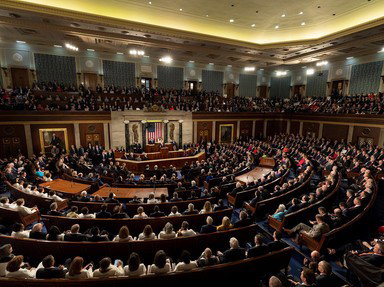
As you may be able to see in the cover photo for this quiz, the relief portraits are located around the wall, at the top of the balcony level. The space directly above the Speaker's chair (which is in front of the US flag) is blank. Moving clockwise, the first 11 images all have a left profile, while the last 11 face right. Only the middle image (Moses) is front-facing. This means that they are all facing the front of the room.
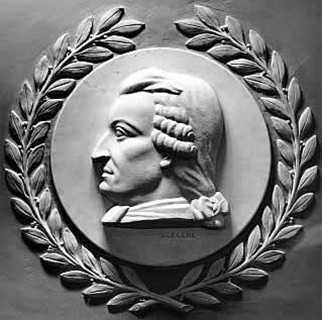
The first sculpture is that of George Mason (1725-1792), a Founding Father who was one of three delegates at the 1787 Constitutional Convention who refused to sign the Constitution. So why was he chosen to be memorialised in the seat of the US government? He was the principal writer of the Virginia Declaration of Rights, a 1776 document which later served as the basis for the United States Bill of Rights - the first ten amendments to the Constitution which addressed the issues which he felt made it impossible for him to support the original document.
The next spot features Robert Joseph Pothier (1699-1772), a French jurist whose extensive writings on Roman Law were used (sometimes verbatim) in the development of the French 'Code Civil'. Then comes Jean-Baptiste Colbert (1619-1683), French prime minister under Louis XIV who is most remembered for his theory (a variety of mercantilism) which had a lasting impact on the nation's economy. His work is said to have inspired Alexander Hamilton, the first US secretary of the treasury.
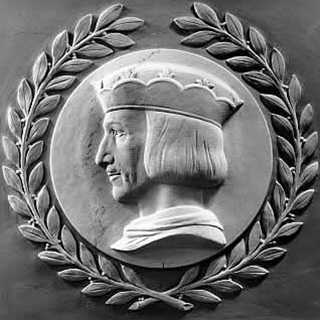
2. Edward I of England
The next position is occupied by Edward I of England (1239-1307), not because of his well-known military efforts but because of his work in codifying English law through the Statutes of Westminster published in 1275 and 1285 (although the documents were actually written primarily by Robert Burnell, his Lord Chancellor). Between them 101 chapters became what was referred to as Common Law. While most of the chapters have subsequently been repealed and replaced by statutes more suited to later societies, a few are still in force, including the requirement for free and fair elections.
One famous provision of the 1275 statute was the decree that any customary practice in force at the beginning of the reign of Richard I in 1189 stood, and dd not need to be substantiated by historical records of laws being made for the. This was later described as being "since time immemorial", a phrase that transferred to the US and Canada, but not necessarily with that specific date attached. It is a phrase frequently used in legal cases involving the rights of indigenous people.
Next around the wall comes Alfonso X (1221-1284) of Castile, who began to develop the 'Siete Partidas', a law code that was finally promulgated by his great-grandson. This remains an important part of the legal code in a number of states in the southwest part of the United States.
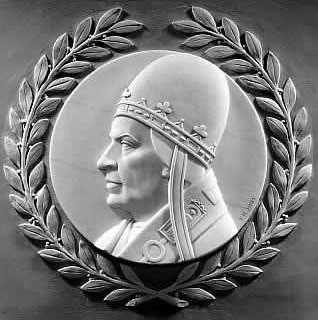
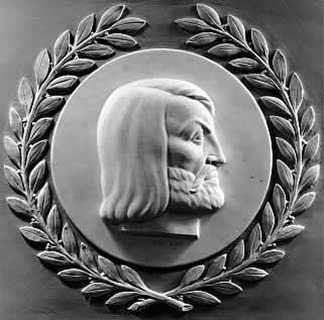
3. Pope Gregory IX
Pope Gregory IX (c. 1145-1241) is not included because he established the Spanish Inquisition, but because he was responsible for 'Decretales Gregorii IX', the main source for medieval Catholic canon law. He compiled a number of earlier documents, making modifications so as to eliminate contradictions and fill gaps. He gets the credit, but the actual legwork was done by his chaplain, Raymond of Penyafort; Gregory then edited and approved the compilation. The 'Decretales' were widely copied, with occasional changes as was inevitable before the first printed copy in 1582 was decreed by Pope Gregory XIII to be the definitive version. It remained in force until 1917, when it was abrogated by a new code (which carried over much of the previous one).
Louis IX of France (1214-1270) made significant reforms to the French legal system, abolishing trial by ordeal or by combat and establishing the presumption of innocence.
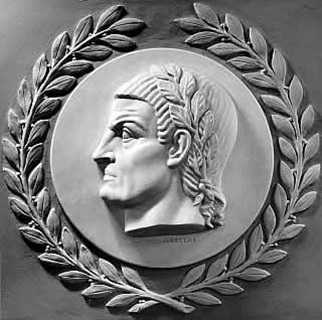
4. Justinian I
Justinian I (c. 482-565) was emperor of the Eastern Roman Empire (also known as the Byzantine Empire), based in Constantinople. His image is on the wall here because it was under this rule that the 'Corpus Juris Civilis' (Body of Civil Law), a collection and rewriting of Roman Law that is still the basis for civil (and ecclesiastical) law in many contemporary states, was compiled. Its four sections are therefore seen as foundation documents of Western law.
The work originally had three parts, the 'Codex', the 'Digesta Pandectae' and the 'Institutiones'. The Code basically compiled all imperial acts up to that time, the digest was a collection of opinions from Roman jurists, and the Institutes was a textbook providing a conceptual framework. While these three sections were planned to be the absolute definitive source for law reference, it became necessary to add more, creating a fourth section called the 'Novellae Constitutiones' (New Laws).
The original 'Corpus' was written in Latin, but translated into Greek when that became the official language of the Byzantine Empire. In that region, it had continuous effect, nut in the western part of what had been the Roman Empire it was pretty much ignored until the Middle Ages. Napoleon used the egal principles of the 'Corpus' as the starting point for developing the Napoleonic Code, which signaled the end of feudalism in Europe.
The next plaque shows Tribonian (c. 485-542), the legal advisor who was the primary person guiding the development of the 'Corpus'.
5. Lycurgus
Moving along, we come to the Spartan lawgiver Lycurgus - who may or may not have existed! Evidence of the details of his life as so scanty that there is no agreement on when he lived, with estimates ranging from the 11th century BCE to the 8th century BCE. He gained almost mythical status, at times seen as nearly a god, due to the extent of the impact of the changes attributed to him on Spartan society - although a number of them took place at times that are clearly later than when he could have lived. He was esteemed by a number of important 18th century thinkers whose philosophies influenced the Founding Fathers of the US for having built a stable state based on unity in communal interest - including (not all that accurately) universal education and the equality of citizens. ('Liberté, Égalité, Fraternité', anyone?)
John Adams (2nd US President) had a rather negative view of Lycurgus, considering him to have doomed his people to suffer in the cause of militarism. James Madison (4th US President), however, in 'Federalist Papers' (#63), cited him as having established an exemplary Constitution.
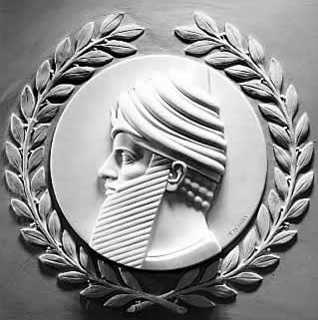
6. Hammurabi
The Babylonian king Hammurabi (c.1810-1750 BCE) has a name that will be familiar to many for the law code he issued, as part of centralising authority and uniting the entire region of Mesopotamia under Babylonian rule. The Code of Hammurabi is one of the oldest legal texts to have been discovered. Archaeological evidence of his reign unearthed in the late 19th century has led to him being considered one of the great figures in the history of law-making.
In 1901 French archaeologists unearthed the primary original text, carved in cuneiform on a basalt stele (a term used for various ancient pillar-like monuments) that stands 2.25 metres high. It can be seen in the Louvre. While the actual stele had long been mislaid (following its removal to Iran as war plunder around 1150 BCE), copies made by scribes abound, so the contents remained known in the region for several hundred years after that. The rediscovery of the Code caused great excitement, as its contents revealed a great deal about Babylonian society at the time, and showed an existing understanding of many aspects of legal theory that were further developed later. For example, the Mosaic concept generally described as 'an eye for an eye' can be found here.
The top section of the stele is a prologue that establishes the king's authority, based on dynastic inheritance and divine approval. The engraving of two figures is understood to be Hammurabi and the Babylonian god of justice, Shamash - although there is disagreement as to which figure is which! It is noted that the king's rule is intended 'to prevent the strong from oppressing the weak', an interesting position from a king who was known for his ruthlessness in warfare. This is followed by over 4,000 lines of text, laws covering areas from family law through property and commercial law to criminal law.
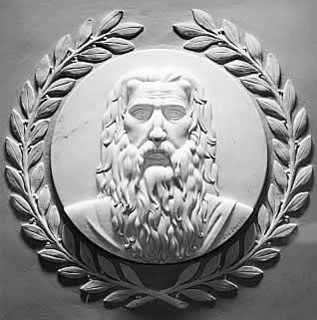
7. Moses
The plaque of Moses (c. 14th-13th century BCE) hangs directly opposite the seat of the Speaker of the House, and is the only one which is sculpted as a front view. The order of the plaques is not historical, and the prominent position given to Moses reflects the Judeo-Christian background to the US society at the time the plaques were installed as part of the renovations to the Capitol Building (1949-50).
Moses is the English name used for a prophet who is said to have led the Israelites out of captivity in Egypt, and led them to the land where they would establish their own nation. While scholars dispute as to whether all things attributed to him were actually the work of a single person, or whether the name came to be used by a number of people to establish an authentic link to the earlier events, Moses is the figure associated with the Mosaic Law. According to the scriptures of the various Abrahamic faiths, this was dictated to Moses by God. The term is first recorded being used in the Book of Joshua, written about 600 BCE, when the Law had been observed by the Jewish people for over 700 years.
Mosaic Law is recorded in the Torah (a word which means Law), the first five books of the Hebrew Bible. Christian scholars usually refer to them as the Pentateuch. The laws promulgated here differ significantly from the other laws recorded in the Middle East up to that time in that they describe the offences as being against god, not just against the society in which they occur. Many people would be familiar with such components as the Ten Commandments, even if only from popular culture references. There is much more, describing moral laws (murder, theft, honesty), societal laws (property, marriage), food laws (clean vs unclean foods food preparation), physical purity laws (menstruation, leprosy), and of course lots of details about explicitly religious observances.
The next plaque commemorates the Athenian Solon (c. 638-558 BCE), who developed a law code to replace the older one of Draco, credited as being one of the foundation steps for establishing Athenian democracy. Next is Papinian (142-212), one of the most respected jurists of ancient Rome. He is followed by Gaius (alive 130-180, but with no more accurate dates of birth and death known), a copious writer on the law who wrote 'Institutiones', a thorough exposition of Roman law around 160.
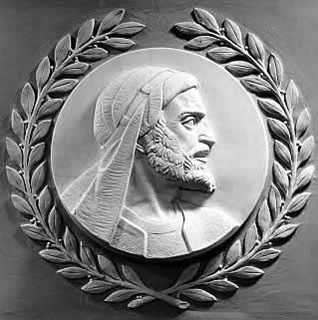
8. Maimonides
The Sephardic Jewish rabbi known as Maimonides (1135/38-1204) was one of the most prolific and authoritative scholars interpreting the Torah during the Middle Ages. His work remains a cornerstone of Jewish scholarship, and his 14-volume work 'Mishneh Torah', compiled while he was living in Egypt, is still seen to have canonical authority. His attempt to provide a complete summary of the Oral Law (those religious beliefs and practices based on tradition rather than scripture) was controversial at the time, as he sometimes drew different conclusion than those found in the Talmud.
The controversy were settled, at least in official eyes, by a declaration that Maimonides was the authority, as the many earlier contributors to the Talmud must have made a mistake in interpretation. This despite the fact that Maimonides, ostensibly in an effort to keep things as brief and clear as possible, did not provide sources for his work. His position was that his summary was more than enough for day-to-day decision making; in-depth study of the Talmud had spiritual benefits, for those so inclined, but would be too onerous for most people -who should nevertheless undertake as much study as they found suitable to their capacity.
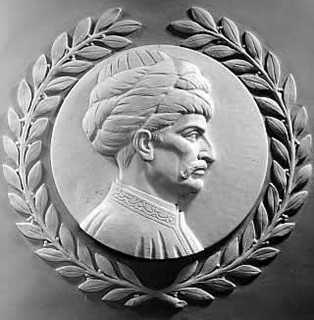
9. Suleiman the Magnificent
The Ottoman sultan Suleiman the Magnificent (1494-1566) may be most familiar due to his military exploits, but he was given the epithet 'Kanuni' (the Lawgiver) because of the major changes he made in the laws in his empire. Essentially, he sought to bring together the two disparate legal structures of sultanic law (Kanun) and Islamic law (Sharia).
Sultanic law in the Ottoman empire had developed to deal with civil areas over which the sultan had control, including land ownership, taxation, and some aspects of criminal law. Islamic law was seen as divine, and outside the powers of the sultan. Suleiman collected all the sultanic judgments that had been issued by the preceding Ottoman sultans, removed duplications, and sorted out which of any contradictory judgments to keep. He then compiled a single comprehensive code, carefully making sure that all was in line with Sharia. The 'Kanune Raya' thus produced lasted for over 300 years.
Beside Suleiman is the plaque of Pope Innocent III (1160/61-1216), included because of his significant impact on Western canon law. The fact that he used this to dominate civil states, that he was responsible for some egregious Crusades, and that his work included a number of strongly anti-Semitic elements does not seem to have been considered significant!
10. Simon de Montfort
Simon de Montfort, 6th Earl of Leicester, 1st Earl of Chester (c.?1208-1265) led the opposition to the English King Henry III that culminated in the Second Barons' War (1264-1267). While his forces were in control, he called two parliaments that had a lasting impact on subsequent parliaments. The first stripped the king of absolute authority, giving far more power to the parliament than had been the case. The second allowed town citizens to become members of parliament, not just the barons and knights. While the purpose of this extension is understood to have been getting more personal support in the representatives that gathered, it established a principle which has continued. As such, Simon de Montfort is seen as one of those responsible for the development of modern parliamentary democracy.
The Dutch jurist Hugo Grotius (1583-1645) is on the next plaque, there because of his role in establishing the principles of international law and the concept of human rights.
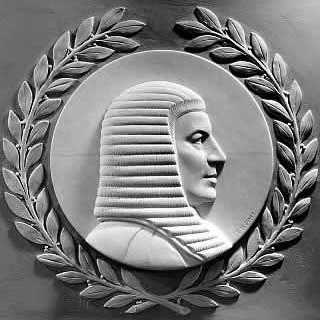
11. Sir William Blackstone
The English politician and jurist Sir William Blackstone (1723-1780) is best known for his 'Commentaries on the Laws of England', long considered the definitive exploration of English common law. Because common law relies on precedent of earlier judicial decisions, it is far more complex to summarise than is the case for civil law, which is based on written statues. Since English common law was established in the North American colonies, courts there relied on Blackstone's 'Commentaries' to provide meaningful point of reference. this continued even after the United States of America became an independent nation - in the 21st century Supreme Court decisions still refer to Blackstone when a decision needs to include a historical discussion that goes back beyond the nation's founding. They are relevant, for example, when it is necessary to consider the intent of the writers of the Constitution when the written words do not make the issue under debate explicit.
The 'Commentaries' is divided into four volumes, providing a coherent structure to the mishmash of decisions being compiled. First is 'The Rights of Persons', dealing with individuals from the monarch through peers, parliamentary members, religious figures, and more down to the individual citizen. Next comes 'The Rights of Things', the longest volume by far, dealing with property. The third volume, 'Of Private Wrongs', deals with torts (civil law); it is followed by 'Of Public Wrongs', dealing with criminal law.
The penultimate plaque shows Napoleon Bonaparte (1769-1821), the French emperor who was responsible for the development of the Napoleonic Code, which (heavily amended over the years) is still the French civil law code. the structure of the Code was based, not on previous French laws, but on Justinian's 'Corpus Juris Civilis' - remember him? While most states of the United States base their legal system on English common law, Louisiana (with a long history of French and Spanish rule) includes many elements of the Napoleonic code.
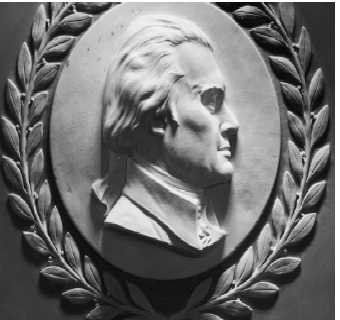
12. Thomas Jefferson
Lucky last in our circuit of the House chamber is Thomas Jefferson (1743-1826), third President of the United States and primary author of the United States Declaration of Independence (1776) and the Virginia Stature for Religious Freedom (1777).
Jefferson was one member of the Committee of Five tasked by the Second continental congress with writing the Declaration of Independence, chosen to be the primary author because of his legal background and (according to John Adams) his skill at writing. He drew on ideas already being proposed, both by philosophers of the Enlightenment such as Locke, Montesquieu and Rousseau, and leaned heavily on his own draft for a constitution for the state of Virginia, and George Mason's draft of a Virginia Declaration of Rights. Other committee members edited his text, the Congress made more changes during its debate on the resolution, it was finally ratified on 4 July 1776 and signed on 2 August. This act of high treason against the Crown committed the colonists irrevocably to war.
"We hold these truths to be self-evident, that all men are created equal, that they are endowed by their Creator with certain unalienable Rights, that among these are Life, Liberty and the pursuit of Happiness."
This quiz was reviewed by FunTrivia editor stedman before going online.
Any errors found in FunTrivia content are routinely corrected through our feedback system.