FREE! Click here to Join FunTrivia. Thousands of games, quizzes, and lots more!
Translating 'Y Ddraig Goch' Trivia Quiz
The Red Dragon
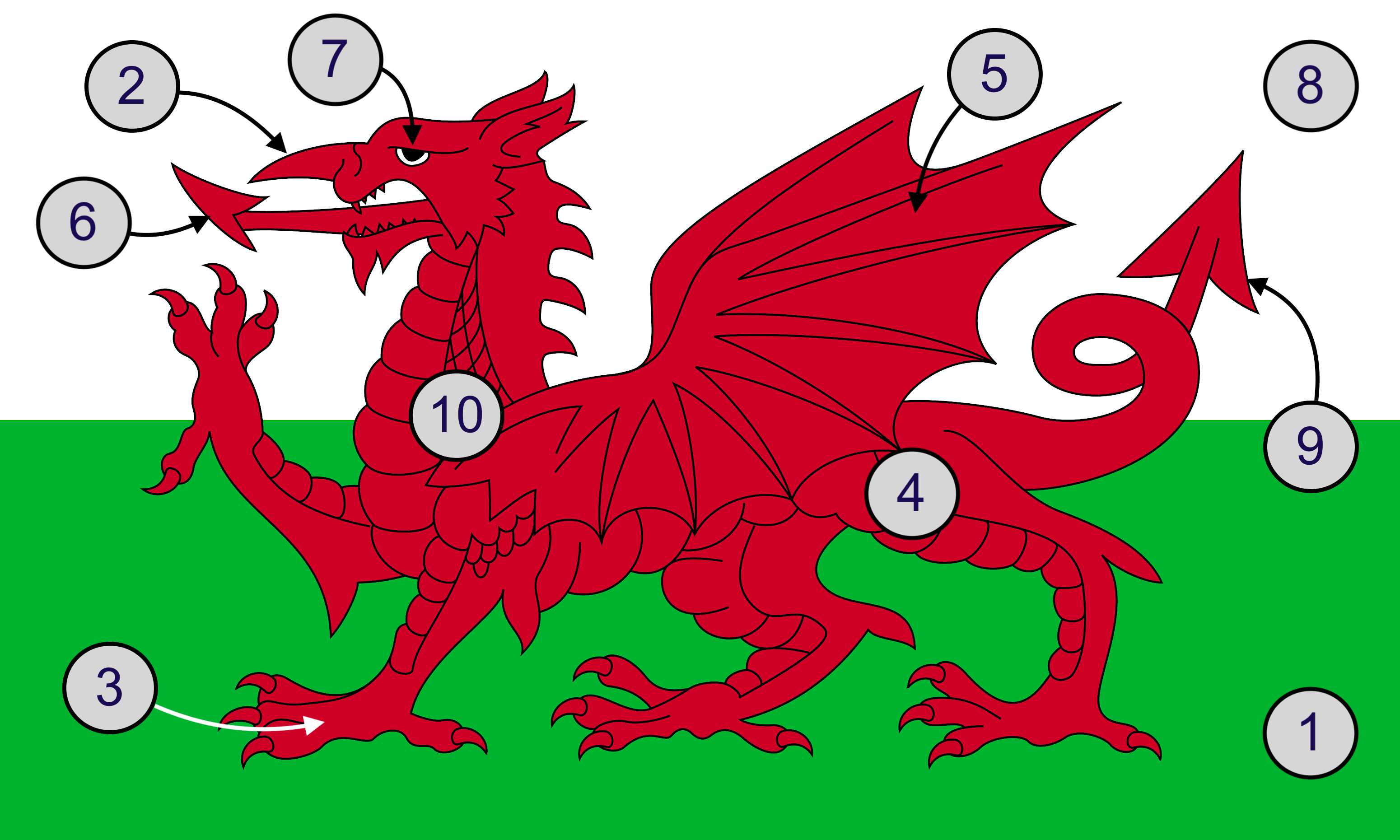
Perhaps I am biased but the Welsh flag is surely one of the world's best? Can you pick out the Welsh words relevant to ten selected features of the magnificent flag known as 'Y Ddraig Goch' or in English, 'The Red Dragon'. Pob lwc (good luck)!
A label quiz
by jonnowales.
Estimated time: 3 mins.
Last 3 plays: Dizart (10/10), rossian (10/10), Strike121 (2/10).
Click on image to zoom
GwyrddDraigTrwynCynffonGwynAdainCochTafodTroedLlygad* Drag / drop or click on the choices above to move them to the answer list. View Image Attributions for This Quiz
The Welsh word for the colour green is "gwyrdd" and the strip of "gwyrdd" on the Welsh flag does a lot of heavy lifting on the historical and symbolic fronts. A fairly surface level inspection of the flag lends itself to the straightforward interpretation of the green strip being a representation of the nation's beautiful countryside, a feature of the country also referenced - within the context of mining and industrialisation - by the film 'How Green Was My Valley' (1941).
Green runs much deeper culturally, however, with the colour representing historic heroism (Welsh soldiers wore green and white at the Battle of Crécy in 1346) as well as being of great significance to the Tudor dynasty, most notably to Henry VII who was born in Pembroke Castle in 1457.
2. Trwyn
The Welsh word "trwyn" can be used in a number of ways including to describe a cape (in the geographical sense) as well as, in the anatomical sense that we are interested in here, the nose. Welsh (Cymraeg) is closely related to Cornish (Kernewek) and they both belong to the Brythonic branch of Celtic languages.
It is therefore not a surprise that a modern Cornish word for nose, "tron", is similar to the equivalent word in Welsh.
3. Troed
"Troed" is the common Welsh word for foot. As well as being anatomically useful, "troed" is used in place names to refer to the fact that the named location is at the foot of a geographical feature such as a hill or mountain. One such example from the South Wales valleys is the village of Troed-y-rhiw near Merthyr Tydfil; its literal translation into English is "foot of the slope".
4. Coch
As mentioned in the introduction to the quiz, the Welsh flag goes by the name of 'Y Ddraig Goch' or, when translated into English, 'The Red Dragon'. One of the unusual features of the Welsh language is the concept of mutation; in order to maintain the flowing, melodic quality of spoken Welsh, the spelling of certain words can - in certain circumstances - change or mutate.
The word for red in Welsh is "coch" but this can mutate to "goch" to make phrases such as 'Y Ddraig Goch' much easier to say. If this mutation isn't applied, a speaker would have to jarringly switch from a hard "g" sound to a hard "c" sound; with the mutation, the first "g" seamlessly rolls into the second "g".
5. Adain
On the flag of Wales, the dragon sports an impressive set of wings. In Welsh, the word for wing is "adain" and it has a complicated array of plural forms, though a commonly used plural would be "adenydd". This plural form gives away the fact that an alternative Welsh word for wing is "aden". "Adain" can also be used to refer to a political wing or faction (right and left wing, for example).
6. Tafod
The dragon on the Welsh flag famously pokes out its tongue - or "tafod" - and this part of the flag is of importance to Cymdeithas yr Iaith Gymraeg (the Welsh Language Society). The organisation's logo features an abstract "tafod" which celebrates the physical and symbolic link between the tongue, speech and language.
Naturally, the society has historically made abundant use of the colour red in its logo and broader branding.
7. Llygad
On the surface, "llygad" follows the same pattern as other Brythonic languages in the respective words for eye commencing with the letter "l" ("lagas" in Cornish and "lagad" in Breton). This is, however, a deception! "Llygad" actually begins with "ll", a digraph which is notoriously tricky to pronounce.
The convention in Welsh is, when required, to capitalise just the first letter of the digraph rather than both ("Llygad" not "LLygad"). This is in contrast to the Dutch "ij" digraph which is conventionally capitalised as "IJ" (IJsselmeer, for example).
8. Gwyn
"Gwyn" is the Welsh word for white, but it is also a fairly common name for men, particularly in parts of the nation with higher numbers of Welsh speakers. In Welsh mythology, Gwyn ap Nudd was the ruler of Annwn (the Otherworld), a utopian realm of youth, beauty and abundance. Variations of the Otherworld also feature in the broader set of Celtic mythologies.
White ("gwyn") and green ("gwyrdd") are a common colour pairing in Welsh culture, a fact reflected in the use of the leek as one of the nation's emblems.
9. Cynffon
"Cynffon" is the word we are looking for to successfully translate tail into Welsh. It is the most appropriate word in the Welsh lexicon when describing large tails whereas "cwt" is a synonym that can also be used alongside "cynffon" for short tails (in particular the scut-like tails of animals such as rabbits and deer).
"Cynffon" is quite a versatile word as it can also be used to refer to non-anatomical tails (such as those present in comets and letters) and to figuratively express a logical conclusion of the form "it follows".
10. Draig
It would be unforgivable to not mention the star of the show, 'Y Ddraig Goch'! The translation of dragon into Welsh is "draig" but it can mutate into "ddraig" where the flow of the language dictates it. "Dd" is a digraph which sounds similar to "th" in English words such as "this" and "that".
In older manuscripts, "dd" is often seen expressed instead by eth (ð), a symbol also seen in Old English. Eth is still present in the Icelandic language to represent the aforementioned "th" sound.
This quiz was reviewed by FunTrivia editor trident before going online.
Any errors found in FunTrivia content are routinely corrected through our feedback system.