FREE! Click here to Join FunTrivia. Thousands of games, quizzes, and lots more!
Quiz about Owl You Need to Know

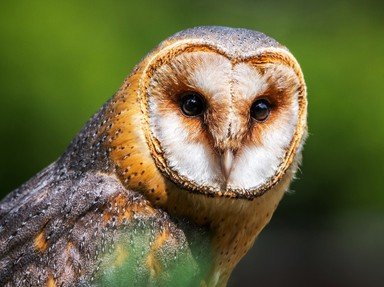
Owl You Need to Know Trivia Quiz

10 Facts About Owls

For those of us who give a hoot, here are ten questions about owls. Are you as wise as an owl?
This is a renovated/adopted version of an old quiz by author barredowl555

A photo quiz by trident. Estimated time: 3 mins.
  1. Home
  2. »
  3. Quizzes
  4. »
  5. Animal Trivia
  6. »
  7. Specific Bird Species
  8. »
  9. Owls

Author
trident
Time
3 mins
Type
Photo Quiz
Quiz #
359,681
Updated
Apr 29 26
# Qns
10
Difficulty
Average
Avg Score
8 / 10
Plays
604
Awards
Top 5% quiz!
Last 3 plays: mulligas (8/10), Guest 24 (10/10), Guest 68 (10/10).
-
Question 1 of 10
1. All owls belong to the order Strigiformes, which is comprised primarily of which of these kinds of birds? Hint


Question 2 of 10
2. Unlike many birds that hunt, owls have two forward-facing eyes as opposed to eyes located on opposite sides of their heads. What is this front-facing kind of vision known as? Hint


Question 3 of 10
3. Humans can generally rotate their necks (to one side) anywhere from 60 to 90 degrees. Owls can do it up to 270 degrees. What is one of the main reasons that owls are far superior in this regard?


Question 4 of 10
4. In most owl species, the female is physically larger than the male.


Question 5 of 10
5. Interestingly, in some species of owl such as the barn owl, a certain body part develops asymmetrically in size and location so as to aid it while hunting. Which body part is it? Hint


Question 6 of 10
6. Owl plumage often utilizes camouflage to both protect the owls from predators as well as hide from prey. What is the more general term in ecology for this kind of adaptation? Hint


Question 7 of 10
7. The vast majority of owls are active at night, but the burrowing owl is an exception. What is the term for animals that are active during the day? Hint


Question 8 of 10
8. Pictured are the talons of a barn owl. What adaptation do owls have that set them apart from other raptors and give them an advantage while hunting?


Question 9 of 10
9. Owls have a tendency to swallow their prey whole, later regurgitating the indigestible parts of the animals. One can come across one of these masses, known as what in the ornithological word? Hint


Question 10 of 10
10. Like many animals, owls have a translucent third eyelid that helps protect their eyes and keep them moist. What is this third eyelid called?


(Optional) Create a Free FunTrivia ID to save the points you are about to earn:

arrow Select a User ID:
arrow Choose a Password:
arrow Your Email:


View Image Attributions for This Quiz

Most Recent Scores
May 02 2026 : mulligas: 8/10
Apr 26 2026 : Guest 24: 10/10
Apr 24 2026 : Guest 68: 10/10
Apr 20 2026 : sciencenerd05: 10/10
Apr 17 2026 : Guest 174: 10/10
Apr 13 2026 : Guest 90: 5/10
Apr 12 2026 : Guest 86: 4/10
Apr 09 2026 : Guest 174: 10/10
Apr 09 2026 : Guest 75: 8/10

Quiz Answer Key and Fun Facts
1. All owls belong to the order Strigiformes, which is comprised primarily of which of these kinds of birds?

Answer: nocturnal birds of prey

All owls fall under the order Strigiformes, a classification that includes over 200 species. Members of this group are defined by features such as large forward-facing eyes, sharp talons, and an almost silent flight pattern. Well-known examples include the barn owl, the great horned owl, the snowy owl, and the barred owl.

Built for nocturnal hunting, owls rely heavily on both vision and hearing to track prey like rodents, birds, and insects. Their facial disk, made up of specialized feathers, funnels sound toward their ears and helps them pinpoint movement. At the same time, their feather structure reduces noise in flight, allowing them to approach targets without detection.
2. Unlike many birds that hunt, owls have two forward-facing eyes as opposed to eyes located on opposite sides of their heads. What is this front-facing kind of vision known as?

Answer: binocular vision

Unlike many birds of prey, owls have forward-facing eyes, a trait that gives them binocular vision. This type of vision allows both eyes to focus on the same object, improving depth perception and making distance judgments far more precise.

With that improved depth perception, owls can strike prey with remarkable accuracy. A wider combined field of view also helps them stay aware of their surroundings. Because both eyes are trained on a single target, they gather more light and detail, which is especially useful in low-light conditions.
3. Humans can generally rotate their necks (to one side) anywhere from 60 to 90 degrees. Owls can do it up to 270 degrees. What is one of the main reasons that owls are far superior in this regard?

Answer: Owls have double the neck vertebrae.

This extreme flexibility comes down to anatomy. Owls have 14 neck vertebrae, double the number found in most mammals. In addition, their pivot system differs significantly; instead of two vertebrae per pivot point, they have one, which increases rotational range.

Their circulatory system is also adapted for this motion, with arteries that include extra loops to maintain steady blood flow even when the neck is twisted.
4. In most owl species, the female is physically larger than the male.

Answer: True

In many owl species, females are noticeably larger than males. This size difference, known as sexual dimorphism, plays an important role in survival and reproduction.

Larger females are better equipped to handle the physical demands of egg production and incubation. They also tend to spend more time caring for offspring, so increased size can help with both endurance and nest defense. Within owl pairs, this division of labor makes the size imbalance functionally useful.
5. Interestingly, in some species of owl such as the barn owl, a certain body part develops asymmetrically in size and location so as to aid it while hunting. Which body part is it?

Answer: ears

In certain owl species, including the barn owl, the ears develop asymmetrically, both in size and placement. One ear sits slightly higher than the other, creating an offset that turns out to be extremely useful. Because of this arrangement, sound reaches each ear at slightly different times.

The owl's brain processes that delay to determine the exact location of a sound source. For a nocturnal hunter, this level of auditory precision is invaluable, especially when prey is hidden in darkness.
6. Owl plumage often utilizes camouflage to both protect the owls from predators as well as hide from prey. What is the more general term in ecology for this kind of adaptation?

Answer: crypsis

Owl plumage often serves a dual purpose: avoiding predators and staying hidden from prey. In ecological terms, this strategy is called crypsis.

Through coloration and patterning, owls blend into their environments with impressive effectiveness. A tawny owl, for instance, can disappear against tree bark due to its mottled feathers. Their plumage also disrupts their outline, making them harder to detect. Beyond visual camouflage, silent flight and nighttime activity further reinforce this concealment strategy, allowing owls to hunt efficiently while remaining largely unnoticed.
7. The vast majority of owls are active at night, but the burrowing owl is an exception. What is the term for animals that are active during the day?

Answer: diurnal

Although most owls are active at night, not all follow this pattern. Some species, such as the burrowing owl, are active during the day; animals with this behavior are described as diurnal.

Burrowing owls, which live in open areas like grasslands and deserts, often hunt in daylight. They tend to avoid the hottest parts of the day but remain active when conditions are manageable. Their prey includes insects, small mammals, and even small birds. Unlike their nocturnal relatives, they do not depend on darkness to hunt successfully.
8. Pictured are the talons of a barn owl. What adaptation do owls have that set them apart from other raptors and give them an advantage while hunting?

Answer: reversible outer toe

Owls possess a distinctive adaptation that sets them apart from most other raptors: a reversible outer toe. This toe, typically the third, can rotate to face either forward or backward.

This flexibility allows owls to adjust their grip depending on the situation. When capturing prey, they can position all four talons forward for a stronger hold. Alternatively, rotating the toe backward improves stability while perching. Although this trait is strongly associated with owls, it is not entirely unique; ospreys also share this feature.
9. Owls have a tendency to swallow their prey whole, later regurgitating the indigestible parts of the animals. One can come across one of these masses, known as what in the ornithological word?

Answer: pellets

When owls eat, they usually swallow their prey whole, including bones, fur, and feathers. Since their digestive systems cannot break down all of these materials, they rely on a different process to handle the leftovers.

Indigestible parts are compressed into a compact mass inside the stomach. Later, the owl regurgitates this mass, known as a pellet. These pellets are often cylindrical and contain recognizable remains such as bones and teeth, making them useful for studying an owl's diet.
10. Like many animals, owls have a translucent third eyelid that helps protect their eyes and keep them moist. What is this third eyelid called?

Answer: nictitating membrane

Like many animals, owls have a third eyelid, a translucent layer that helps protect and maintain their eyes called the nictitating membrane.

Positioned beneath the standard eyelids, it can sweep across the eye's surface without fully blocking vision. Its functions include shielding the eye from debris, keeping it moist, and spreading tear fluid evenly across the cornea. Because of this, owls can maintain visual clarity while still protecting their eyes during flight or while capturing prey. Although common among birds, reptiles, and amphibians, this feature is largely absent in primates, including humans.
Source: Author trident

This quiz was reviewed by FunTrivia editor rossian before going online.
Any errors found in FunTrivia content are routinely corrected through our feedback system.
5/9/2026, Copyright 2026 FunTrivia, Inc. - Report an Error / Contact Us