FREE! Click here to Join FunTrivia. Thousands of games, quizzes, and lots more!
Quiz about Uncovering Hooters Barred Owls

Uncovering Hooters: Barred Owls Quiz


The first in a series of quizzes on owl species without their own quizzes. Beautiful, secretive residents of America's northern forests, barred owls are the first bird I think of when someone says "owl." Let's learn a little about their life history.

A photo quiz by etymonlego. Estimated time: 3 mins.
  1. Home
  2. »
  3. Quizzes
  4. »
  5. Animal Trivia
  6. »
  7. Specific Bird Species
  8. »
  9. Owls

Author
etymonlego
Time
3 mins
Type
Photo Quiz
Quiz #
423,625
Updated
Apr 08 26
# Qns
10
Difficulty
New Game
Avg Score
7 / 10
Plays
11
Last 3 plays: Guest 68 (4/10), GoodwinPD (10/10), Guest 99 (5/10).
-
Question 1 of 10
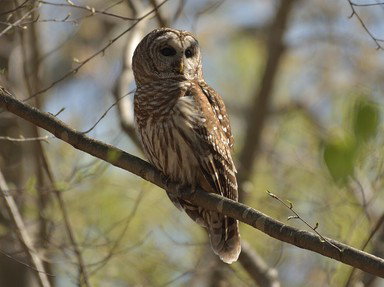
1. To my eternal dismay, someone decided to name BARRED owls so similarly to BARN owls that my weak powers of diction can scarcely differentiate them. What bars give the barred owl their name? Hint


Question 2 of 10
2. Barred owls are one of the few American owls with dark eyes, rater than yellow. This is a clue that barred owls are...


Question 3 of 10
3. The call of the barred owl is one of the most recognizable, partly because every birder knows the mnemonic used to remember it. Do you know it? Hint


Question 4 of 10
4. Barred owls are big, but they're not the biggest birds in the night sky. Which other raptor is known to prey on the barred owl? Hint


Question 5 of 10
5. In the Pacific Northwest, the U.S. Fish and Wildlife Service has asked citizens to shoot hundreds of thousands of barred owls. What are they trying to stop? Hint


Question 6 of 10
6. Let's practice your owl ID skills! Here are four common North American owl species (and don't worry, I left out the spotted owl this time). Which is the barred owl? Hopefully by now this quiz has taught you a couple of clues to spot it. Remember to click on the image if you'd like a closer look. Hint


Question 7 of 10
7. When you're on the owl prowl, it helps to remember that other birds have much more experience locating them than does humanity. "Mobbing" is a behavior (demonstrated here by a red-winged blackbird and a heron) where smaller birds gang up on an unwanted visitor. What birds are well known for "mobbing" barred owls, and could help you spot one? Hint


Question 8 of 10
8. Another clue to finding a barred owl is to look for owl pellets. Owl pellets are the remains of food that have been...


Question 9 of 10
9. When it comes time to settle down and build a nest, what word describes a barred owl's habits? Hint


Question 10 of 10
10. No bird tests the ethics of birdwatchers quite the way owls do. They are some of the most sought-after birds in the woods and some of the most sensitive to our activities. Three of these are common stress responses in owls. Which does NOT suggest stress? Hint


(Optional) Create a Free FunTrivia ID to save the points you are about to earn:

arrow Select a User ID:
arrow Choose a Password:
arrow Your Email:


View Image Attributions for This Quiz

Most Recent Scores
Today : Guest 68: 4/10
Today : GoodwinPD: 10/10
Today : Guest 99: 5/10
Today : jackslade: 7/10
Today : demurechicky: 7/10
Today : sluggo13: 5/10
Today : Guest 216: 6/10
Today : teachdpo: 7/10
Today : Aph1976: 3/10

Quiz Answer Key and Fun Facts
1. To my eternal dismay, someone decided to name BARRED owls so similarly to BARN owls that my weak powers of diction can scarcely differentiate them. What bars give the barred owl their name?

Answer: The vertical stripes on their front

Barred owls have vertical lines that break up a paler front, and tiny white dapples across their dark brown back. Their scientific name is Strix varia, "varia" in reference to the fairly wide range of patterns possible on their back and chest, as well as the amount of feathers on their extremities. At least two subspecies have been split off as entirely separate species: the fulvous and cinereous owls (their names mean "reddish" and "ash-colored" respectively).

Barn and barred owls share much of their American range, so the confusion is not for nothing. The name may also dismay any vexillologists, for whom bars are horizontal and stripes are vertical. Wing bars are an extremely common field mark, differentiating some birds from closely similar species, but they aren't prominent in barred owls.
2. Barred owls are one of the few American owls with dark eyes, rater than yellow. This is a clue that barred owls are...

Answer: Strictly nocturnal (hunt at night)

Whereas owls with orange or yellow eyes tend to hunt at dawn, dusk, or even in daylight, barred owls are among the most strictly nocturnal of owl species. (Of course, that doesn't mean an owl can't get woken up from a nap and poke its head out during the day, but hunting is highly unusual.) Guides and illustrations tell me the eyes are a dark brown, but to me they seem to look pitch black.

Noting the eye color of an owl can narrow down your options quickly. I am once again saddened to tell you that the one other widespread North American owl with black eyes is the barn owl, so their eye color will do little to help verbal confusion. The good news: barn owls are pale, and their fronts will have either black speckles or be unmarked. A barred owl will always have those prominent bars.
3. The call of the barred owl is one of the most recognizable, partly because every birder knows the mnemonic used to remember it. Do you know it?

Answer: Who cooks for you, who cooks for you all?

As any grade schooler knows, the sillier the mnemonic, the easier it is to remember. I'm not sure why barred owls want to know so much about our division of labor, but these little vocal patterns make memorizing bird calls so much simpler. Compared to the great horned owl, the most owly-sounding owl, the barred owl's call is more complex, variable, and has a reedier timbre to it.

They might also make monkey-like calls to each or to scare away unwanted trespassers, like, uh, you. Believe me, on a dark trail at night, they can do an excellent job at scaring you.
4. Barred owls are big, but they're not the biggest birds in the night sky. Which other raptor is known to prey on the barred owl?

Answer: Great horned owl

If you're out owling, you'll routinely find great horned owls perched on the top of the tallest pine trees. They are the lords of the moonlit forest, and even barred owls cower before them. You'll usually find barred owls somewhere in the middle of the canopy, to protect themselves from these predators. Very small owls, like the saw-whet and boreal owls, are famously hard to spot, partly because they roost close to the trunks of thick trees.

I haven't been able to write a question about the barred owl's diet because I haven't found something that they won't try to eat. Yes, they prefer mice, squirrels, and rabbits, but they'll also eat other birds lizards and snakes, bats, weasels, crawdads, and fish. Rarely, they can take opossum, raccoons, skunk, and even other raptors. Both small hawks and other owls are occasionally taken.
5. In the Pacific Northwest, the U.S. Fish and Wildlife Service has asked citizens to shoot hundreds of thousands of barred owls. What are they trying to stop?

Answer: Outcompeting of local birds

The range of barred owls, America's second most common owl after the great horned owl, has only recently expanded westward into that of the spotted owl. Spotted owls are very similar to barred owls - bonus points if you noticed that the photo is actually a spotted, not a barred, owl. Even the owls get confused sometimes, and hybrids have been found. But the bigger danger than cross-breeding is that spotted owls are meeker than the territorial barred owls, which has put pressure on this already vulnerable species.

While no plan has been finalized at time of writing, the FWS has pushed to allow people to cull the barred owls. Conservation comes at a cost, and in this case, we must choose between intervention or possible extinction. Both have ethical disadvantages. There is an argument to be made that it's not our place to dictate which of two species ought to dominate, but it's also true that human logging attracted barred owls to the region in the first place. Do we have a responsibility to undo our actions, or a responsibility to leave well enough alone?
6. Let's practice your owl ID skills! Here are four common North American owl species (and don't worry, I left out the spotted owl this time). Which is the barred owl? Hopefully by now this quiz has taught you a couple of clues to spot it. Remember to click on the image if you'd like a closer look.

Answer: B

The answer is B, for barred owl! Choice A is that pesky barn owl again - they too have black eyes, but their pale appearance and characteristic, pronounced beak make them stand out in a crowd. The cutie in spot D is a saw-whet owl, which are much smaller.

In my neck of the woods, short-eared owls are the closest lookalike. As you can tell by the photo, short-eareds, unlike their long-eared cousins, may have not have visible head tufts at all. The dead giveaway that they are not barred owls is their golden eyes.
7. When you're on the owl prowl, it helps to remember that other birds have much more experience locating them than does humanity. "Mobbing" is a behavior (demonstrated here by a red-winged blackbird and a heron) where smaller birds gang up on an unwanted visitor. What birds are well known for "mobbing" barred owls, and could help you spot one?

Answer: Crows

Crows are the mob bosses, particularly when it comes to raptors. In fact, Audubon's online guide lists barred owls as "About the size of a Crow" - though this even match-up is the exception and not the rule. Smaller birds, such as chickadees, are famous mobbers, and other birds know to respond to chickadees, either by joining the mob or fleeing at their tip-off. Both chickadees and crows are intelligent, gregarious, widespread, and highly vocal birds, and smart birdwatchers listen up for their commotion down the trail. It pays to be on the mob's good side.

It's surprising that even one tiny bird can shoo off a huge predator. Keep in mind that barred owls are ambush predators. There isn't too much to fear from an owl you can see coming all the way across a field, especially if you've got any way of hurting it. An owl chased by a chickadee must feel like the Karate Kid trying to catch a fly with chopsticks.
8. Another clue to finding a barred owl is to look for owl pellets. Owl pellets are the remains of food that have been...

Answer: regurgitated.

Calling owls "cats with wings" (if pigeons are "rats with wings") is apt in lots of ways. For one, they both produce hairballs! O.K., owl pellets include lots of other matter - the closer you inspect any owl pellet picture, the worse it gets - but on first impression they kind of look like a teddy bear's ripped out stuffing. Pellets are expelled from the bird's beak, rather than the, uh, other end.

With skill that I do not posses, it's possible to match the owl to its leavings. Those of barred owls are lighter gray than the soot-colored barn owls. You can mail-order educational kits to receive your very own pile of owl regurgitations, if you wish to dissect them and inspect last month's dinner. (I'll stick to tracking owls by ear, thanks.)
9. When it comes time to settle down and build a nest, what word describes a barred owl's habits?

Answer: Sedentary, controlling small territories for years

Barred owls are sedentary, which in this context refers to their migrations, not their exercise habits. Barred owls don't migrate or travel far. The Cornell Lab of Ornithology banded and relocated 158 owls, and found every single one of them less than 6 miles from where they were before. Contrast that with - what else? - barn owls, which have been found with food in their bellies from over 300 miles away!

Barred owls are known to "borrow" old nests or drays from other animals, especially crows, squirrels, and red-tailed hawks. They only need the nests for the breeding season, so in some places, between breeding seasons, the owls might alternate the exact same nesting location with red-shouldered hawks. Apparently, the owls are really bad houseguests - the owls tear the nests, abandon them, and leave them to the hawks to fix!
10. No bird tests the ethics of birdwatchers quite the way owls do. They are some of the most sought-after birds in the woods and some of the most sensitive to our activities. Three of these are common stress responses in owls. Which does NOT suggest stress?

Answer: Avoiding eye contact

It's tricky to read owls - as the wrong answers suggest, two exactly opposite responses can both indicate stress! Puffing out its feathers, hunching its back, or fanning its wings behind its head in imitation of a frilled lizard, all make the owl appear larger, standard intimidation stuff. Another stress response is for owls to freeze in place, especially if they are watching you. The good news is that common sense prevails with eye contact. If an owl is ignoring you, it's probably content!

The most important goal when observing an owl is never to flush it - that is, prompt it to fly out of its hiding spot. As mentioned, owls are easily mobbed, and a flushed owl sticks out like pink at a funeral. You could potentially drive the owl to leave the area altogether.

In writing this quiz, I was sad to discover how easy it is to find photos and "action shots" of obviously stressed owls. I hope the culprits were simply unaware of their bad actions, and didn't flush them deliberately. Please don't bother a real animal for the sake of having a pretty one on your wall.
Source: Author etymonlego

This quiz was reviewed by FunTrivia editor rossian before going online.
Any errors found in FunTrivia content are routinely corrected through our feedback system.
4/8/2026, Copyright 2026 FunTrivia, Inc. - Report an Error / Contact Us