FREE! Click here to Join FunTrivia. Thousands of games, quizzes, and lots more!
Alpha and Omega Trivia Quiz
First and last books in classic series
Alpha and omega are the first and last letters of the Greek alphabet, and often used to symbolise the beginning and end of something. Can you match the first book in the series (on the left) to the last book of the same series (on the right)?
A matching quiz
by Lottie1001.
Estimated time: 3 mins.
"Swallows and Amazons" was the first of the twelve books completed by Arthur Ransome in his series of stories about a group of children who loved sailing adventures. The title is taken from the names of the two sailing boats crewed by the Walker children and the Blackett girls one summer in the Lake District in northern England. It was first published in 1930, and was one of five books set there. Three of them are also summer stories with sailing and camping adventures, while one is set in the winter, when the children can go sledding and skating.
Four of the other books in the series were set in eastern England. Two involve sailing on the Norfolk Broads; one has the children exploring an island on the Suffolk coast; the fourth sees four of the children sailing across the North Sea to the Netherlands.
The remaining three books took them further afield, although there is some thought that "Peter Duck", set in the West Indies, and "Missee Lee", set on the Chinese coast, were intended as stories, made up by the children, of adventures they would like to have had.
The last completed book of the series, "Great Northern?", published in 1947, is set on the coast of the Scottish Highlands. The title refers to a rare bird, which they might, or might not, have found nesting there.
2. Gerry Goes to School
Answer: Janie Steps In
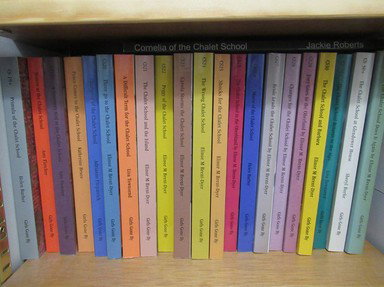
"Gerry Goes to School" was the first book written by Elinor M. Brent-Dyer, who is probably better known for the much longer series of Chalet School books. It was first published in 1922, and became the starting volume for a series of seven books. It became known as the La Rochelle series, after the third book "The Maids of La Rochelle", which tells of three orphaned sisters who found a home in a cottage called la Rochelle in Guernsey.
The first two books in the series are set in Surrey, in southern England, although there is mention of a forthcoming holiday in Guernsey at the end of the second story. The fourth and fifth books both start in Surrey and move to Guernsey for the holidays. The last two books are both set almost completely in Guernsey.
The second to sixth books were published between 1924 and 1932. Many of their characters make appearances in the Chalet School series The last book, "Janie Steps In" was published in 1953; it explains some of the connections between the two series.
3. Anne of Green Gables
Answer: Rilla of Ingleside
"Anne of Green Gables" was written by L. M. Montgomery and first published in 1908. It tells the story of the orphaned Anne Shirley finding a home with Marilla and Matthew Cuthbert in the settlement of Avonlea, on Prince Edward Island, in south-eastern Canada. They eventually decided that she could stay despite the fact that she wasn't the boy they had hoped for.
Although, as a girl, she was not able to give Matthew much help around the farm, she eventually learned to be useful to Marilla inside the house. Anne also did well at school, and subsequent books tell of her university life, and her experiences as she became a teacher. By the end of the series, Anne had married her childhood classmate, Gilbert Blythe, who had trained as a doctor.
The last of the books, chronologically, was "Rilla of Ingleside"; it was published just after the First World War. It tells of Anne's youngest child, known as Rilla (short for Marilla), and how she grew up during the war years. It was the seventh book to be published; three more books were subsequently written, to fill in the story during some of the intervening years.
4. Girls of the Hamlet Club
Answer: Two Queens at the Abbey
"Girls of the Hamlet Club" was written by E. J. Oxenham, and first published in 1914. It would become the first of a series of thirty-eight stories known as the Abbey Series. The last book was "Two Queens at the Abbey", published forty-five years later, in 1959. E. J. Oxenham also published around fifty other books, many of which are regarded as connectors to the Abbey series. The main characters in some of the other books also make appearances in some of the Abbey books.
The first book has no mention of the abbey. The protagonist, Cicely Hobart, joined a new school when she went to live with her grandparents in the Chilterns, in southern England. She was not impressed to find there were two factions in the school, the town girls who came from wealthy families, and the rather despised girls who came from the outlying hamlets. They were unable to join any of the school societies, because of the high subscriptions, so Cicely started the Hamlet Club. The girls amused themselves with folk dancing and planning celebrations for May Day, with the crowning of a May Queen.
The abbey appears in the second book, "The Abbey Girls", when two cousins, Joan and Joy, who lived near a ruined abbey, joined the school. The theme of folk dancing and May Day celebrations continued throughout the series. The two queens referred to in the last book of the series, "Two Queens at the Abbey" were Joy's twin daughters, who were joint May Queens for the year.
5. Five Children and It
Answer: The Story of the Amulet
"Five Children and It" was written by Edith Nesbit in 1902. The story was originally serialised in "The Strand" magazine, before being expanded and published as a book. It would become the first book of a trilogy. The other two stories were "The Phoenix and the Carpet" and "The Story of the Amulet", published in 1904 and 1906 respectively.
The first story tells of five children who moved to the Kent countryside from London. They met a sand-fairy while playing in a gravel pit. This is the 'It' of the title, and it is known as the Psammead. It had the ability to grant wishes, but when granted, they did not always turn out as the children hoped. The second and third books cover more of the children's adventures, with the Psammead having to be rescued from a pet shop in the third story.
A sequel to the series, "The Return of the Psammead" was written by Helen Cresswell, and published in 1992. It tells of another family's adventures with the sand-fairy.
6. Wish for a Pony
Answer: A Wind is Blowing
"Wish for a Pony" was written by Monica Edwards and first published in 1947. It would become the first of fifteen books in the Romney Marsh series. The last was "A Wind is Blowing", published in 1969. The series is set on Romney Marsh in the south-east of England, where Monica lived for several years after her family moved there when she was a child.
Monica Edwards also wrote a series of eleven books known as the Punchbowl farm series. They appeared between 1947 and 1967. They are set around the eponymous Punchbowl Farm in Surrey, based on the farm where Monica lived with her husband and children. The two series interconnect at times, with characters from one series appearing books in the other series.
The first book, "Wish for a Pony", tells how Tamzin, a clergyman's daughter (like Monica herself), managed to acquire a pony, and the adventures she had with her best friend, Rissa. In later books Rissa's cousin, Roger, and his friend, Meryon, join the girls in their adventures. In the last book, "A Wind is Blowing", Meryon became temporarily blind after trying to stop a robbery; Tamzin started a tape correspondence with him, and then they trained a guide dog for him.
7. The Lion, the Witch and the Wardrobe
Answer: The Last Battle
"The Lion, the Witch and the Wardrobe" was written by C. S. Lewis and first published in 1950. It was the first of what would become a series of seven chronicles about Narnia. The last in the series was "The Last Battle" which was first published in 1956. All are set in the fictional fantasy land of Narnia.
Although the books were published in the order that they were written, there is some argument for reading the sixth book, "The Magician's Nephew" first, and the fifth title, "The Horse and His Boy", second, before going on to "The Lion, the Witch and the Wardrobe". In a letter written to a fan in 1957, Lewis said that he thought there would only be one book, then he found a second, "Prince Caspian", and later a third, "The Voyage of the Dawn Treader". While the fourth book, "The Silver Chair", follows on, chronologically, from the third story, the next two could be regarded as prequels, since they are set earlier in time than the previous four books.
"The Lion, the Witch and the Wardrobe" tells of the time when the four Pevensie children were evacuated to a house on the outbreak of the Second World War, and how they discovered the land of Narnia by going through a wardrobe. The next three books tell of more of their adventures in Narnia. "The Magician's Nephew" tells of the creation of the land of Narnia. The last book in the series, "The Last Battle", tells of the destruction of the land of Narnia.
8. Exile for Annis
Answer: Strangers at Farm School
"Exile for Annis" was written by Josephine Elder and first published in 1938. It was the first of what would become a trilogy of stories about the Farm School. The second was "Cherry Tree Perch", published in 1939; the last, "Strangers at Farm School", was published in 1940.
Josephine Elder was a qualified doctor, but as a woman GP in the 1920s and 1930s she found she had time on her hands, and turned to writing to supplement her income. She had already written a trilogy of stories about Erica's experience at a local High School, and her subsequent education at the University of Cambridge, not unlike her own life. With the Farm School, she wrote about a different type of school.
Annis had always attended the local High School, but she was sent to live with relatives in the country for the sake of her health. She was horrified to find that her new school was both progressive and co-educational; it had no definite timetable, and very few rules. The first book, "Exile for Annis", tells the story of how she settled down and learned to like the new ways.
In the last book, "Strangers at Farm School", the school had become significantly larger, with the introduction of a number of new pupils, including some evacuees from central Europe who were fleeing persecution in the Second World War. Annis had become one of the oldest pupils, and a leader in the school.
9. What Katy Did
Answer: In the High Valley
"What Katy Did" was written by Susan Coolidge and first published in 1872. It would be the first of five books about the Carr family, with the last, "In the High Valley", being published in 1891.
Katy Carr was the eldest of five motherless children living a small town in Ohio, USA. She was high-spirited, and full of good ideas for them all to have fun. Unfortunately, she was disobedient one day, with the result that she fell of a swing and seriously injured her back. The first book tells of how she learned to live with her immobility, and how she was able to learn to walk again.
The next story, "What Katy Did at School" gives an account of the time she, and her next sister, Clover, spent at a boarding school in New England. The third book is "What Katy Did Next", which tells of Katy's adventures when she accompanied an older friend, with a young daughter, on a voyage across the Atlantic Ocean to England and then on to France and Italy.
By the last two books, Katy is married. The stories concentrate on her younger siblings, and their adventures in Colorado. In the fourth book, "Clover", the eponymous heroine, took her youngest brother, Phil, to Colorado for the sake of his health. They were surprised by how civilised it was, and how much they liked it, and settled there. The last story, "In the High Valley", tells of Clover's life with her husband and family, and that of her next sister, Elsie, who joins the family in Colorado and also gets married.
10. Redshanks Warning
Answer: Ambermere Treasure
"Redshanks Warning" was written by Macolm Saville and first published in 1948. It was the first of six books in the Jillies series about the adventures of the three motherless Jillions children, and often also with their friends, the two Standing boys. The last book in the series was "Ambermere Treasure", published in 1953.
The first story, "Redshanks Warning", is set on the north Norfolk coast. The next book, "Two Fair Plaits", is set in London at Christmas. "Strangers at Snowfell", the third book, follows on immediately, when the the children are travelling to Scotland for the New year, but their train is stranded in a snowdrift near the village of Shap in Cumberland.
The fourth book, "The Sign of the Alpine Rose", sees the Jillions family, with their father, travelling to the Austrian alps in the early summer. "The Luck of Sallowby" is the fifth story; it is set during a flood in the East Anglian fens. The last book, "Ambermere Treasure", is a summer holiday story in Surrey in southern England.
Malcolm Saville has written many different series of books for children. Possible the best known is the Lone Pine series, with settings in Shropshire, Rye, London, Devon and Yorkshire. He is well known for writing accurately about real places, which the readers can visit and explore for themselves if they are so inclined.
This quiz was reviewed by FunTrivia editor looney_tunes before going online.
Any errors found in FunTrivia content are routinely corrected through our feedback system.