FREE! Click here to Join FunTrivia. Thousands of games, quizzes, and lots more!
The Thames is Liquid History Trivia Quiz
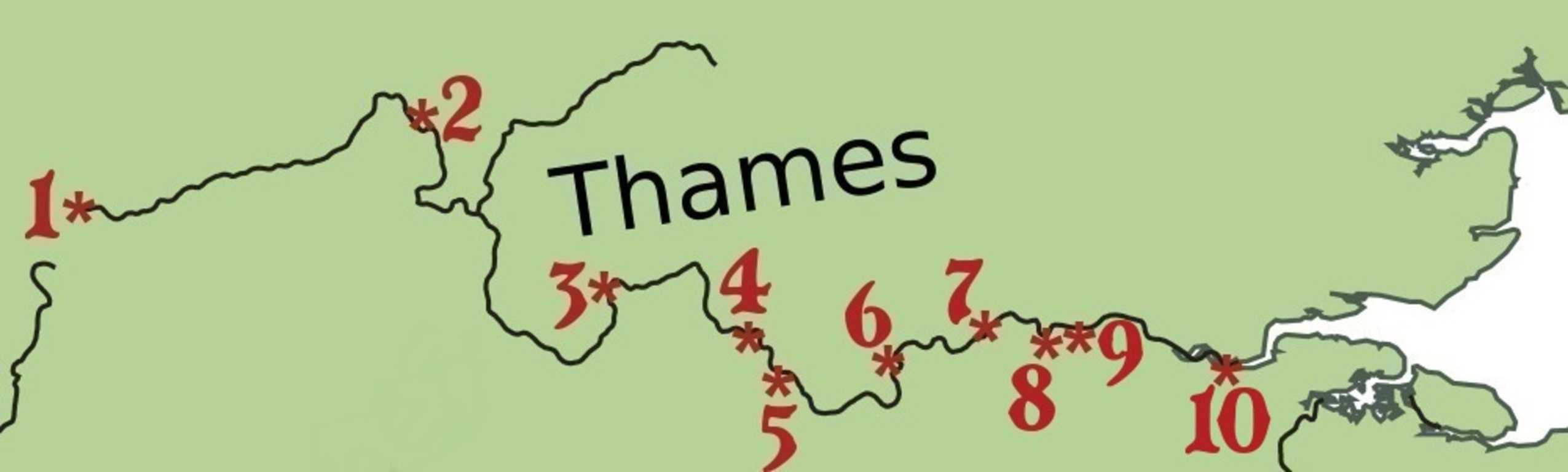
Inspired by a quote from politician John Burns, this quiz follows the Thames from west to east through locations connected with English geography, education, sport, royalty, government, science, and history.
Last 3 plays: kstyle53 (6/10), Reamar42 (10/10), Kabdanis (10/10).
Click on image to zoom
GravesendWindsor CastleTwickenham StadiumThames BarrierThames HeadPalace of WestminsterOxford UniversityRunnymedeHenley-on-ThamesGreenwich* Drag / drop or click on the choices above to move them to the answer list. View Image Attributions for This Quiz
Thames Head, near Kemble in Gloucestershire, is traditionally identified as the source of the Thames. From here the river flows approximately 346 km (215 mi) across southern England before entering the North Sea. The Thames passes through cities and towns including Oxford, Reading, Windsor, and London, and has played an important role in transport, trade, and settlement throughout English history.
2. Oxford University
Oxford is home to the University of Oxford, whose origins date to the late eleventh century. The university consists of more than thirty colleges and is one of the world's oldest centres of higher learning. Alumni and staff have included British prime ministers, Nobel Prize winners, scientists, authors, and religious leaders.
The city developed both as a university centre and as an important crossing point on the Thames.
3. Henley-on-Thames
Henley-on-Thames is closely associated with rowing and has hosted the Henley Royal Regatta since 1839. The regatta takes place on a straight stretch of the Thames and attracts competitors from schools, universities, clubs, and national teams. The event reflects the long relationship between the river and organised sport in England.
4. Windsor Castle
Windsor Castle was founded by William the Conqueror in the eleventh century and has served as a royal residence for nearly a thousand years. It remains one of the official residences of the British monarch and is regularly used for state visits, ceremonies, and other official events. Few buildings illustrate the continuity of the English and later British monarchy as clearly as Windsor Castle.
5. Runnymede
Runnymede is associated with the sealing of Magna Carta in 1215. The agreement emerged from a dispute between King John and a group of barons, but it later became known for establishing the principle that the monarch was subject to the law. Magna Carta has influenced constitutional developments in Britain and has been cited in legal and political traditions around the world.
6. Twickenham Stadium
Twickenham Stadium has been the headquarters of the Rugby Football Union since the early twentieth century. With a capacity of more than 80,000 spectators, it is the largest stadium in the world built specifically for rugby union. It hosts England's home international matches as well as domestic cup finals and other major competitions.
7. Palace of Westminster
The Palace of Westminster is the meeting place of the House of Commons and the House of Lords. The current building largely dates from the nineteenth century after a fire destroyed much of the previous palace in 1834. It is here that laws are debated and passed, making it the centre of parliamentary government in the United Kingdom.
Its clock tower, the Elizabeth Tower, houses the bell known as Big Ben.
8. Greenwich
The Royal Observatory at Greenwich was established in 1675 during the reign of Charles II to improve navigation at sea. In 1884 the Prime Meridian, passing through Greenwich, was adopted as the international reference point for longitude. Greenwich Mean Time (GMT), based on observations made here, became the foundation of the global system of standard time zones.
9. Thames Barrier
The Thames Barrier was completed in 1982 as part of London's flood-defence system. Its ten movable gates can be raised when high tides and storm surges threaten the capital. Stretching about 520 m (1706 ft) across the river, the barrier was designed to reduce the risk of flooding to millions of people and major areas of infrastructure in London.
10. Gravesend
Gravesend became an important port on the lower Thames because of its position between London and the sea. For centuries, merchant ships, emigrants, naval personnel, and travellers passed through the town on journeys to destinations across the British Empire and beyond. Gravesend is also associated with Pocahontas, who died there in 1617 while preparing to return to Virginia.
Her memorial is a reminder of the early links between England and North America.
This quiz was reviewed by FunTrivia editor agony before going online.
Any errors found in FunTrivia content are routinely corrected through our feedback system.