FREE! Click here to Join FunTrivia. Thousands of games, quizzes, and lots more!
Quiz about Come On
Quiz about Come On

Come On Trivia Quiz

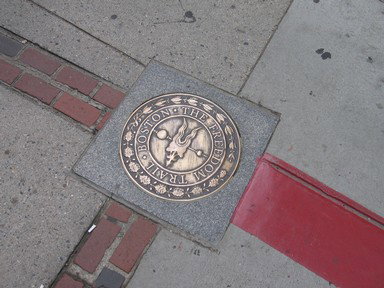
The Boston Freedom Trail

Since the 1950s, visitors to Boston have been able to follow a 2.5-mile red line as they visit the city's historic sites. Today's tour starts at Boston Common. Can you place the other 15 sites that form official stops on the trail in the correct order?

An ordering quiz by looney_tunes. Estimated time: 3 mins.
  1. Home
  2. »
  3. Quizzes
  4. »
  5. Geography Trivia
  6. »
  7. Massachusetts
  8. »
  9. Boston

Author
looney_tunes
Time
3 mins
Type
Order Quiz
Quiz #
426,496
Updated
Nov 16 26
# Qns
15
Difficulty
New Game
Plays
7
Last 3 plays: misstified (15/15), Guest 104 (15/15), Reamar42 (15/15).
Mobile instructions: Press on an answer on the right. Then, press on the question it matches on the left.
(a) Drag-and-drop from the right to the left, or (b) click on a right side answer, and then click on its destination box to move it.
Place these 15 stops of the Freedom Trail in order as you will encounter them after starting at Boston Common. This covers the whole trail, but some guided tours only cover a portion of it.
What's the Correct Order?Choices
1.   
(Beacon Hill)
Copp's Hill Burying Ground
2.   
(evangelism)
Bunker Hill Monument
3.   
(Crispus Attucks)
Old North Church
4.   
(James II)
Old State House
5.   
(Ben Franklin)
Granary Burying Ground
6.   
(Nathaniel Hawthorne)
Paul Revere House
7.   
(pre-revolutionary rallies)
Boston Latin School
8.   
(government)
Old Corner Bookstore
9.   
(manslaughter)
Old South Meeting House
10.   
(market and meetings)
Boston Massacre Site
11.   
(silversmith)
Faneuil Hall
12.   
(lantern in steeple)
King's Chapel
13.   
(hilltop)
Massachusetts State House
14.   
(harbor)
USS Constitution
15.   
(battleground)
Park Street Church


Most Recent Scores
Today : misstified: 15/15
Today : Guest 104: 15/15
Today : Reamar42: 15/15
Today : Balonyman: 9/15
Today : nnamarie: 11/15
Today : xchasbox: 13/15
Today : Luckycharm60: 15/15

Quiz Answer Key and Fun Facts
1. Massachusetts State House

If you are taking an official guided tour, you will probably be meeting at the Visitor Information Centre in Boston Common, so that makes a suitable starting point for our virtual tour. The oldest city park in the continental United States is bounded by five thoroughfares: Tremont Street, Park Street, Beacon Street, Charles Street, and Boylston Street. The Visitor Information Centre is on Tremont Street, and we move from there to the northern corner of the Common, where the Massachusetts State House in situated at 24 Beacon Street.

The State House is an impressive building - as is the case for most buildings designed to house the government of a city or state. The Beacon Hill land on which is was constructed was once owned by John Hancock, and the building was designed by the renowned architect Charles Bullfinch. The cornerstone was placed in a Masonic ceremony on 4 July 1795, conducted by Paul Revere, who was at that time the Grand Master of the Grand Lodge of Massachusetts. It was completed in 1798, but has since had a number of extensions. The dome, currently gilded with a gilded pine cone on top, was originally painted wood, which proved to leak; in 1802 Paul Revere's copper company covered it in copper (originally painted gray, then yellow, then gilded).

We don't have time to explore the interior of the building - feel free to return when you have a couple of hours to spare absorbing the history - but note the many statues that can be seen in front of the building, in tribute to significant Bostonians. They include the Civil War general Joseph Hooker, the famed orator Daniel Webster, educational reformer Horace Mann, President John F. Kennedy, long-term US senator Henry Cabot Lodge, colonial religious leader Anne Hutchinson, and Quaker martyr Mary Dyer.
2. Park Street Church

From the State House we proceed southeast along Park Street to the corner of Tremont Street, where the Park Street Church stands. The church was built in 1809, modelled on a Christopher Wren church. Its steeple, 66 m high, made it the tallest building in the United States between 1809 and 1828, and can still be seen from quite a distance.

The church has a long history of evangelical leaders, and strong positions on social issues. It was one of two churches that worked together to establish the City Mission Society in 1816, with a mission to serve the urban poor; this endeavour closed in 2023, with Old south Church taking on some of its ongoing programs. Its third pastor, Edward Beecher (brother of Harriet Beecher Stowe, author of 'Uncle Tom's Cabin'), held that position from 1826 until 1830, providing the forum at which William Lloyd Garrison delivered his first major statement against slavery on 4 July 1829. In the 21st century, addressing social issues remains a key focus, with both theological statements and practical assistance to the homeless and to immigrants who struggle in a new country being ongoing.
3. Granary Burying Ground

Next door to the Park Street Church on Tremont Street is the Granary Burying Ground, Boston's third-oldest cemetery, dating from 1660. It was known as the South Burying Ground until 1737, when its name was changed to reference the granary building that then stood where the Park Street Church is now located.

Close to the entrance from Tremont Street are the American casualties of the 1770 Boston Massacre, a confrontation whose magnitude is probably more accurately reflected by its British designation as the Incident on King Street: soldiers shot at a crowd of 300-400 citizens who were throwing stones at them, injuring 11 men. Three died on the spot: Samuel Gray, James Caldwell and Crispus Attucks, the last generally considered the first person to have died in the American Revolution. Patrick Carr and Christopher Monk died of their injuries, and the other six recovered.

The cemetery has 2,345 grave markers, with a number of unmarked graves - the total is thought to be around 5,000. Buried along with the victims of the Boston Massacre is Christopher Seider, an 11-year old who was killed by soldiers a few days before the Boston Massacre, making him another contender to be considered the first to die in the Revolution. Other notable graves include Paul Revere, Samuel Adams and John Hancock, names that will be familiar to most from their involvement in the Revolution.

As well as the historic graves, you will note a prominent obelisk erected in 1827 using granite from the same quarry as was used for the Bunker Hill Monument to commemorate the family of Benjamin Franklin (who was born in Boston, even though he is buried in Philadelphia). His father and mother, along with other relatives, are buried here.
4. King's Chapel

Moving north along Tremont Street we come to King's Chapel, at the corner of Tremont and School Street. The King's Chapel was established in 1688 as the first Anglican church in New England, during the reign of James II. It was located in a wooden building that was part of the King's Chapel Burying Ground (no connection, despite the name!), Boston's oldest cemetery, which still stands next door to the church. The current building, constructed between 1749 and 1754 around the outside of the original church, which was then dismantled and removed through the windows of the stone church, was designed by Peter Harrison, and designated a National Historic Landmark in 1960.

Inside the church you can see the box pews, traditionally owned by members for their exclusive use. The organ there now is the sixth one to be installed as part of the church's strong sacred music tradition. The bell, originally hung in 1766, cracked in 1814, when it was recast by (you guessed it) Paul Revere, the largest bell to come out of his foundry.

The King's Chapel Burying Ground, adjacent to the Chapel, sacrificed part of its land for the chapel when no private owner was willing to sell to an Anglican group at a time when congregationalism was the official religion of the state. Notables interred there include Isaac Johnson, who provided the land to be used as a cemetery, and John Winthrop, first governor of the Massachusetts Bay Colony.
5. Boston Latin School

Established on 23 April 23 1635, this is the oldest public school in the United States. It was intended to provide free education in the academic essentials (of which Latin was, of course, a primary component). And yes, it is still a compulsory subject in the 21st century, although the current school is located further south than this original site, at 45 School Street. After the school moved to a different spot, the site was used for a courthouse until 1841, when it found use as City Hall. That building was demolished and the building now called Old City Hall opened in 1865.

This stop is not just a chance to see a building that was designated a U.S. National Historic Landmark in 1970. The statue of Benjamin Franklin, who attended Boston Latin while it was operating on this site, was the first portrait statue (showing the subject as they actually appeared, not wearing classical robes) in Boston. Each side of the pedestal has a bronze relief plaque illustrating a facet of his life: 'Franklin Experimenting with Electricity', 'Franklin at the Declaration of Independence', 'Franklin in His Printing Shop' and 'Franklin at Paris Peace Treaty'.
6. Old Corner Bookstore

Continuing in a southeasterly direction along School Street, we come to the Old Corner Bookstore, on the corner of Washington Street. The site, which is actually four interconnected buildings, is not only on the Freedom Trail, it also is included in the Literary Trail and the Women's Heritage Trail - Boston has a lot of trails!

The first wooden building on the site, the house of Anne Hutchinson, burned down in the Great Boston Fire of 1711, and was replaced by a new stone building that was both an apothecary shop and the owner's residence. In 1829 Timothy Harrington Carter took up a lease on the corner building and built two annexes to establish a bookstore. Between 1832 and 1865 it was used as a publishing company as well as a bookstore, and became the hangout for literary luminaries that included Henry Wadsworth Longfellow, Ralph Waldo Emerson, Nathaniel Hawthorne, Charles Dickens (when he was in town visiting his American publisher), and Oliver Wendell Holmes Sr. The bookstore remained in operation until 1903.

During the 20th century a number of commercial activities have lodged in the building, and in 1959 a developer proposed to demolish it to build a motel. This sparked a movement to protect the building, and in 1973 it was listed on the National Register of Historic Places.
7. Old South Meeting House

Continuing along Washington Street, the next stop is the Old South Meeting House. The meeting house was built for the use of the congregation of the Old South Church in 1729, and became famous as the place where the Boston Tea Party was organised in 1773. In 1775, British troops occupied the building and turned it into an indoor riding facility. The interior was restored in 1783, and the building returned to its use for church services and public meetings that attracted crowds too large to fit into Faneuil Hall.

Following the 1872 Great Fire, there were moves to scrap the building, which led to one of the first successful preservation movements, and the building has been a museum since 1877. It is one of the few remaining meeting houses that have a traditional meeting-house layout, planned to serve both religious services and secular meetings. It has a combination of box pews and slip pews, with additional seating in the gallery with fixed seats on three walls - not the north wall, where the pulpit is located.
8. Old State House

The Old State House (which served that function between 1713 and 1798, when it became Boston's City Hall) is located a bit further along Washington Street. It is (probably) Boston's oldest public building, and both a National historic Landmark and a Boston Landmark.

During the 1760s, the State House was where British parliamentary acts (such as the Stamp Act of 1765) were proclaimed. The courthouse also saw some famous incidents, such as James Otis arguing a case in 1761 against the Write of Assistance in a case he lost, but which Samuel Adams marked as the start of the revolution. It was also in this courthouse that those involved in the 1770 Boston Massacre were tried. On 18 July 1776 the Declaration of Independence was read from the balcony of the State House, and it was all happening. In 1780 John Hancock was inaugurated there as the first governor of the state of Massachusetts.

In the 19th century, following the opening of the New State House, this building was occupied by a number of commercial ventures, with some council offices being housed in parts of the building. Since 1882 it has primarily operated as a museum. Around 1900 the construction of Boston's subway system led to a proposal to replace the building with a subway station; they settled for modifications to provide an entrance.
9. Boston Massacre Site

Actually, the plaque on the footpath next to the Old State House is not at the exact site of the 1760 incident called the Boston Massacre, which took place outside the Old Custom House, around the corner on what is now State Street (then known as King Street). Paul Revere's famous etching of the event shows the Custom House behind the line of soldiers who are firing on the assembled citizens, with the Old State House towering in the central background. Those involved were subsequently tried, with Samuel Adams acting leading the defense for the soldiers, despite his anti-British feelings, in order to ensure they had a fair trial. He argued that they were acting in self-defense; successfully for six of them, but two who had definitely fired directly into the crowd were convicted of manslaughter, and sentenced to having their thumbs branded. The five civilians who died were buried together in the Granary Burying Ground, visited earlier in the tour.

The marker to commemorate the Boston Massacre was placed on a traffic island on State Street at the intersection with Devonshire Street around 1886. It was moved in the early 2010s as part of the renovations of the subway station to its current location on the footpath slightly to the east of the Old State House.
10. Faneuil Hall

From the Old State House we travel north across State Street then east across Congress Street, turning north again, then right until we get to Merchants Row where a left turn brings us to Faneuil Hall. The street name might be a clue that the building was originally built as a market, named after the colonial merchant and slave trader who had paid for its construction, Peter Faneuil. Its Great Hall was used for town meetings, unless the crowd was too large for the space, in which case the meeting was transferred to the Old South Meeting House. The first building was destroyed by fire in 1761, but was replaced, becoming a centre for the revolutionary sentiments that were running through the colony. Faneuil Hall was used to house British troops between 1768 and 1776, when the British evacuated from Boston in March.

In the 1820s Boston became a city, so had a City Council structure that rendered town meetings obsolete, and the markets moved to the newly-built Quincy Market next door. Faneuil Hall remained a popular place for public events - you just needed a request signed by 50 voters to get authorisation to use it. Like many of the other buildings on our tour, it has required extensive renovation and restoration over the years.
11. Paul Revere House

The next stretch of the Freedom Trail involves one of the longest walks between sites, across the JFK Expressway, along Hanover Street then left on North Square until we reach the house at 19 North Square where Paul Revere once lived. He purchased the house in 1770, moving in with his wife Sarah. When she died in 1773, he was left with eight motherless children ,and soon married his second wife, Rachel, with whom he had another seven or eight children. Although there were never more than seven children in the house at any time, it still required some extensions to make room! While he moved out and back in several times before finally selling the house in 1800, it remains the site most associated with him.

In the early 20th century the house was acquired by one of Paul Revere's descendants, who established the Paul Revere Memorial Association to restore the house and establish a museum. It opened to the public on 18 April 1908, the 133rd anniversary of his famous ride. Actually, it was not all that famous, just another one of the acts leading up to the American Revolution, until William Wadsworth Longfellow's poem proclaimed it as historic and heroic. Revere was one of several messengers sent out to warn the colony's minutemen of an imminent attack from British troops traveling up the Charles River. This advance warning, delivered by over 40 messengers, played a crucial role in the colonists' success in the subsequent battles in Lexington and Concord.
12. Old North Church

From Paul Revere's House we travel a few blocks towards the Charles River, until we reach the Old North Church (originally called Christ Church) on Salem Street. This Episcopal Church (which still functions as such) was built in 1723, making it the oldest standing church in Boston. While it is a nice example of Georgian architecture, that is not why it is included on the Freedom Trail.

It was from the steeple of this church that lanterns were hung to warn the residents of Charlestown (north, across the Charles River) that British soldiers were on their way for a confrontation. Most Americans would have heard the line "One if by land, two if by sea" popularised in Longfellow's 1861 poem 'Paul revere's Ride'. This referred to one part of the plan - hanging one or two lanterns in the steeple to indicate whether the soldiers were marching across the land, or moving up the river. Two lanterns were hung - but exactly by whom is a matter of debate - on the night of 18 April 1775. At the same time Paul Revere and William Dawes rode out to carry the same message, alerting people as they went, before meeting John Hancock and Samuel Adams in Lexington, and proceeding to Concord with Samuel Prescott. The trio was intercepted, with Revere arrested, Dawes escaping to return to Lexington, and only Prescott making it through to Concord. Their mission allowed the citizens' militia to assemble and rebuff the British troops in battle the following day.
13. Copp's Hill Burying Ground

Continuing up towards the Charles River, the Freedom Trail stops at Copp's Hill Burying Ground, originally known as the North Burying Ground when it was established in 1659. It is Boston's second cemetery, and the site of some famous gravesites. The hill gets its name from William Copp, who lived nearby - exactly why is not clear. He and his family are among those buried in the cemetery, along with colonial ministers Increase Mather and his son Cotton Mather (he of the Salem witch trials in 1692-3) and his grandson Samuel Mather, Robert Newman and John Pulling (either or both of them responsible for placing the lanterns in the steeple of the Old North Church) and Shem Drowne, the coppersmith who created the grasshopper weathervane that tops Faneuil Hall.

The Burying Ground was not originally part of the Freedom Trail when it opened in 1951, but it was included as a stop because so many tourists following the trail wanted to stop there. During the Revolution, British soldiers were rumored to be using the grave markers for target practice while they occupied it. Its location on Boston's third highest hill, overlooking the harbour, made it a valuable spot where they set up a battery from which shells were launched towards Bunker Hill.
14. USS Constitution

Proceeding downhill to Boston Harbor, and crossing to the Charlestown Navy Yard, the Freedom Trail takes us to the USS Constitution, the oldest commissioned naval vessel which is still afloat (as of 2026!), having been launched in 1797. She was built in Boston to protect merchant ships, then to be used in the First Barbary War (1801-1805), but it was the War of 1812 that made her famous. As well as capturing a number of British merchant ships, she captured five warships, earning the nickname 'Old Ironsides' for the exploits of her crew. She was retired from active service in 1881 (an amazing length of active duty, as the average when she was built was 10-15 years, not 84), and designated a museum ship in 1907.

In 1947 the US Postal Service issued a stamp commemorating Constitution, and in 1960 she was designated a National Historic Landmark. In July 1997 she sailed off the coast from Marblehead back to Charlestown, and was given a 21-gun salute on arrival. Her role today is described as promoting understanding of the navy's role in war and in peacetime.
15. Bunker Hill Monument

From the deck of the Constitution you can look up towards the northwest and see the 67 m high granite obelisk erected between 1825 and 1843 to commemorate the Battle of Bunker Hill, which took place on 17 June, 1775. Actually, that is a bit of a misnomer. While Bunker Hill was the original target, most of the actual fighting took place on Breed's Hill, next door - and that is where the monument stands. Both hills had been stealthily occupied by colonial forces led by William Prescott. When the British forces realised they were there, an attack was begun which proved successful - but it required several waves of attack, and over 1,000 soldiers were injured or killed. The battle established the fact that the untrained colonial militia could engage effectively against British troops.

Like several other sites visited on the Freedom Trail, Bunker Hill is associated with a particular catch-phrase: the commander was said to have told the troops, "Don't fire until you see the whites of their eyes", to avoid overeager shooting which would waste valuable ammunition because thee target was too far away. There is no historical evidence that this was actually said (and different reports attribute it to different people), but it is a sound military tactic.
Source: Author looney_tunes

This quiz was reviewed by FunTrivia editor agony before going online.
Any errors found in FunTrivia content are routinely corrected through our feedback system.
11/16/2026, Copyright 2026 FunTrivia, Inc. - Report an Error / Contact Us