FREE! Click here to Join FunTrivia. Thousands of games, quizzes, and lots more!
Quiz about War Firsts

War Firsts Trivia Quiz


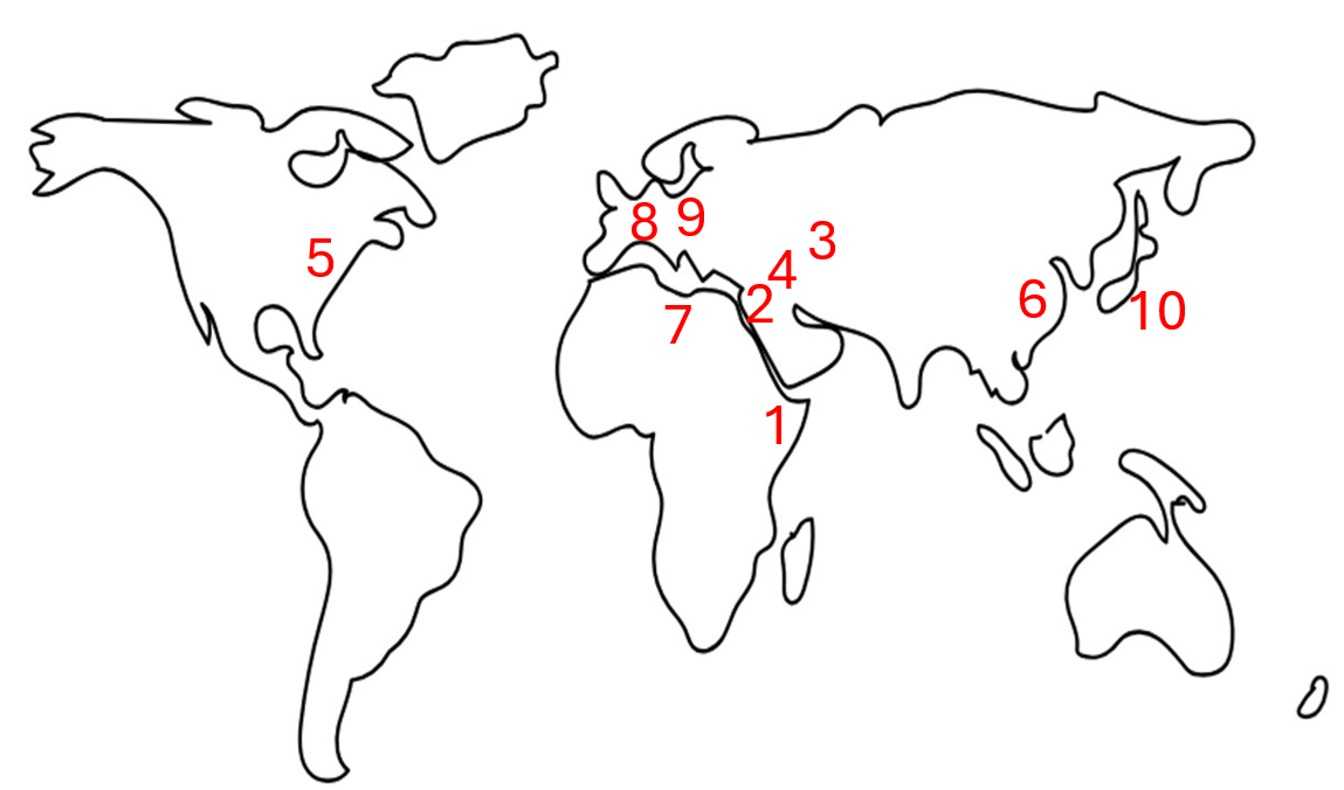
The numbers on the map represent the places where there were firsts in war. Please match the event, place, or piece of technology to its numbered location on the map.

A label quiz by misdiaslocos. Estimated time: 3 mins.
  1. Home
  2. »
  3. Quizzes
  4. »
  5. History Trivia
  6. »
  7. War History

Author
misdiaslocos
Time
3 mins
Type
Label Quiz
Quiz #
424,209
Updated
May 19 26
# Qns
10
Difficulty
Tough
Avg Score
5 / 10
Plays
23
Last 3 plays: Guest 165 (3/10), cdecrj (5/10), Southendboy (8/10).
Please Note - technology has been used when the location in the clue would have been too obvious.
Click on image to zoom
Ain Zara Oasis (1911) - First aerial attack from a heavier-than-air aircraft Messerschmitt Me 262 (1944) - First jet airplane used in battle Kinabu (883-859 BC) - First recorded use of siege weapons Lake Turkana (10,000 years ago) - First evidence of intergroup warfare Battle of Hampton Roads (1862) - First battle of ironclad ships Sintashta culture (2100 BC) - First war chariots Battle of Megiddo (1400s BC) - First reliably recorded battle Little Boy (1945) - First use of atomic weapon Siege of Kaifeng (1232 AD) - First use of rockets in war Battle of the Somme (1916) - First use of tanks in war
* Drag / drop or click on the choices above to move them to the answer list.
View Image Attributions for This Quiz
1.   
2.   
3.   
4.   
5.   
6.   
7.   
8.   
9.   
10.   

Most Recent Scores
Today : Guest 165: 3/10
Today : cdecrj: 5/10
Today : Southendboy: 8/10
Today : Reamar42: 8/10
Today : debbitts: 2/10
Today : magijoh1: 8/10
Today : Guest 141: 2/10
Today : rustic_les: 8/10
Today : Indonesia129: 10/10

Quiz Answer Key and Fun Facts
1. Lake Turkana (10,000 years ago) - First evidence of intergroup warfare

About 10,000 years ago near Lake Turkana in northern Kenya, in East Africa, archaeologists discovered what may be the oldest known evidence of organized violence between human groups. At a site called Nataruk, researchers found the remains of 27 people, including men, women, and children, who appeared to have died in a violent attack.

Many of the skeletons showed signs of severe injuries, such as skull fractures, broken bones, and arrowheads lodged in their bodies. Some victims may have had their hands tied before they were killed. Scientists believe these people were hunter-gatherers, and the attack may have been caused by competition over food, land, or resources.

The discovery is important because it suggests that warfare and conflict between groups may have existed much earlier in human history than many experts once believed.
2. Battle of Megiddo (1400s BC) - First reliably recorded battle

The Battle of Megiddo took place around 1457 BC at Megiddo, in present-day Israel. It is often considered the first battle in history that was recorded in reliable detail. The battle was fought between the army of Egyptian Pharaoh Thutmose III and a group of rebel Canaanite city-states led by the king of Kadesh.

Thutmose III surprised his enemies by leading his troops through a narrow mountain pass that his enemies thought was too dangerous. His risky plan worked, and the Egyptians won a major victory. We know about this battle because Egyptian scribes recorded it on the walls of the Karnak Temple Complex.
3. Sintashta culture (2100 BC) - First war chariots

The Sintashta culture lived around 2100 BC in what is now southern Russia and northern Kazakhstan, near the Ural Mountains in Central Asia. Archaeologists believe they created the first true war chariots in history. These light, two-wheeled vehicles were pulled by horses and were much faster than older carts used for transportation.

Scientists discovered chariot remains in Sintashta burial sites, including wheels, horse skeletons, and weapons. These chariots gave armies a major advantage in speed and mobility and later spread to places like Egypt, India, and the Middle East. The invention of war chariots changed warfare by making battles faster and more organized.
4. Kinabu (883-859 BC) - First recorded use of siege weapons

The siege of the city of Kinabu (located somewhere in the Tur Abdin plateau), which took place between 883 and 859 BC in the Neo-Assyrian Empire was located in what is now northern Iraq, and led by the Assyrian king, Ashurnasirpal II. This is often cited as one of the earliest recorded uses of siege weapons in warfare.

Assyrian armies used battering rams, ladders, and siege towers to attack fortified cities with large walls. Records and carvings from the reign of Ashurnasirpal II show soldiers breaking through defenses and attacking cities in highly organized ways. These new siege tactics made it easier for powerful empires to conquer well-protected cities, and helped the Assyrians build one of the strongest empires of the ancient world.
5. Siege of Kaifeng (1232 AD) - First use of rockets in war

The Siege of Kaifeng took place in 1232 AD in Kaifeng, located in present-day China. It is famous for being one of the first recorded uses of rockets in warfare. During the siege, the defending Jin dynasty used "fire arrows," which were early gunpowder rockets launched at attacking Mongol Empire forces. These weapons could fly through the air and explode or spread fire when they landed, terrifying enemy soldiers and horses.

Although the Mongols eventually conquered Kaifeng, the battle showed how gunpowder weapons were beginning to change warfare. These early rockets were the ancestors of later missiles and modern rocket technology.
6. Battle of Hampton Roads (1862) - First battle of ironclad ships

The Battle of Hampton Roads took place in 1862 near Hampton Roads, in the state of Virginia. It was the first battle in history between ironclad warships, which were ships protected by iron armor. During the American Civil War, the Confederate ship CSS Virginia fought the Union ship USS Monitor.

The battle ended in a draw, but it proved that wooden warships were becoming outdated. After this battle, navies around the world began building iron and steel warships, changing naval warfare forever.
7. Ain Zara Oasis (1911) - First aerial attack from a heavier-than-air aircraft

The attack at Ain Zara took place in 1911 during the Italo-Turkish War in what is now Libya, in North Africa. It is known as the first recorded aerial attack from a heavier-than-air aircraft. Italian pilot Giulio Gavotti flew over Ottoman forces near Ain Zara and dropped small bombs by hand from his airplane.

The bombs caused little physical damage, but the attack was historically important because it introduced airplanes as weapons of war. This moment marked the beginning of air warfare, which would become a major part of conflicts throughout the 20th century.
8. Battle of the Somme (1916) - First use of tanks in war

The Battle of the Somme took place in 1916 in northern France during World War I. It is famous for being the first major battle in which tanks were used in warfare. The new British armored vehicle, the Mark I tank, was introduced to break through heavily fortified German trench lines.

Tanks were slow and unreliable at first, and many broke down during the battle, but they showed promise as a new kind of weapon that could cross trenches and barbed wire. Although the Battle of the Somme was extremely costly in lives, it marked the beginning of armored warfare, which would become a major part of modern military strategy.
9. Messerschmitt Me 262 (1944) - First jet airplane used in battle

The Messerschmitt Me 262 first entered combat in 1944 during World War II in Germany. It was the first jet-powered fighter aircraft used in battle. The earliest operational use of the Me 262 came from bases in Bavaria, especially near the town of Augsburg at Lechfeld Air Base. From there, it flew combat missions over Germany and occupied Europe.

Built by Nazi Germany, the Me 262 was much faster than Allied propeller planes and could reach speeds over 500 miles per hour. It was mainly used to attack Allied bombers flying over Europe. Although it was technologically advanced, the plane arrived too late and in too small numbers to change the outcome of the war. Still, it helped begin the jet age and influenced the design of future military aircraft.
10. Little Boy (1945) - First use of atomic weapon

The Little Boy was used in 1945 during the final stages of World War II. It was dropped by the United States on the city of Hiroshima in Japan on August 6, 1945. This was the first time an atomic weapon was used in warfare. The bomber B-29 Superfortress, named Enola Gay, carried the bomb and released it over the city.

The explosion caused massive destruction and loss of life, and it marked a major turning point in world history. After this event, nuclear weapons became a central part of global military strategy and international politics.
Source: Author misdiaslocos

This quiz was reviewed by FunTrivia editor ponycargirl before going online.
Any errors found in FunTrivia content are routinely corrected through our feedback system.
5/19/2026, Copyright 2026 FunTrivia, Inc. - Report an Error / Contact Us