FREE! Click here to Join FunTrivia. Thousands of games, quizzes, and lots more!
Cheese Mixture Trivia Quiz
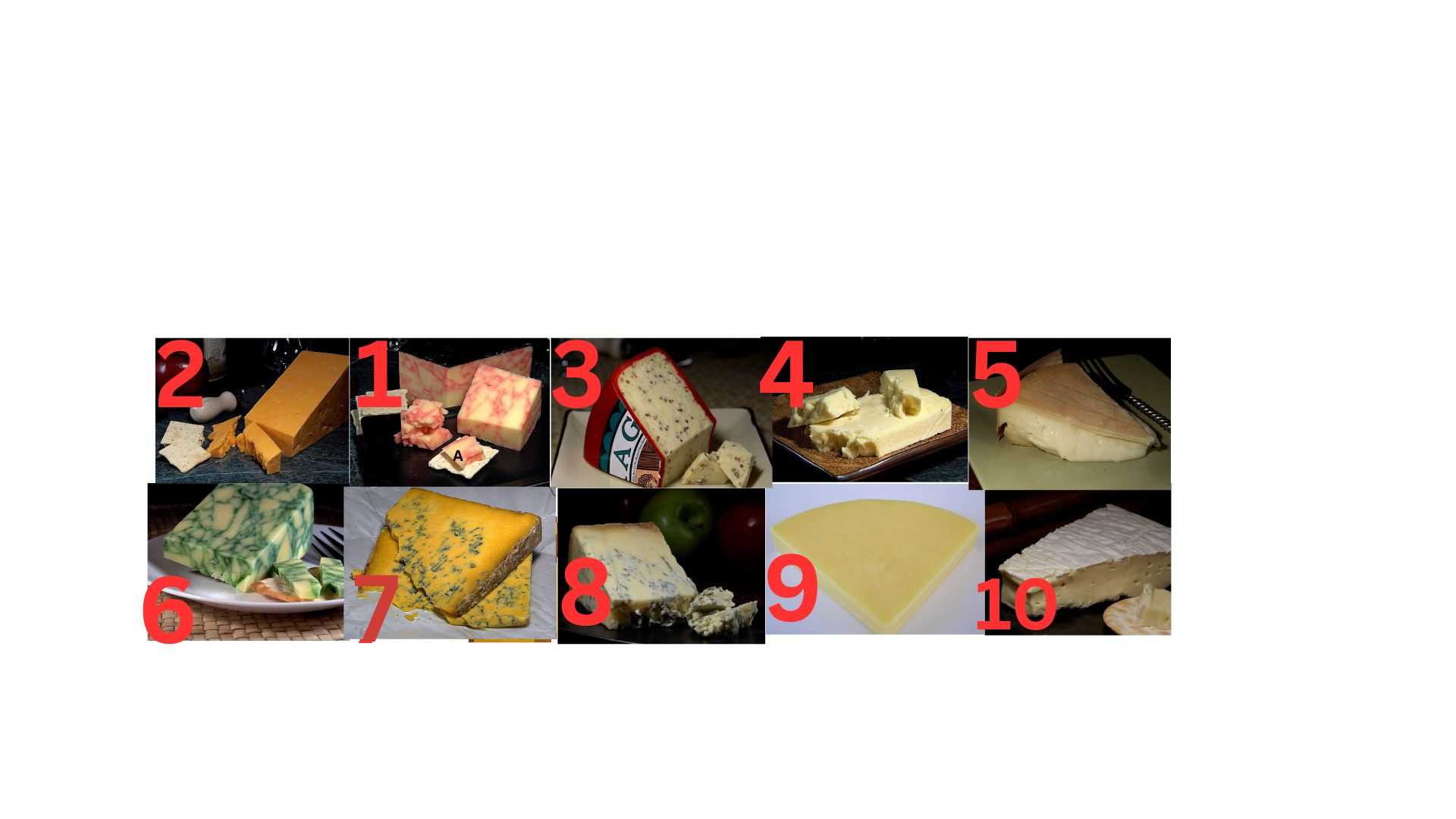
Here we have ten different types of cheeses. Can you spot which is which?. All you have to do is select the number image that corresponds to the type of cheese. To make the photo larger, just click on the image. Good luck and have fun.
Digby
A label quiz
by Lord_Digby.
Estimated time: 3 mins.
Last 3 plays: kimcable1966 (10/10), cardsfan_027 (10/10), hojoger (6/10).
Click on image to zoom
Ayrshire's DunlopStinking BishopRed LeicesterSage DerbyBrie de MeauxRed Windsor Red Dragon WelshBlue StiltonWensleydaleShropshire Blue* Drag / drop or click on the choices above to move them to the answer list. View Image Attributions for This Quiz
Red Windsor is a light cream-coloured English cheddar cheese from Leicestershire, crafted from pasteurized cow's milk and marbled with wine, typically Bordeaux or a mixture of port wine and brandy. It was first launched in 1969.
2. Red Leicester
Red Leicester is an English cheese that resembles cheddar but has a crumbly texture. It is usually matured for 6 to 12 months. The rind has a reddish-orange colour and is covered with a powdery mould. Since the 18th century, it has been dyed orange by adding annatto extract during production. Made from cow's milk, the cheese is named after the city of Leicester.
3. Red Dragon Welsh
Red Dragon is a semi-firm Welsh cheddar cheese that is coated in a vibrant red wax and is flavoured with brown ale and whole grain mustard seeds. It is also known as Y-Fenni and has a creamy, buttery texture that is enhanced by a mildly spicy, tangy mustard flavour.
4. Wensleydale
Wensleydale is a vale in North Yorkshire, England. Wensley is a very small village located in Richmondshire. Wensleydale cheese goes back several hundreds years when monks first made this cheese. In 1897 Wensleydale went on sale for the first time to the general public in the busy market town of Hawes.
This cheese is made from cow's milk, which can be either pasteurised or unpasteurised. The texture is soft but is also crumbly and has a hint of honey. This cheese goes very well with fruit; some of the cheeses offered for sale can be mixed with cranberries or apricots and mango.
5. Stinking Bishop
"Stinking Bishop" is a smooth, creamy cheese with a semi-soft texture, renowned for its pungent aroma. It is considered the smelliest cheese in Britain. The cheese is named after the "Stinking Bishop" pear, which is used to produce the pear cider that washes the cheese's rind.
The pear itself was named after Frederick Bishop, a 19th-century farmer from Gloucestershire, who earned the unpleasant nickname due to his excessive drinking and unruly behaviour.
6. Sage Derby
Derby cheese has a smooth, creamy texture which features a green marbled appearance, accompanied by a pleasantly mild sage flavour that reveals an almost minty taste. It is England's oldest and most renowned cheese, traditionally produced exclusively for special events like harvest and Christmas. In recent times this cheese has become available all year round.
7. Shropshire Blue
The history of Shropshire Blue is unclear. One of the earliest stories is that Dennis Biggins was the first to create this cheese in the 1930s. The second theory is that Andy Williamson, a cheesemaker, invented the cheese at the Castle Stuart Dairy in Inverness, Scotland. This factory closed down in the 1980s. Nowadays, this cheese is now made by several cheese factories, with Colston Bassett Dairy being one of them.
Colston Bassett Shropshire Blue tastes slightly spicy and sweet with a creamy undertone and long-lasting flavor. It has a beautiful, soft, and rich interior that resembles marble. This cheese is made from pasteurized cow's milk and uses vegetable rennet. The orange color comes from the addition of annatto, a natural food coloring. Penicillium roqueforti produces the veining. A particular favorite at Christmas time, it is perfect at home on a cheese board any time of the year.
8. Blue Stilton
Authentic blue Stilton is protected and can only be made in three counties - Leicestershire, Derbyshire, and Nottinghamshire. According to its Protected Designation of Origin (PDO). The cheese uses pasteurised cows' milk and traditional techniques' which is inoculated with penicillium roqueforti - the blue mould spores essential for producing the famous veining.
Britain's best-known blue cheese, with a history that can be traced to at least the early 18th century and the village of Stilton in Cambridgeshire. At the time, it was a hard, creamy cheese, famously mentioned by travel writer Daniel Defoe as being served full of mites or maggots. Over the years, production moved to the Midlands, and the cheese developed into the softer, blue-veined style we recognise today.
9. Ayrshire's Dunlop
Around 1690, Barbara Gilmour, an Ayrshire farmer's daughter and a Covenanter, married Mr. J. Dunlop of Hill Farm in Dunlop after spending some time in exile in Ulster to avoid religious persecution. Around then, Barbara developed a new kind of cheese that changed Scottish cheesemaking by using whole milk instead of the leftover skimmed milk.
The characteristics of Dunlop cheese are that it is a mild, sweet, buttery-tasting cheese with a semi-soft texture when young but maturing to a fudge or hard texture after a few months. Dunlop cheese is soft and tasteless when turned out of the cheese vat or mold. It requires six to twelve months to mature and to acquire the light, elegant, charming flavour and fragrance peculiar to the Dunlop.
10. Brie de Meaux
As the name suggests Brie de Meaux is a French cheese and made from raw, unpasteurised cow's milk. This cheese takes around six to eight weeks to mature. Brie de Meaux can be traced back to the Middle Ages when the monks at the Priory of Rueil en Brie first created the cheese.
The outer layer has a soft, delicate white rind, while the interior of the cheese is straw-yellow, creamy, and soft.
This quiz was reviewed by FunTrivia editor Bruyere before going online.
Any errors found in FunTrivia content are routinely corrected through our feedback system.