
FREE! Click here to Join FunTrivia. Thousands of games, quizzes, and lots more!
Quiz about Elements of Church Architecture

Elements of Church Architecture Quiz


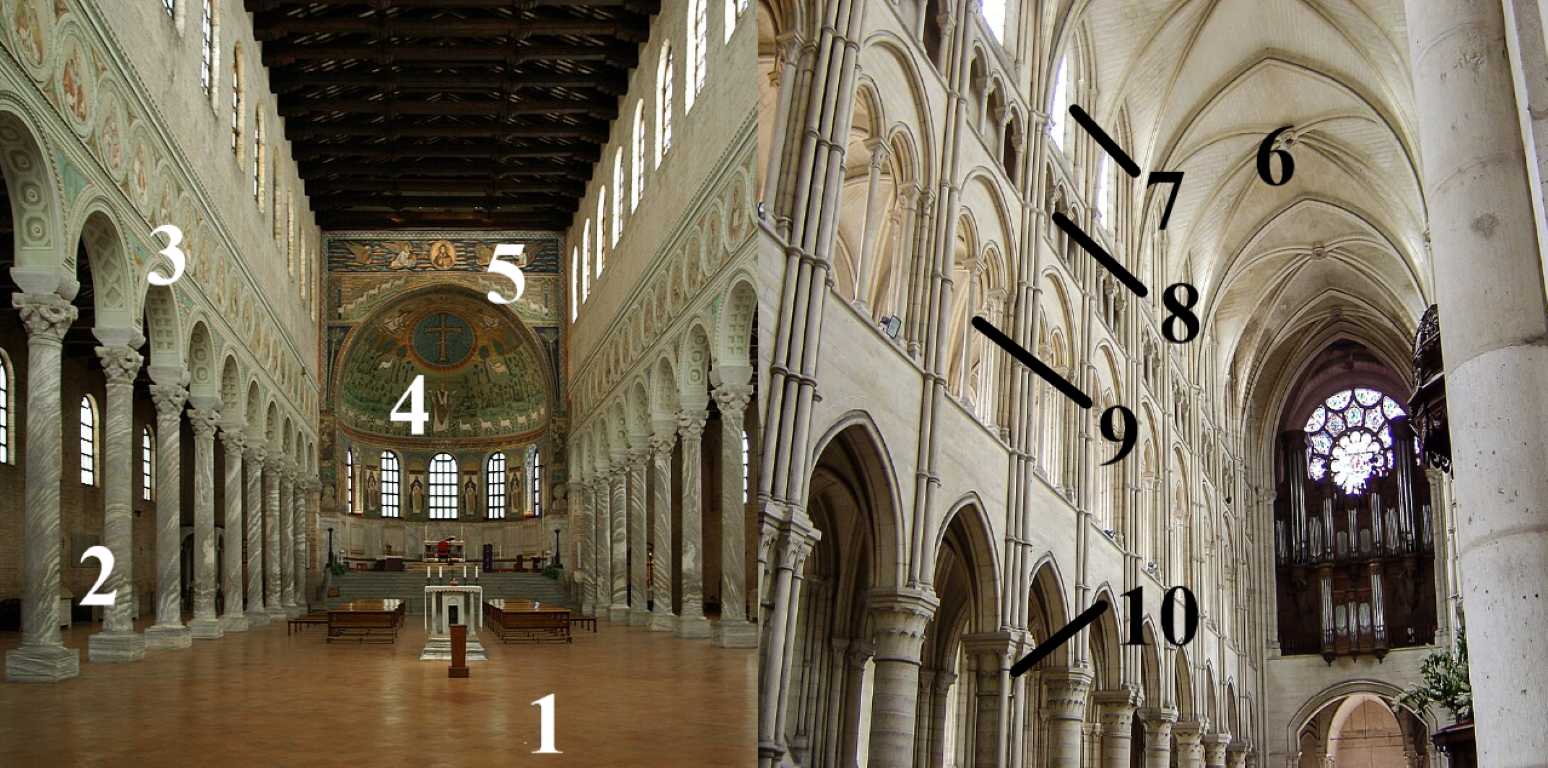
The photo collage in this quiz shows the interiors of two medieval churches from different periods side by side. Can you match each of the elements in the photo with its correct name?

A label quiz by LadyNym. Estimated time: 3 mins.
  1. Home
  2. »
  3. Quizzes
  4. »
  5. Humanities Trivia
  6. »
  7. Architecture
  8. »
  9. Architecture Terms

Author
LadyNym
Time
3 mins
Type
Label Quiz
Quiz #
421,976
Updated
Dec 13 25
# Qns
10
Difficulty
New Game
Avg Score
6 / 10
Plays
23
Last 3 plays: londoneye98 (8/10), Guest 24 (1/10), fado72 (10/10).
Click on image to zoom
triumphal arch rib vault triforium arcade apse nave gallery clerestory side aisle compound pier
* Drag / drop or click on the choices above to move them to the answer list.
View Image Attributions for This Quiz
1.   
2.   
3.   
4.   
5.   
6.   
7.   
8.   
9.   
10.   

Most Recent Scores
Today : londoneye98: 8/10
Today : Guest 24: 1/10
Today : fado72: 10/10
Today : Guest 38: 0/10
Today : jonathanw55: 3/10
Today : Guest 176: 8/10
Today : Guest 1: 3/10
Today : Strike121: 1/10
Today : xchasbox: 3/10

Quiz Answer Key and Fun Facts
1. nave

The first of the two photos I have chosen for this label quiz depicts the interior of the Basilica of Sant'Apollinare in Classe near Ravenna (northeastern Italy), an outstanding example of Early Christian church architecture. Along with other seven sites in Ravenna, the Basilica - consecrated in 549 AD - was designated as a UNESCO World Heritage Site in 1996.

In Western Europe, Early Christian churches were often modelled on Roman public buildings, of which the basilica was the most significant. One of the distinctive features of the Roman basilica was the nave, a wide, central area with windows placed near the ceiling. The nave (from "navis", the Latin word for ship - possibly suggesting the Barque of St. Peter, a symbol for the Catholic Church) is the main body of a church, reserved for the congregation. In many Early Christian churches, a separate, covered vestibule called a narthex is located at the west end of the nave, on the opposite side of the main altar.
2. side aisle

In church architecture, a side aisle is a passageway that runs parallel to the nave, from which it is separated by rows of columns. In Roman and Early Christian basilicas (including Sant'Apollinare in Classe), as well as Gothic churches, the roof of the side aisles was generally lower than that of the nave. Etymologically, the word aisle is related to the Latin "ala" (wing), while its homophone "isle" comes from the Latin "insula".

The largest Early Christian basilicas, such as three of the four papal basilicas in Rome, had two pairs of side aisles - one on each side of the nave. Of these, Saint John and Saint Paul Outside the Walls have kept the original structure, while Saint Peter's Basilica only has two side aisles. Chapels or other recessed spaces (such as tombs or niches with statues) often line the walls of the aisles. Baroque churches, on the other hands, are often characterized by having no side aisles at all.
3. arcade

As its name suggests (from the Latin "arcus", originally meaning bow), an arcade is a series of contiguous arches, each of which is supported by columns or piers. Frequently employed in Hellenistic and Roman architecture, arcades became an essential feature of the interior of Christian churches, as well as outside spaces such as courtyards and cloisters, where they create a covered walkway. In Romanesque architecture, blind arcades - that is, arcades that have no openings, but are applied to the surface of a solid wall - were often used as ornamental elements on the façades of buildings, such as, for instance, Pisa Cathedral.

In the Basilica of Sant'Apollinare in Classe, the arcades have the function of supporting the walls of the nave and separating the nave itself from the side aisles. The arches are supported by simple Greek marble columns with carved capitals. The distance from one column to the next is called a bay, whose size may determine the size of other parts of a church.
4. apse

Located at the eastern end of the nave in a standard basilica design, the apse is a semicircular recessed space covered by a semi-dome. The term comes from the Greek "apsis", meaning arch or vault. The apse developed from the exedra, a large, usually raised space located at the opposite end from the entrance of a Roman basilica. While in the Roman civic building the exedra was reserved for magistrates, in Christian churches the apse became part of the chancel (also known as sanctuary), which contains the high altar and is therefore reserved for the clergy. Seen from outside, the apse of a church is not always round: in Sant'Apollinare in Classe it has a polygonal shape.

In Early Christian, Byzantine and Romanesque churches, the apse was frequently decorated with mosaics, as is the case of Sant'Apollinare in Classe. The apse mosaic bears the motif of the "crux gemmata" (jewelled cross) at its centre, with the figure of the saint below it, surrounded by white lambs. In later eras, the apse was often decorated with frescoes: however, in many Gothic churches the walls were almost completely occupied by large stained glass windows, and the apse was occasionally replaced by a flat wall.
5. triumphal arch

The term triumphal arch is most often associated with the imposing, free-standing structures built throughout the ages with the intent of celebrating or commemorating some influential person or event. However, in medieval churches the term denotes something rather different - the arch that marks the entrance to the chancel, the part of the church reserved for the clergy. This arch often supported a rood (life-size cross or crucifix) - a use that was more common in Northern Europe than in other parts of the continent.

In Early Christian churches such as Sant'Apollinare in Classe, the triumphal arch was decorated with mosaics that complemented those of the apse. In this case, the motif of the lambs also appears on top of the arch, below the symbols of the four Evangelists and a medallion framing the face of Jesus Christ.
6. rib vault

The second half of the photo shows a detail of the interior of Laon Cathedral, in northern France - one of the buildings that best represents the Early Gothic style in church architecture. A remarkably well-preserved building, the cathedral was built between 1150 and 1235, and underwent extensive modifications in the 19th century.

The first highlighted element, the rib vault, is one of the defining features of Gothic church architecture, along with the ogival (pointed) arch and the flying buttress, which allow these buildings to reach unprecedented heights. This type of vaulting consists of a framework of crossed (as in the photo) or diagonal arched ribs, with thin stone panels filling the spaces between them. The main purpose of the rib vault - which was first introduced by the Romans in the 2nd century AD, and was also employed in early Islamic architecture - was to reduce the weight of the vault itself, and transmit it to specific points such as rows of columns or piers.

Rib vaults replaced the barrel or groin vaults of Romanesque cathedrals and churches, which required thicker walls and smaller windows. In later examples of Gothic architecture, standard rib vaults featured decorative ribs added to the structural ones - such as the fan vaults that characterize the English Perpendicular style (seen, for instance, in Gloucester Cathedral and King's College Chapel, Cambridge).
7. clerestory

A word of Old French origin, clerestory has the literal meaning of "clear storey" - that is, a high section of wall that contains windows providing light and ventilation to a building. The clerestory formed the upper level of a Roman basilica, and in later centuries became the upper part of the nave of a church building, which usually rose above the roof of the side aisles. In medieval (Romanesque and Gothic) churches, the insertion of clerestory windows was made possible by the use of groin or rib vaulting, which shifts the weight of the vaults away from the outer walls. In Gothic churches, the clerestory was supported from the outside by flying buttresses.

While the nave of Sant'Apollinare in Classe only has two levels - arcade and clerestory - the nave of Laon Cathedral, with its four tiers, displays the typical Gothic search for height. The clerestory windows, however, are not as tall as those of later Gothic churches due to the presence of two additional levels between the clerestory and the arcade. In some later cathedrals, the height of the clerestory windows can account for one-third of the total height of the nave wall.
8. triforium

As can be seen by looking closely at the photo, the triforium is an interior gallery located above the side aisles that opens onto the nave of a church building. The term comes from the Latin (of Greek origin) for "three doors". In Early Christian and Byzantine basilicas, the triforium was a spacious passageway usually reserved for women (referred to as "matroneum"), while in Romanesque and Gothic churches it was often narrow and set within the thickness of the walls. The bays of a triforium were usually divided into two or three arches by small but often ornate columns. In later Gothic buildings (such as Cologne Cathedral in Germany), triforia were richly decorated by carvings and other ornamental details.

The triforium of Laon Cathedral is located directly below the clerestory windows. It has triple arches (some rounded, some pointed); its columns have carved capitals. Though short in height and so narrow as to be almost blind, it circumnavigates the large cathedral building in its entirety.
9. gallery

Also known as tribune, the gallery is an elevated space - similar to a balcony, though not projecting from a wall - situated directly above the side aisles and overlooking the nave. Often confused with the triforium, the gallery is broader and higher, and provides space for people to congregate during services. While the gallery was common in Byzantine and Romanesque churches - where it also had the function of allowing air to circulate within the buildings - in Gothic architecture it was often omitted to allow for taller clerestory windows. The triforium, on the other hand, became more of a decorative feature than a functional one.

In Laon Cathedral, which belongs to the Early Gothic period, the gallery is the second tier of the nave, located between the arcade and the triforium; like the latter, it circumnavigates the building in its entirety. Each of its bays, divided into two pointed arches, correspond to a bay of the arcade. These bays are separated by slender colonnette shafts rising from the tops of the columns in the arcade, emphasizing the height of the nave.
10. compound pier

The use of compound piers (also known as cluster piers) alongside the simple columns derived from Roman architecture was introduced by Romanesque and Norman architecture, but became more prominent and structurally relevant in the Gothic period. As can be seen in the photo, these piers consist of a central shaft with smaller ones attached to it, generally cut from a single stone. Being larger and sturdier, they supplement single columns in the function of supporting large architectural structures - in this case, a four-tiered nave.

A type of compound pier, associated with High Gothic architecture, is known as "pilier cantonné" (cornered pier), with four colonnettes attached to a central pillar that create a complex shape. This kind of pier is also used to support the arcade and the aisle vaults.
Source: Author LadyNym

This quiz was reviewed by FunTrivia editor looney_tunes before going online.
Any errors found in FunTrivia content are routinely corrected through our feedback system.
12/14/2025, Copyright 2025 FunTrivia, Inc. - Report an Error / Contact Us