FREE! Click here to Join FunTrivia. Thousands of games, quizzes, and lots more!
Quiz about People of the French Quarter

People of the French Quarter Trivia Quiz


Can you match each of these people with the reason why their name is associated with the French Quarter of New Orleans?

A matching quiz by looney_tunes. Estimated time: 3 mins.
  1. Home
  2. »
  3. Quizzes
  4. »
  5. People Trivia
  6. »
  7. In Common

Author
looney_tunes
Time
3 mins
Type
Match Quiz
Quiz #
426,566
Updated
Nov 20 26
# Qns
10
Difficulty
New Game
Plays
2
(a) Drag-and-drop from the right to the left, or (b) click on a right side answer box and then on a left side box to move it.
QuestionsChoices
1. Founded New Orleans in 1718  
  Jean-Baptiste Le Moyne de Bienville
2. Designed city layout in 1721  
  Elizabeth Werlein
3. Led American troops at 1815 Battle of New Orleans  
  Adrien de Pauger
4. Founded eponymous restaurant in 1840  
  Moon Landrieu
5. Founded Central Grocery Co. in 1906  
  Antoine Alciatore
6. Fought for preservation of the French Quarter in the 1920s  
  Salvatore Lupo
7. Established Café Lafitte bar in the 1930s  
  Ray Nagin
8. District Attorney who conducted Bourbon Street raids in 1962  
  Tom Caplinger
9. Installed scenic boardwalk in the 1970s  
  Jim Garrison
10. Officially reopened the French Quarter after Hurricane Katrina  
  Andrew Jackson


Select each answer

1. Founded New Orleans in 1718
2. Designed city layout in 1721
3. Led American troops at 1815 Battle of New Orleans
4. Founded eponymous restaurant in 1840
5. Founded Central Grocery Co. in 1906
6. Fought for preservation of the French Quarter in the 1920s
7. Established Café Lafitte bar in the 1930s
8. District Attorney who conducted Bourbon Street raids in 1962
9. Installed scenic boardwalk in the 1970s
10. Officially reopened the French Quarter after Hurricane Katrina

Most Recent Scores
Today : gracemercy1: 10/10
Today : mazza47: 10/10

Quiz Answer Key and Fun Facts
1. Founded New Orleans in 1718

Answer: Jean-Baptiste Le Moyne de Bienville

Jean-Baptiste Le Moyne de Bienville (1680-1767) was born in Montreal, and served as governor of the territory known as French Louisiana for several terms in the first half of the 18th century. He accompanied his brother on a number of exploratory voyages, in the course of which he came across a bend in the Mississippi which he felt offered a secure site for the capital of the colony. The exact date on which the new city was founded is not known, but the traditional celebration is set on 7 May, which is probably about when it happened in 1718.

The first stage of establishing the city was building some housing for the troops that would need to be stationed there, and sufficient storehouses to provision them. It was not until 1719 that soldiers and troops began to be transferred from Mobile, a city which he had previously co-founded and supervised. In 1723 Bienville established his residence in the building now known as the custom House, and named his new city 'La Nouvelle-Orléans', in honour of France's Prince Regent, Philippe II, Duke of Orléans. It was during his third term (of four) that New Orleans became the capital of French Louisiana in 1723.
2. Designed city layout in 1721

Answer: Adrien de Pauger

One of the first things Bienville needed to do after getting troops (and their families) in place was to construct a plan for the city's development. He quarreled with his cousin, Pierre Le Blond de La Tour, the colony's chief engineer who had started work on levees and a city plan, but who felt strongly that Biloxi would make a more suitable capital. As a result, in 1920 Bienville appointed one of Le Blond's assistants, Adrien de Pauger, to be the official architect of New Orleans.

De Pauger's plans constructed the city as a rectangle 11 blocks long and seven blocks wide , surrounding a Place d' Armes (military parade ground) - the region now known as the French Quarter, or the Vieux Carré (Old Square). The design was very similar to the one Le Blond had developed for Biloxi. The streets of the French quarter were named after Roman Catholic saints and French nobility - with the ruling House of Bourbon giving their name to the street that runs through the centre of the area, from Canal Street to Esplanade Avenue.

Adrien de Pauger was born somewhere between 1662 and 1665. As well as laying out the plan for the city streets, and drawing detailed maps of the city, he also designed a number of buildings, including the first Roman Catholic church. When he died in 1726 he is believed to have been buried in the still-incomplete Saint Louis Church. The building he designed burned down in the Great New Orleans fire of 1788; it was replaced by the current Saint Louis Cathedral (designated a cathedral in 1793), although extensive renovations in the 1850s mean little of the original structure actually remains.
3. Led American troops at 1815 Battle of New Orleans

Answer: Andrew Jackson

Andrew Jackson's victory in this final battle of the War of 1812, which took place on January 18, after the peace treaty had been signed in Ghent (but before that news had reached the United States, and before the treaty was ratified and came into effect on February 16), marked the end of the British attempt to capture the Gulf Coast. It took place about 8 km southeast of the French Quarter, but was the reason why Jackson Square, an historic park in the French Quarter, got its current name.

Formerly known as the Place d'Armes, the site where Louisiana was officially made part of the United States as part of the 1803 Louisiana Purchase was declared a National Historic Landmark in 1960. Its French name reflects its original use as a military parade ground and arsenal (and occasionally as a place of execution), but following the Great New Orleans fire of 1788 the rebuilt cathedral and town hall were arranged to front onto a park. It was in that town hall, formally known as the Cabildo, that the Louisiana Purchase was officially signed on 4 July 1803. The centrepiece of the square is an equestrian statue of Andrew Jackson, a copy of on that Clark Mills had designed for Lafayette Square in Washington DC, which was installed in 1856.

Andrew Jackson (1767-1845) started off as a lawyer. He represented Tennessee in the US Hose of Representatives from 1796 until September 1797, when he transferred to being the state's Senator until April 1798. From June 1798 until 1804 he was a Justice on the Tennessee Superior Court. He resigned that position to concentrate on his personal financial affairs, which were at the time somewhat parlous. In 1813, he was one of many who saw the war with Great Britain as a chance to enforce their rule over Native Americans and repel the British, so raised around 2,000 volunteers to start the campaign that ended with the Battle of New Orleans. Following the war, he served another term in the Senate, and was the 7th President of the United States, elected in 1828 and serving two terms, 1829-1837.
4. Founded eponymous restaurant in 1840

Answer: Antoine Alciatore

Located at 713 Rue St. Louis, Antoine's is one of New Orleans' most famous restaurants - not only is it one of the oldest family-run restaurants in the city, it is known as the birthplace of a number of famous dishes - oysters Rockefeller springs to mind. Antoine's son Jules created the dish in 1899, using oysters instead of the traditional snails because of a snail shortage. The Rockefeller family had nothing to do with the creation of the dish, the name was simply chosen to be that of a famously wealthy man, to suggest the richness of the dish. The exact recipe for the original green sauce which is the dish's trademark is not known, but many have approximated it with various green herbs including parsley, celery, scallions and capers. Spinach is often used, although the original recipe definitely did not include it.

Over the years the restaurant expanded into several neighboring properties, until in the 21st century customers could choose from 15 rooms, each decorated with a different theme, many of them related to Mardi Gras. The menu is described as Haute Creole, meaning that French techniques of preparing and serving Haute Cuisine are applied to dishes using traditional Creole ingredients. One dish considered to epitomize this, pompano en papillote, consists of pompano fish wrapped in a parcel with shellfish and vegetables then baked. And while you are there, don't forget to order the Café Brûlot with your dessert. The coffee is laced with orange liqueur, flavoured with sugar, lemon peel, cloves and a cinnamon stick before being flambéed at the table.

Antoine Alciatore (born around 1825) ran the restaurant from 1840 until his death in 1875, when his wife Julie took over for two years while their son Jules trained in France. Jules managed the restaurant from 1887 until 1934, when his son Roy took over until 1972. From 1972 until 1975 William and Roy Guste, Antoine's great-grandsons were in charge, with Roy Jr taking over 1975-1984. Roy Jr's cousin then managed the restaurant until 2005, when his nephew Rick Blount took over to manage the recovery from the devastation of Hurricane Katrina.
5. Founded Central Grocery Co. in 1906

Answer: Salvatore Lupo

While a number of places have laid claim to creating the muffuletta sandwich identified with New Orleans cuisine, the most-agreed on spot for its origin is the Central Grocery, where Salvatore Lupo brought the concept with him as he immigrated from Sicily, and modified it to utilise local ingredients. The sandwich is made with a round loaf that is sliced horizontally (like a hamburger bun, but bigger). It is filled with layers of various processed meats and cheeses, which vary with the maker, and the essential olive salad. This is actually a spread, made from roughly chopping together green olives, black olives, olive oil, sweet peppers, onions, capers, parsley, chili, garlic and selected other herbs and/or spices. Pickled celery, cauliflower, carrots may be part of the paste, or chopped and added separately. the sandwich is quite large - patron often purchase a quarter for their meal. The Central Grocery not only offers the sandwiches to customers, it will provide the ingredients, including a jar of the olive salad, as a take-away for those who want to make their own muffuletta. They even offer shipping - you can order a couple of sandwiches sent for delivery at your next party, if you are so inclined, or just the essential olive salad.

Located on Decatur Street, Central Grocery is exactly what the name promises - a grocery store that offers imported pasta and olive oil, along with processed meats and cheeses and other items one might associate (at least in Australia) with a deli. It has been run by family members since it was established in 1906. When Salvatore Lupo retired in 1946 his son-in-law took over. As of 2026, the business is owned by Salvatore's grandson and two of his cousins. According to their website, "We've always made our muffuletta's [sic] with meats sliced in house, locally baked handmade bread and our family's Italian Olive Salad."

Salvatore Lupo was born on 3 November 1880 in Palermo, Città Metropolitana di Palermo, Sicilia, Italy and died in 17 August 1957 in New Orleans, Orleans Parish, Louisiana, USA.
6. Fought for preservation of the French Quarter in the 1920s

Answer: Elizabeth Werlein

Elizebeth Thomas Werlein (1883-1946) was born into a wealthy Michigan family, and spent much of her early years engaged in 'typical' socialite activities, in what would now be called a jetsetting lifestyle. In 1908, that all changed when a short visit to New Orleans led to her meeting music publisher and instrument dealer Philip Werlein III. They were married later that same year, and settled in New Orleans. Elizebeth threw herself into being a social benefactress of the city, efforts which were redoubled following her husband's death from flu in 1917. This included establishing sewing classes for underprivileged girls, founding the New Orleans Red Cross canteen in 1919, and becoming the first president of the Louisiana League of Women Voters in 1920.

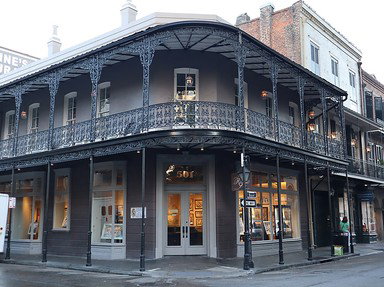
The 1920s saw growing public interest in preserving buildings of architectural significance, and Elizebeth Werlein campaigned actively for maintaining groups that had cultural significance, including Le Petit Salon, Le Petit Théâtre du Vieux Carré, and Le Quartier Club. She also collected extensive photographs of culturally significant buildings (including the famous wrought iron balconies characteristic of the French Quarter, and, as founder and first president of the Vieux Carré Property Owners Association, she led the drive to establish an official organisation to monitor the preservation of the area's unique architectural character. When the Vieux Carré Commission (VCC) was established in 1925, it was just an advisory body, with little influence. In 1936, however, an amendment to the Louisiana constitution gave it some regulatory power, power which increased steadily in the years during and following World War II, to protect the district. Today, it is virtually impossible to make any changes to the exterior of a building - including hanging unauthorised decorative lights at Christmas!
7. Established Café Lafitte bar in the 1930s

Answer: Tom Caplinger

Bourbon Street is known for its bars, and one of the most famous was Café Lafitte, located in a building on the corner of Bourbon Street and St. Philip Street known as Lafitte's Blacksmith Shop. One of the oldest buildings in New Orleans (built before 1722 by Nocolas Touze), this is one of the very few buildings which have survived both the Great Fire of 1788 and the fire of 1794. It is rumored to have been owned by the famous privateers Jean and Pierre Lafitte, and used as a cover for their smuggling business. The pirate theme in decorations and drinks is a natural for the bar.

The first bar in this building, Café Lafitte, was opened by Roger 'Tom' Caplinger (along with HArold Barthel and Mary Collins), who leased the abandoned building in 1933 (shortly after the end of Prohibition) and turned it into a nightspot that attracted celebrities such as Noël Coward, Truman Capote and Tennessee Williams, and also became popular with the gay community. They were known for allowing generous tabs, which was an issue when the owner died in 1953 and they couldn't afford to buy it. (A few years later, a box full of IOUs was found which would have provided sufficient funds for the purchase of the building, had they been collectible.) Caplinger was forced to move, and established Café Lafitte in Exile further down the block. The original building continues to operate as well.

Caplinger died while sleeping in a cot in the bar of Café Lafitte in Exile in March of 1956.
8. District Attorney who conducted Bourbon Street raids in 1962

Answer: Jim Garrison

After World War II, Bourbon Street became the nightlife centre of the city, featuring not only bars but also burlesque houses where exotic dancers, comedians, risqué singers, and live bands entertained the crowds. 'Decent citizens' moved to clean the place up, but with little success before Jim Garrison was elected District Attorney. A few months after taking office, he started a series of raids on the entertainment venues on Bourbon Street, forcing the closure of a number of nightclubs that were convicted of prostitution and selling overpriced alcohol. The headlines helped his career, and venues became more discreet, but the nightlife continued.

James Carothers Garrison (born Earling Carothers Garrison;1921-1992) will be most familiar to many from his role in investigating the assassination of President John F. Kennedy. Garrison was convinced that this was the result of a conspiracy that involved the CIA, the FBI, the Pentagon, the Mafia and more. (He later narrowed his focus to the CIA, but never abandoned his contention that there was a conspiracy, not a lone gunman.) He served as District Attorney of Orleans Parish from 1962 until 1973, during which time he led the unsuccessful prosecution of New Orleans businessman Clay Shaw in relation to the conspiracy.

In the 1991 film 'JFK', largely based on Garrison's book 'On the Trail of the Assassins', he made a cameo appearance as Earl Warren, the Supreme Court judge who supervised the congressional investigation into Kennedy's death. In one of those scenes, Warren is arguing against Garrison's conspiracy theory as he stands on the steps of the Supreme Court.
9. Installed scenic boardwalk in the 1970s

Answer: Moon Landrieu

Maurice Edwin Landrieu (1930-2022) was nicknamed 'Moon as a child, and legally changed his first name to Moon in 1969, during his first campaign to be mayor of New Orleans. He served as the city's 56th mayor from 1970 until 1978, and was noted for his efforts to develop the tourist potential of the city. To that end, he arranged the construction of a wooden boardwalk along the Mississippi River, running the length of the French quarter. The intent was to give residents (and, of course, visitors) access to the river bank, which had previously been dominated by warehouses. The boardwalk, which is now a brick-paved promenade along the levee, offers views of the river and the French quarter, especially a clear view of Jackson Square which it passes. Wrought iron benches offer seating, if you want to relax and enjoy the views, or finish up the muffuletta or beignet you scored in the Quarter. The promenade is called the Moon Walk in honour of the man behind the original idea.

As well as his promotion of tourism in New Orleans, Moon Landrieu was responsible for the establishment in 1976 of the Historic District Landmarks Commission, which extended the control over construction and demolition that the Vieux Carré Commission had exercised over the French Quarter since 1936.
10. Officially reopened the French Quarter after Hurricane Katrina

Answer: Ray Nagin

On 29 August 2005 Hurricane Katrina hit New Orleans with a vengeance, creating storm surges that led to multiple breeches of the levees protecting the city. Within two days, over three-quarters of the city was flooded, with some parts under 5 metres of floodwater. The French Quarter, because it (like most of the area developed before the middle of the 19th century) was built above sea level, suffered far less damage than most of the city, with minor flooding. Most of the damage in the Quarter was wind damage, and some buildings did suffer heavily. Because so many structures were intact, there was little of the looting that occurred in more severely flooded parts of the city, but the French Quarter remained closed for nearly a month before it became one of the first parts of the city in which businesses were allowed to reopen.

Clarence Ray Nagin Jr. (born 1956) served as the 60th Mayor of New Orleans from May 2002 to May 2010. Although he is included here because of the significance of Hurricane Katrina, he is actually not much of a hero. His response to the disaster has been criticized for being too slow to evacuate, and managing the evacuation poorly. The subsequent recovery programs received similar comments. In 2014 he was sentenced to serve ten years in federal prison on corruption charges.
Source: Author looney_tunes

This quiz was reviewed by FunTrivia editor gtho4 before going online.
Any errors found in FunTrivia content are routinely corrected through our feedback system.
Related Quizzes
1. He's Got a Record Very Easy
2. There's No Telling Average
3. Mad Shadows Easier
4. Aquanauts Average
5. Cash and Carrie Easier
6. Stowaways Average
7. These People Rock! Average
8. Millennials! Average
9. A Fine Eton Mess Average
10. Selfless Sacrifices for Greater Good Easier
11. Noted People Easier
12. Just Leave it to the Kids Average

11/20/2026, Copyright 2026 FunTrivia, Inc. - Report an Error / Contact Us