Last 3 plays: idlern (3/10), mazza47 (10/10), thomas1975 (8/10).
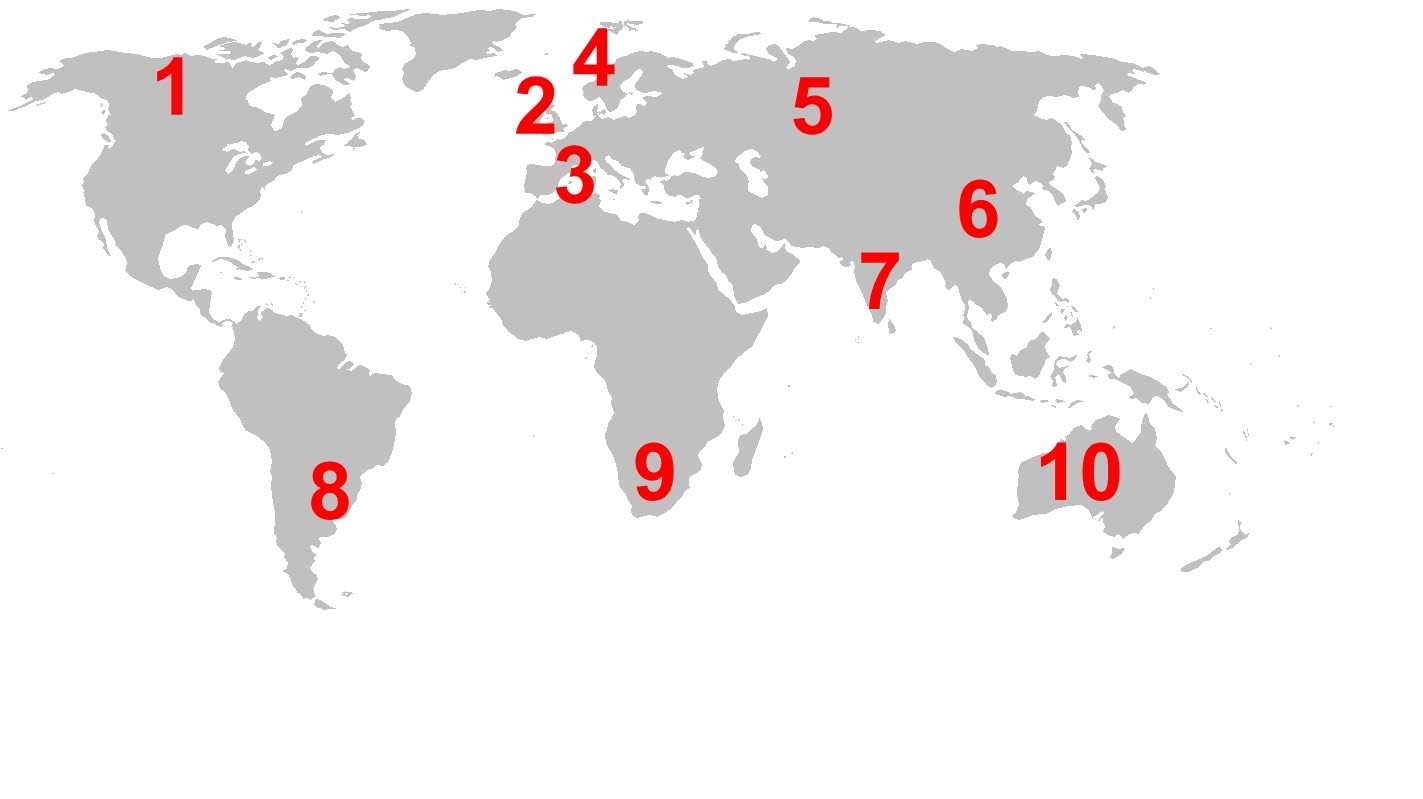
Many countries have more than one patron saint (for instance the USA has five patron saints for the whole country, and almost every state has its own patron saint). I've selected the patron saints to avoid overlapping, so that only one correct solution can be given that suits all countries involved.
Click on image to zoom
The Virgin MaryThomas the ApostleFrancis XavierJean de BrebeufGeorge Joan of ArcMary MacKillopOlaf HaraldssonAndrew the ApostleFrancis Solano* Drag / drop or click on the choices above to move them to the answer list. View Image Attributions for This Quiz
Jean de Brebeuf (1593-1649) was born in Normandy and joined the Society of Jesus. He went as a missionary to Canada in 1625 and converted many Huron to Christianity.
De Brebeuf lived with the Huron several years and was fluent in their language. He also taught the native language of the Huron to other French missionaries and even French traders.
But then the Iroquois went to war against the Huron. The Iroquois captured Jean de Brebeuf and tortured him till death.
Pope Pius XI canonized Jean de Brebeuf in 1930, and Pope Pius XII declared in 1940 that Jean de Brebeuf was one of the patron saints of Canada - the place where he was martyred.
2. George
Saint George was probably a Roman soldier from Greek descent, born in Cappadocia and martyred under Emperor Diocletian in 303. But George is not only a saint in the Christian religion, he became also a venerated prophet in the Muslim world.
One of the best known legends is that a dragon terrorized a region in the Middle East, possibly Lydda (nowadays Israel - between Jerusalem and Tel Aviv) or Trebizond (Turkey, near the Black Sea). The people had to bring sacrifices to the dragon, up to their local princess. And then appeared George, mounted on his war horse, who battled the dragon and killed it with his lance.
As this legend was first put in writing several centuries after the life and death of George, the historicity of this legend is very much in doubt. But there is almost no doubt that a certain soldier named George was martyred in 303 at the orders of Diocletian.
Saint George is patron saint of many countries. The best known of his patronages is of course England, where April 23 (supposedly the date when George died) is an important national feast.
3. Joan of Arc
Joan of Arc (1412-1431) was a simple peasant girl, but she felt it her duty to take up arms and serve for the French king Charles VII in the Hundred Years' War. Her presence at the battlefield did inspire a French victory at Orleans, and then she pressed on towards Reims (where Charles was crowned).
After the coronation ceremony, Joan insisted on retaking Paris, but Charles first tried to negotiate a truce.
Meanwhile Joan was captured and transferred to Rouen, where the English put her on trial for heresy.
The trial was not held up to the usual standards, as the English pressed for a conviction. And so Joan was convicted and executed by burning at the stake.
4. Olaf Haraldsson
Olaf Haraldsson (995-1030) was king Olaf II of Norway from 1015 until 1028. His contemporaries ascribe to him to have christened all of Norway, but historians disagree with this simplistic representation of facts. Olaf did indeed commit some effort to christen the Norse inland, but coastal areas had already visible Christian influence.
Olaf was canonized almost immediately after his death, and based upon his so-called Christianization of all of Norway, he was soon declared Norway's patron saint.
5. Andrew the Apostle
After the death and resurrection of Jesus Christ, his Apostles spread out all over the world to spread Christianity. Andrew went to the regions around the Black Sea and would even have reached Kiev, then the capital of what would become the Russian Empire. (Nowadays Kiev is the capital of Ukraine). According to local sources, Andrew predicted the future of Kiev as a city with many Christian churches.
Andrew was put to death in Patras, in the northern part of Greece. His relics were spread to many places, including even Scotland - at that time considered the end of the world.
According to tradition in the Orthodox Christian Church, the patriarch of Constantinople is the successor of Saint Andrew.
6. Francis Xavier
Francis Xavier (1506-1552) was born in Navarre, Spain. In 1534 he was one of the first to join Ignatius of Loyola in founding the Society of Jesus.
In 1540 the Portuguese King sought some priests as missionaries to the newly colonized territories in Asia. Francis was one of the two Jesuits who travelled to Asia for missionary work, and Francis became the more successful of both.
Francis Xavier started his missionary work in India, concentrating on converting the lower classes - but without great advancement. Then he travelled to Indonesia and Japan, where he first approached the nobility - a tactic that gave off better results. In 1552 he travelled to some Chinese islands, but before seriously undertaking missionary work, he fell ill. Francis Xavier died the same year.
Francis Xavier is probably patron saint of several countries, but sources disagree. The website www.catholic.org lists him only as national patron saint of China, while www.catholicdoors.com lists him as national patron saint of Australia, India, Mongolia and Pakistan. Wikipedia lists even more countries of which Francis Xavier is patron saint: China, India, Pakistan, Fiji, Japan, New Zealand, Indonesia, Brunei, Singapore and Sri Lanka.
7. Thomas the Apostle
Thomas the Apostle is best known for the episode in which he doubted the resurrection of Jesus Christ, until He appeared to him and allowed him to touch the deadly wounds. After Pentecost, Thomas travelled to the east to preach the Christian religion. Thomas died in 72 in India, near Chennai, the east coast of India.
Saint Thomas thus became national patron saint of India, where there are several major churches dedicated to him. As he originally was a stone mason charged with building houses, he has also been declared patron saint of architects.
8. Francis Solano
Francis Solano (1549-1610) was born in Spain. He joined the Order of Friars Minor (Franciscan order) and went as a missionary to South America. He started his missionary work in 1589 in Peru, spreading his mission to Paraguay, Bolivia, Chile and Argentina -countries that all chose him for national patron saint.
The number 8 on the world map is placed within the frontiers of Argentina.
Francis Solano would have easily adopted the various languages of local tribes, but at least one source mentions the miracle that he would speak Spanish and yet be understood by members of various tribes who didn't speak Spanish at all.
9. The Virgin Mary
There are some major discrepancies in the list of national patron saints whereas South Africa is concerned: www.catholicdoors.com mentions Rose of Lima and Our Lady of Guadalupe, and www.catholic.org has selected Our Lady of the Assumption.
Finally the website catholicsaints.info confirmed that Pope Pius XII declared Our Lady of the Assumption to be patron saint for the whole southern part of Africa (including thus South Africa and some adjacent countries). Wikipedia mentions Martin of Tours and Saint George in the list of patron saints per country to be patron of South Africa, but neither the article on Saint George nor the article on Saint Martin mention South Africa as one of their patronages.
There is a local martyr (Blessed Benedict Daswa) who also comes into mind, but he has not been canonized at the moment I wrote this quiz.
The Virgin Mary is of course one of the most venerated saints in the Christian tradition. She gave life to Jesus Christ and was present at His crucifixion.
The story of Our Lady of Guadalupe (and the reason why Mary is patron saint of dozens of South-American places) is worth discussing here.
On the way to Mexico City, a peasant named Juan Diego witnessed in December 1531 the apparition of a beautiful lady, who spoke to him in Nahuatl and declared to be Mary, mother of Jesus Christ, and asked him to inform the clergy of her wish that a church be erected at that spot (nowadays the city of Guadalupe, Mexico).
Juan Diego visited the archbishop of Mexico City, but the archbishop would not believe him without a piece of physical evidence. Mary appeared to Juan Diego three more times, and at the last apparition she left physical evidence. She told Juan Diego to pick some Castilian roses on the spot (which normally was barren, and Castilian roses were not native to Mexico anyway). He wrapped the roses in his cloak, and when he showed the flowers to the archbishop, the cloak miraculously presented a painting of the Virgin Mary.
10. Mary MacKillop
Mary MacKillop (1842-1909) was born in Melbourne, Australia. She worked at first as a governess for some wealthy children, but included poor children of the neighbourhood also in her teachings. In 1864 she started a catholic school, and her sisters plus several other young girls congregated to teach the poor children. The congregation was named the Sisters of Saint Joseph of the Sacred Heart and received papal approval in 1875.
Mary MacKillop was canonized in 2010, as the first saint born in Australia (according to the Roman Catholic church - the Orthodox church has canonized another Australian).
This quiz was reviewed by FunTrivia editor LeoDaVinci before going online.
Any errors found in FunTrivia content are routinely corrected through our feedback system.