FREE! Click here to Join FunTrivia. Thousands of games, quizzes, and lots more!
Quiz about Elementally Speaking Antimony

Elementally Speaking: Antimony Quiz


If you've ever wanted to learn about antimony-or if you're eager to show off your deep knowledge of it-here's the quiz you've been waiting for your whole life (sorry). From its symbol to its uses in plastic and batteries, this one runs the gamut. Enjoy!

A multiple-choice quiz by JJHorner. Estimated time: 2 mins.
  1. Home
  2. »
  3. Quizzes
  4. »
  5. Science Trivia
  6. »
  7. Chemistry
  8. »
  9. Specific Elements

Author
JJHorner
Time
2 mins
Type
Multiple Choice
Quiz #
423,996
Updated
Apr 30 26
# Qns
10
Difficulty
Average
Avg Score
8 / 10
Plays
27
Last 3 plays: Guest 166 (3/10), Guest 99 (6/10), cardsfan_027 (10/10).
- -
Question 1 of 10
1. What is the chemical symbol for antimony? Hint


Question 2 of 10
2. How many protons do antimony atoms each contain? Hint


Question 3 of 10
3. On the periodic table, antimony is classified as what type of element? Hint


Question 4 of 10
4. What ore is the primary natural source of antimony? Hint


Question 5 of 10
5. Antimony is known for its high electrical conductivity.


Question 6 of 10
6. Which of these properties best describes how antimony reacts when struck or stressed? Hint


Question 7 of 10
7. Antimony, like water, expands when it solidifies.


Question 8 of 10
8. What type of batteries commonly use antimony to strengthen lead components and improve durability? Hint


Question 9 of 10
9. Antimony compounds are used in the production of what type of material for bottles and packaging? Hint


Question 10 of 10
10. When combined with halogens, antimony trioxide exhibits a property which makes it useful as a what? Hint


(Optional) Create a Free FunTrivia ID to save the points you are about to earn:

arrow Select a User ID:
arrow Choose a Password:
arrow Your Email:


Most Recent Scores
Today : Guest 166: 3/10
Today : Guest 99: 6/10
Today : cardsfan_027: 10/10
Today : cowalsh: 10/10
Today : mjgrimsey: 4/10
Today : bigjohnsludge: 10/10
Today : pennie1478: 9/10
Today : psnz: 10/10
Today : james1947: 10/10

Quiz Answer Key and Fun Facts
1. What is the chemical symbol for antimony?

Answer: Sb

Chemists lovingly refer to antimony as Sb. If it feels like that symbol wandered drunkenly onto the periodic table from some other language... well, it did. The symbol comes from the element's Latin name 'stibium'.

Ancient Egyptians used compounds of antimony as eye makeup, giving their eyeliner a bit of a toxic flair because you only live once. Fast forward a few thousand years and antimony is still hanging around, now helping harden lead in batteries and playing a major role in flame retardants. If it's not really the life of the party, it's still useful in a quiet, unassuming way.

Also, a tip to the unwary: this is one you probably don't want to eat. I'm here to help, folks.
2. How many protons do antimony atoms each contain?

Answer: 51

Antimony has an atomic number of 51 on the periodic table. This means every antimony atom has exactly 51 protons tucked into its nucleus. You want more protons? Go take a tellurium quiz. Team Antimony wears number 51 with pride.

Chemistry is picky that way.

Those 51 protons (and the electron configuration they set up) also explain why antimony behaves the way it does. It sits in that weird middle ground between metals and nonmetals, making it a metalloid. So it borrows traits from both sides. We'll get into some of its metalloid traits as we go on.
3. On the periodic table, antimony is classified as what type of element?

Answer: Metalloid

Yeah, antimony sits in that awkward middle-child area of the periodic table where elements cannot quite decide what they want to be. It is classified as a metalloid, meaning it borrows traits from both metals and nonmetals. It can conduct electricity better than a nonmetal but not as well as a true metal. Jack of all trades, master of none.

This in-between status actually makes antimony pretty useful. It shows up in semiconductors, flame retardants, and alloys where a little bit of flexibility goes a long way. Metalloids like antimony are quite the problem-solvers of the element world. None of the flash and flair of the noble gases. None of the stubborn sturdiness of the alkaline earth metals. But give them a chance and the right job, they'll happily deliver for you. Go metalloids!
4. What ore is the primary natural source of antimony?

Answer: Stibnite

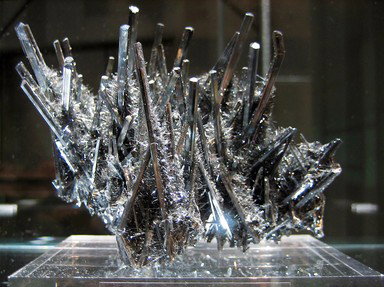
Stibnite is the primary natural source of antimony. It's pretty hard to miss once you know what to look for. Look at the cover photo for this quiz. It's not inconspicuous.

Stibnite forms these long, needle-like metallic crystals that look way too dramatic to be real. Chemically, it is antimony sulfide, and for centuries it has been the go-to ore for getting at the element. The name also ties back to antimony's Latin name 'stibium', which explains that slightly mysterious chemical symbol Sb.

Stibnite has been more than just an industrial raw material. As I mentioned above, ancient civilizations ground that flashy rock into powder and used it as eye makeup, especially in Egypt and the Middle East. Nefertari, your eyeliner is fantastic! Is that the flame-retardant metalloid that all the girls have been talking about?
5. Antimony is known for its high electrical conductivity.

Answer: False

Nah, I lied. I'm sorry. In truth, antimony is not winning any awards when it comes to electrical conductivity. As a metalloid, it sits in that middle ground where it CAN conduct electricity, but it's about as eager to do so as I am to clean the toilet. Compared to true metals like copper or silver, which let electrons zip right on through with minimal resistance, antimony is more like my wife trying to make a left turn. "Aw, honey. You could have gone!"

But like my wife, this reluctance is actually part of the charm. Because antimony is not too conductive and not too insulating, it is useful in semiconductors and electronic components where controlled electrical behavior matters more than getting home in time for the big game.
6. Which of these properties best describes how antimony reacts when struck or stressed?

Answer: Brittle and prone to shattering

Antimony doesn't take kindly to being hit. It's like me that way. It doesn't stretch or bend. It just snaps. This brittleness is its calling card. When stress is applied, the material fractures rather than deforming. If you were hoping to hammer it into shape or pull it into wires, you would be in for a short and ever so disappointing day in the garage.

This brittle nature is one reason antimony is often mixed with other metals instead of being used on its own. When added to lead, for example, it can harden the alloy without making it completely fragile. Thus, the alloy manages to be strong and durable, despite being made of two relative wimps.
7. Antimony, like water, expands when it solidifies.

Answer: True

Antimony is one of those weirdos that expands when it solidifies, much like water turning into ice. Most substances do the opposite. Their atoms pack closer together as they freeze.

Not antimony, though. It forms a crystalline structure in its solid state that actually takes up more space than its liquid form. So instead of shrinking neatly into place, it puffs up a bit, which is not at all what you would expect unless you've spent a lot of time thinking about crystal lattices, and I really hope that you haven't.

The reason comes down to how its atoms arrange themselves. In liquid form, antimony atoms are relatively disordered and can sit closer together.

Once it solidifies, the atoms lock into a more open, rigid structure with slightly greater spacing between atoms. This expansion property is weirdly useful. It helps antimony-containing alloys fill molds more completely when cooling, making them valuable in casting applications where fine detail matters.
8. What type of batteries commonly use antimony to strengthen lead components and improve durability?

Answer: Lead-acid batteries

Yep, lead-acid batteries are where antimony does some of its best work. A small amount of antimony is added to the lead plates inside the battery to make them harder and more durable. Pure lead is soft, which isn't what you want when you're dealing with repeated charging cycles and mechanical stress. Throw in a bit of antimony, and suddenly those plates can take a lot more abuse without falling apart. Go antimony!

This ingenious little tweak has been especially important in traditional car batteries, where reliability matters more than glitz. Antimony helps the plates maintain their shape and improves overall battery lifespan, even if it comes with a slight trade-off in efficiency.
9. Antimony compounds are used in the production of what type of material for bottles and packaging?

Answer: Polyethylene terephthalate (PET) plastics

Antimony compounds play an important role in making polyethylene terephthalate, which is commonly known as PET, or so they say. This is the clear, lightweight plastic you know from everything from water bottles to food packaging.

Antimony compounds act as catalysts during production, helping the chemical reactions run faster and more efficiently. Sans antimony, the whole process gets a lot slower and less practical on an industrial scale.

PET itself is popular because it is strong, transparent, and surprisingly good at keeping things fresh. It also has decent recyclability, which gives it a bit of an environmental edge compared to some other plastics, even if the overall plastic situation is still... well, complicated.
10. When combined with halogens, antimony trioxide exhibits a property which makes it useful as a what?

Answer: Flame retardant

Without doubt, this is the question fans of antimony have been waiting for. Antimony trioxide shines when it teams up with halogens like bromine or chlorine. Together, they form a dynamic duo that interferes with combustion at the chemical level.

Instead of letting a fire do what a fire does best, these compounds disrupt the chain reactions that keep flames going. The result? Materials that are much harder to ignite and slower to burn. If you're looking for a flame retardant, that's a good thing.

This is why antimony trioxide shows up in things like plastics, textiles, and electronic components, places where fire safety is not optional. It does not actually stop something from catching fire entirely, but it buys some time by slowing the spread.

And that's all I've got to say about antimony.
Source: Author JJHorner

This quiz was reviewed by FunTrivia editor rossian before going online.
Any errors found in FunTrivia content are routinely corrected through our feedback system.
Related Quizzes
1. Oxygen Average
2. Hydrogen - The Lightest Element Average
3. Iron Average
4. Hydrogen Tough
5. Sulfur Average
6. Aluminum Tough
7. Carpe Diem: Cesium the Day Average
8. Mercury Average
9. Helium - The Balloon Gas Average
10. Helium Tough
11. Carbon - the basis of life Average
12. Breathe deep: Oxygen Tough

4/30/2026, Copyright 2026 FunTrivia, Inc. - Report an Error / Contact Us