FREE! Click here to Join FunTrivia. Thousands of games, quizzes, and lots more!
Quiz about My Head in the Clouds

My Head in the Clouds Trivia Quiz

Identify the Cloud Type

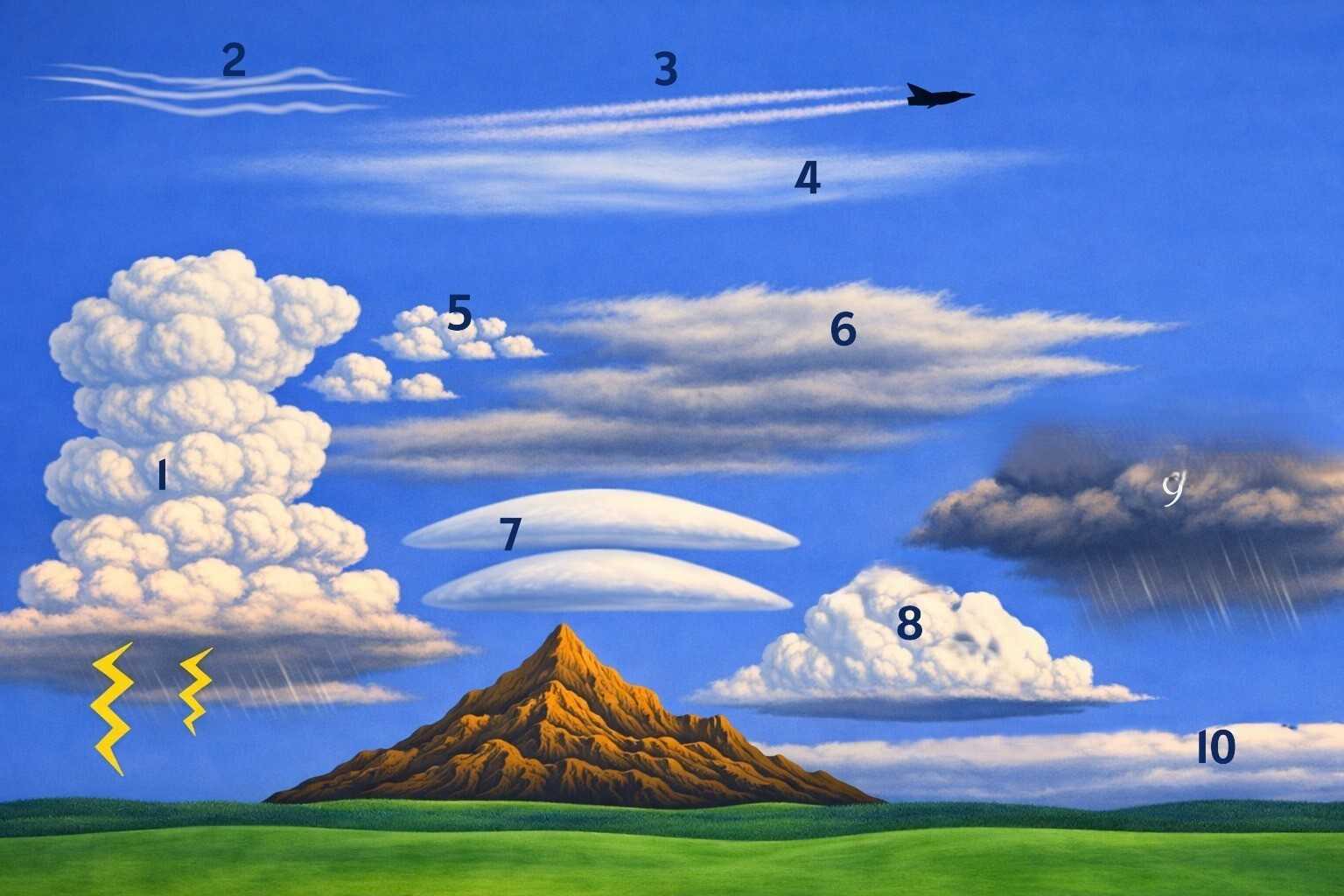
Clouds are valuable signposts to our weather. Pilots and sailors in particular learn to read them to keep safe and take best advantage of conditions. Can you identify these clouds?

A label quiz by windrush. Estimated time: 3 mins.
  1. Home
  2. »
  3. Quizzes
  4. »
  5. Science Trivia
  6. »
  7. Environment
  8. »
  9. Weather

Author
windrush
Time
3 mins
Type
Label Quiz
Quiz #
424,009
Updated
May 03 26
# Qns
10
Difficulty
Tough
Avg Score
6 / 10
Plays
19
Last 3 plays: Guest 188 (6/10), Olderbison (2/10), xchasbox (6/10).
Drag and drop the labels to identify the cloud type. The clouds can be identified by whether they are high, medium or low level in the sky (although a couple can extend through layers).
Click on image to zoom
Cumulus Lenticular Altostratus Cumulonimbus Nimbostratus Cirrus Contrail Cirrostratus Altocumulus Stratus
* Drag / drop or click on the choices above to move them to the answer list.
View Image Attributions for This Quiz
1.   
2.   
3.   
4.   
5.   
6.   
7.   
8.   
9.   
10.   

Most Recent Scores
Today : Guest 188: 6/10
Today : Olderbison: 2/10
Today : xchasbox: 6/10
Today : malidog: 4/10
Today : LancYorkYank: 10/10
Today : Jaydel: 5/10
Today : bernie73: 1/10
Today : Aph1976: 5/10
Today : cowalsh: 10/10

Quiz Answer Key and Fun Facts
1. Cumulonimbus

Cumulonimbus (or cu-nims, as their friends affectionately know them) are storm clouds. They start off as the harmless cumulus but, due to atmospheric instability, (and often in a low-pressure system) warm air will be forced upward very rapidly, and the cloud will rapidly start to tower from close to the ground, often into the upper (cirrus) layer, where it may form an anvil head with its upper surface flattened and spreading downwind.
2. Cirrus

Cirrus are very high level clouds formed of ice crystals. The typical cirrus clouds are delicate and wispy, sometimes forming feather or mare's tail shapes high in the sky. They usually form when warm and dry air rises extremely high, bringing with it dust particles which form into thin cloud as the air cools and condenses.
3. Contrail

Though man-made, a contrail is still an ice cloud, line shaped, often forming two parallel lines. It is formed when a hot, humid engine exhaust mixes with extremely cold air in the high atmosphere, typically between 25,000 and 35,000 ft.
4. Cirrostratus

Cirrostratus is a very high, milky, thin veil of cloud that can cover large areas, sometimes the entire sky seen from an observer's viewpoint. It generally forms before a major 'front' or weather change, and is caused by a large area of warm moist air slowly ascending until it reaches the upper atmosphere and forms a sheet (sometimes thick, sometimes thin) of ice crystals.
5. Altocumulus

Altocumulus are caused by convection (warm air rising) in the middle (Alto) level of the atmosphere (roughly 7,000-25,000 ft). In the same way that cumulus forms in the lower levels, it cools and condenses into small cloudlets, sometimes covering a large area of sky.
6. Altostratus

Altostratus are middle level clouds that form a fairly uniform horizontal sheet. They are often predictors of a warm front, and can be followed by a period of steady rain (or, in colder climates, snow).
7. Lenticular

Lenticular clouds are often called wave clouds by sailplane pilots as they mark an area of rising (often extremely fast rising) air. They form when air is forced upward over an obstacle, such as a steady wind rising over a mountain range and, because the air is smooth rather than turbulent, the cloud takes on a smooth laminar appearance, often shaped like a cross section of a wing, or even looking like a flying saucer.

Airline pilots try to avoid these areas as, behind the smooth rising air, there is often an extremely turbulent rotor, causing what were once called 'air pockets', with incredibly rough rapidly sinking air.
8. Cumulus

Cumulus range from fluffy cottonwool clouds to much larger formations which can, under very unstable conditions such as a pressure trough, grow into towering cumulonimbus. For the most part they are the markers of a warm sunny day, much loved by sailplane pilots as signposts to the next thermal (the column of rising air beneath the cloud).

They will sometimes align as 'cloudstreets' on a breezy day, allowing a sailplane or soaring bird to fly in almost uninterrupted rising air without having to stop to circle. Great fun!
9. Nimbostratus

Nimbostratus generally means a day with gloomy, overcast conditions bringing continuous rain or sleet. It generally forms in the middle (alto) layer of our atmosphere, although it will often spread to the other levels, possibly because it has a tendency to hang around. It often forms on the leading edge of a warm front.
10. Stratus

Stratus clouds are much the same as cirrostratus or altostratus, but at a much lower level. Again, this is a fairly flat sheet of cloud, usually spread over a wide area, sometimes described as above-ground fog. It may occasionally cause a light drizzle but, generally, the air is very stable and uniform.

This is the kind of day best left to the duty instructor and pupils to practise their circuits and landings in the two-seater. I am going to open the club bar, and we can enjoy some tall flying stories together. Cheers!
Source: Author windrush

This quiz was reviewed by FunTrivia editor rossian before going online.
Any errors found in FunTrivia content are routinely corrected through our feedback system.
Related Quizzes
1. A History of Weather Easier
2. A Question of Weather Easier
3. Hazard a Guess? Average
4. Dust In the Wind Average
5. Lightning Facts Average
6. Let It Rain Average
7. Riders on the Storm Average
8. My Mind Melted! Average
9. Seasonal Weather in Wichita, Kansas Average
10. Sometimes It Snows In April Average
11. The Science of Snowflakes Average
12. Red Sky at Night Average

5/3/2026, Copyright 2026 FunTrivia, Inc. - Report an Error / Contact Us