FREE! Click here to Join FunTrivia. Thousands of games, quizzes, and lots more!
A Dozen Outstanding British Landmarks Quiz
There are many, many landmarks and points of interest in the UK. Here are but twelve of them. You need to match the photo of the landmark to its location in the UK.
Last 3 plays: wycat (4/12), SueLane (12/12), MargW (9/12).
Match the location to the landmark. If the quiz were to match the landmark name to the photo, this would have been too easy (e.g. Tower Bridge, Dover Castle). To make the quiz a bit easier, all the landmarks are in a certain order...
Drag-Drop or Click from Right
Options
YorkFalkirkLiverpoolPortsmouthBristolBelfastConwy, WalesLondonCounty AntrimGateshead near NewcastleFirth of ForthBrighton
Sep 14 2026
:
wycat: 4/12
Sep 11 2026
:
SueLane: 12/12
Sep 09 2026
:
MargW: 9/12
Aug 31 2026
:
piet: 12/12
Aug 26 2026
:
Southendboy: 12/12
Aug 25 2026
:
Dorsetmaid: 12/12
Aug 23 2026
:
jonathanw55: 7/12
Aug 22 2026
:
Guest 51: 10/12
Aug 22 2026
:
jogreen: 12/12
Quiz Answer Key and Fun Facts
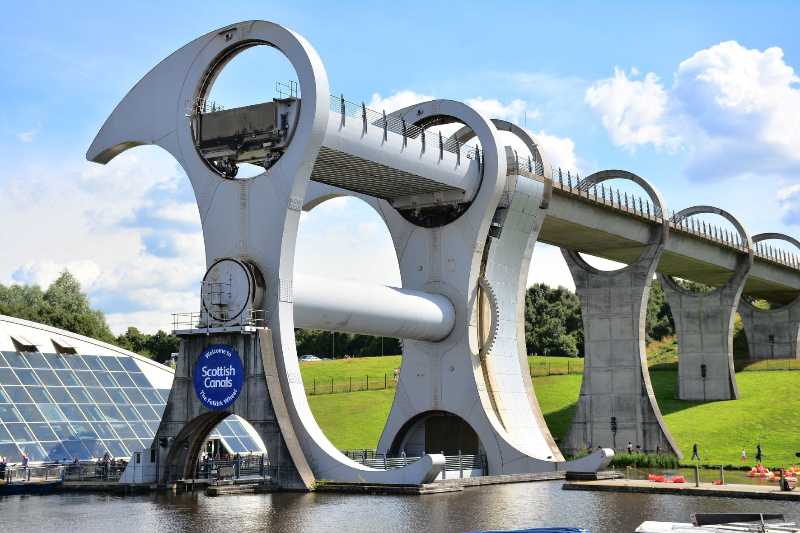
1. Falkirk
Falkirk Wheel 56.01 N, 3.84 W
The Falkirk Wheel is a rotating boat lift in Tamfourhill, Falkirk, between Edinburgh and Glasgow, connecting the Forth and Clyde Canal with the Union Canal.
These two canals were once the lifeblood of the transportation of goods between Scotland's two biggest cities. However, the railway network in the mid-19th century eroded the importance of the canal network, and by the 1930s, the maintenance and upkeep of the canals exceeded the income they produced. This maintenance was due in no small way to the extensive lock system needed to connect the two canals, which had a 35-metre (115 ft) difference in height, requiring a series of 11 locks needing 3500 tonnes (3400 long tons) of water movement per vessel.
As a Millennium project, there was a proposal and funding to connect the two canals again so that they could host a leisure craft waterway. The piece de resistance of this project was the Falkirk Wheel, which raises boats by 24 m 79 feet). However, the Union Canal is still 11 metres (36 ft) higher than the aqueduct which meets the wheel, necessitating a pair of locks between the top of the wheel and the Union Canal. The Wheel is the first rotating boat lift in the world and one of only two boat lifts in the UK. The Alderton Boat Lift is in Cheshire and nowhere near as sophisticated.
Construction occurred between 1999 and 2002. The Wheel itself cost £17.5 million to build, but this was part of a much wider £84.5 million Millennium Link project, which was the total cost to link the two canals. It is now one of Scotland's biggest tourist attractions.
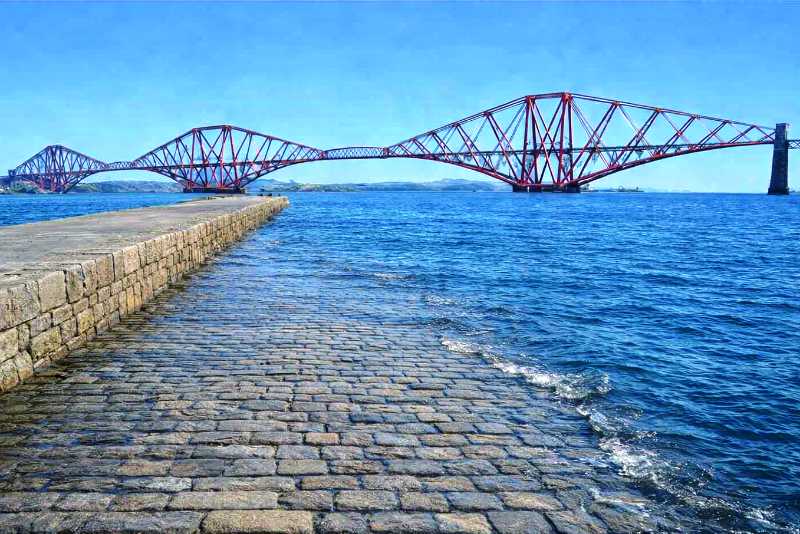
2. Firth of Forth
Forth Bridge 56.00 N, 3.34 W
The Firth of Forth is an inlet of the North Sea that separates Fife and Lothian, north of Edinburgh. For transport, it was first crossed by ferries. Railways from London's King's Cross to Aberdeen had to deviate westward to get around the inlet. A large bridge was required. In 1882, construction of the Forth Bridge began. It was a special bridge, well ahead of its time. Everything about it was unique: the cantilever design was revolutionary, as it used three huge double cantilever structures which are 361 ft (110 m) tall, with two main spans of 1,709 ft (521 m). These were the largest cantilever spans in the world at the time of construction, and over 130 years later they were still the second-longest behind Canada's Quebec Bridge. This was the UK's first major all-steel construction. (Previously, most bridges were constructed of wrought iron). Its engineering scale can be illustrated by the caissons (support for upright pylons), which were sunk 89 feet (27 m) into bedrock below the sea bed. The bridge used 55000 tonnes of steel, 140 cubic yards of masonry and 6.5 million rivets.
Around 200 trains per day still crossed the bridge in 2025. In 2016, it was voted Scotland's greatest man-made wonder, and it was named a UNESCO World Heritage Site in 2017.
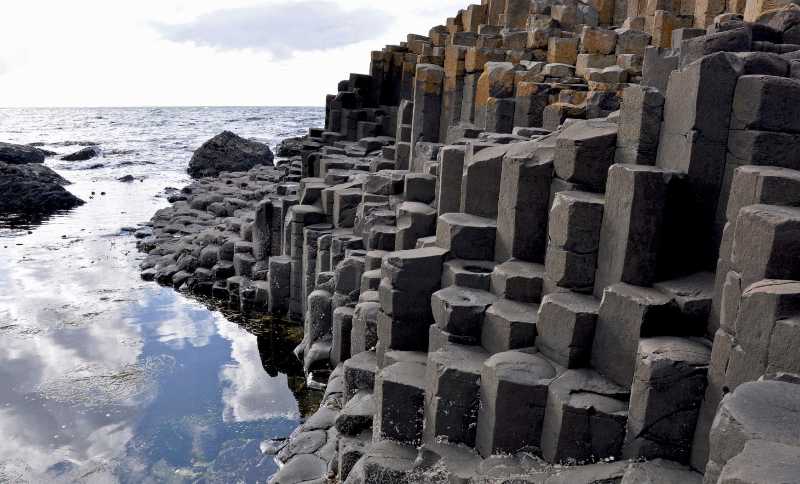
3. County Antrim
Giant's Causeway 55.23 N, 6.24 W
The Giant's Causeway consists of approximately 40,000 interlocking basalt columns, a result of an ancient volcanic eruption in the Paleogene era, 43-66 million years ago. This occurred when molten basalt was forced through chalk beds to form a volcanic plateau. As the lava cooled, contraction and solification into columns occurred. The column height can be as high as 12 metres (39 ft). The tops of the columns are mainly hexagonal, but may have four, five, seven, or eight sides. These form stepping stones from the shoreline cliffs until they recede into the sea.
According to mythology, the Irish giant Fionn mac Cumhaill (Finn MacCool) was challenged to a fight by Benandonner, the Scottish giant. MacCool built the causeway across the Irish Sea to meet and fight the Scot.
The area was designated a World Heritage Site by UNESCO in 1986. A 2005 survey by "Radio Times" revealed that the causeway was the fourth-greatest natural wonder in the UK behind Dan yr Ogof (Welsh caves), Cheddar Gorge, and the White Cliffs of Dover.
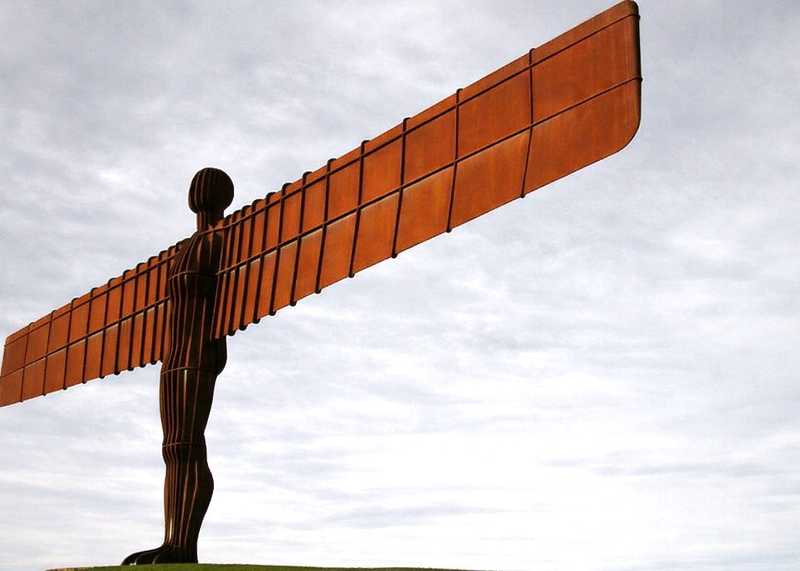
4. Gateshead near Newcastle
Angel of the North 54.91 N, 1.59 W
The Angel of the North is a modern sculpture by Antony Gormley that stands on a hill near the A1 at Gateshead on the main southern approach to the city of Newcastle. As such, it is seen by over 23 million people every year. In 1990, a project was commenced by Gateshead Council to create a landmark that would be a "millennial image that would be a marker and guardian for our town". The result was the Angel of the North, completed in 1998.
The sculpture stands 20 metres (66 ft) tall with a wingspan of 54 metres (177 ft). The vertical ribs on the wings and body act somewhat like a skeleton and deflect wind downwards to the sculpture's foundations to enable it to withstand wind speeds of over 100 miles per hour (160 km/h).
Despite initial opposition, the sculpture has become an icon and landmark for northeast England. At Christmas time in 2018, a group of ten abseiled to the top of the statue to place a Santa hat on its head. They then abseiled again to remove the hat before the New Year. The sculpture has certainly caught the public's imagination.
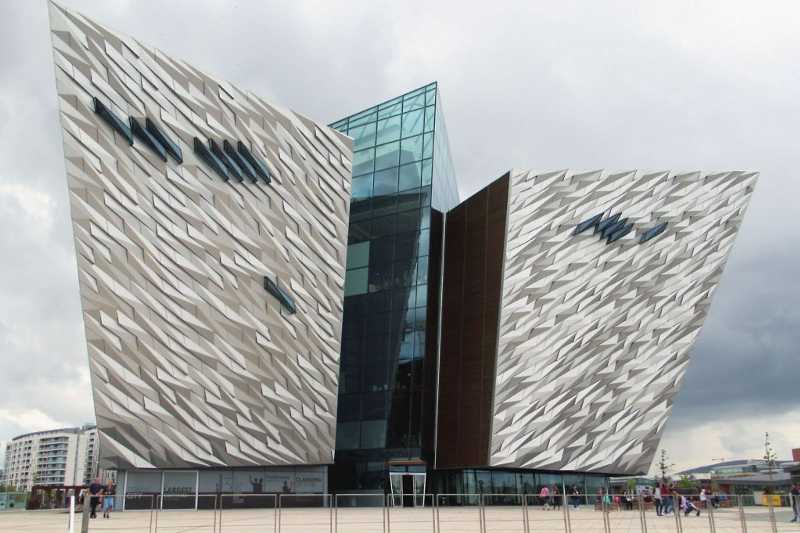
5. Belfast
Titanic Belfast 54.61 N, 5.91 W
Titanic Belfast is a landmark, museum and public attraction in Belfast, Northern Ireland, which opened in 2012, a century after the RMS 'Titanic' sank. It is built on a historic site (renamed the Titanic Quarter in 2001 and earmarked at the time for regeneration) that was once the Harland & Wolff shipyard where the RMS 'Titanic' was built. However, the decline of shipbuilding in Belfast left much of the area derelict after much of the shipbuilding infrastructure was demolished. Some of the heritage features were given listed status, such as the 'Olympic', 'Titanic', and 'Britannic' slipways as well as the huge Samson and Goliath cranes, themselves a Belfast landmark.
The eight-story building contains more than 12,000 square metres (130,000 sq ft) of floor space, most of which is occupied by museum galleries dedicated to the Titanic, conference and community facilities. The distinctive external design resembles a series of four ships' prows, with the main prow pointing towards the middle of the 'Titanic' and 'Olympic' slipways. The buildings are 126 feet (38 m) high, the same height as the 'Titanic's hull. The buildings are very distinctive as they are clad in 3000 separate silver anodised aluminium shards.
The visitor projections showed that 425,000 visitors annually would visit the facility, of whom between 130,000 and 165,000 would come from outside Northern Ireland. In its first year of operation, these projections were exceeded, with 807,340 visitors, of whom 471,702 were from outside Northern Ireland. In 2016, the museum was awarded the World's Leading Tourism Attraction Award at the World Travel Awards.
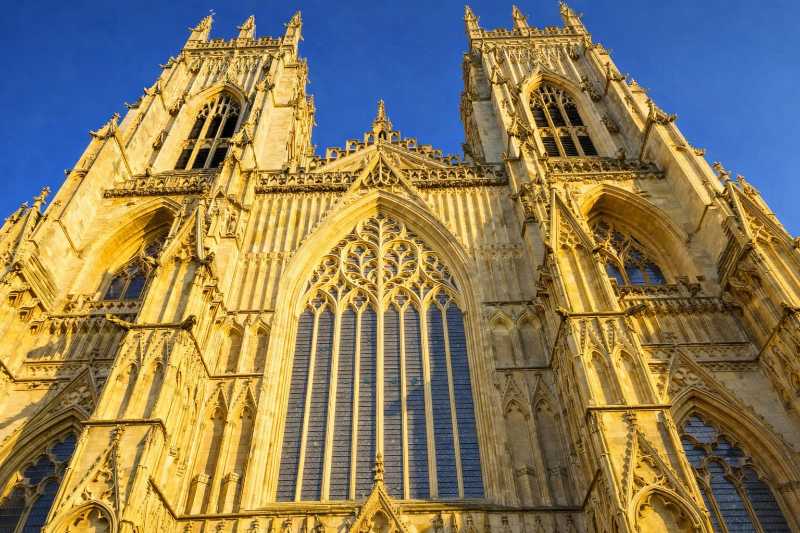
6. York
York Minster 53.96 N, 1.08 W
The Cathedral and Metropolitical Church of Saint Peter in York, known more commonly as York Minster, is an Anglican cathedral in the city of York. It is the seat of the archbishop of York, which is the second-highest office of the Church of England. The minster is a Grade I listed building and a scheduled monument, which gives it added protection against change. The church can trace its origins back to 627. The present church was commenced in 1230, and its present configuration was completed in 1472. It has survived fires, ransacking and the English Civil War.
York Minster, Canterbury Cathedral, and Westminster Abbey are the three giants of English religious architecture. However, despite being built to match the prestige of Canterbury Cathedral, it is the most English of the three, with Canterbury Cathedral having Norman and French influences. While Westminster Abbey is English Gothic, it has more French attributes than the other two. The current York Minster, which commenced in 1220, is bigger, lighter and more structurally ambitious than Canterbury. Its size is huge: 525 feet (160 m) in length, 235 ft (72 m) in height and the widest nave in England. While it has mainly architectural innovations, none more so than the octagonal chapter house, which has no central supporting column.
York Minster has more medieval glass than any other English cathedral, which includes: The Great East Window (1405-8), which is the largest single expanse of medieval stained glass in the world (and depicts the Book of Revelation); The Five Sisters windows (c. 1250-1260), which are five 53ft lancets, making it the largest expanse of grisaille glass in the world; and the Rose Window (c. 1500) is 73 panels of stain glass that depicts the union of the Houses of York and Lancaster. There are approximately two million pieces of glass in the whole cathedral.
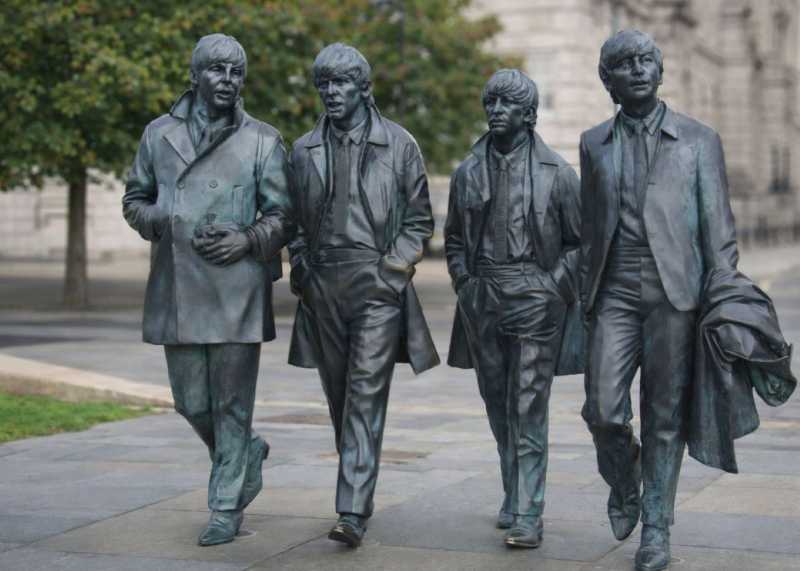
7. Liverpool
53.40 N 2.99 W Beatles Statue
The Beatles Statue is a tribute to the four musicians who were all Liverpool lads. The statue was unveiled on 4th December 2015 to mark 50 years since the last Liverpool Beatles concert. The statue can be seen at the Pier Head, next to the intersection of Brunswick Street and Canada Boulevard, near the Three Graces, thereby connecting Liverpool maritime waterfront legacy with its musical heritage. Each statue is 2.0-2.2 metres tall ( 6'7"-7'2"), whereas the Beatles' actual height ranged from 1.65-1.80 m (5'6" to 5'11"). The statue was funded by Liverpool's Cavern Club (200,000 pounds), with Andy Edwards, a local sculptor, creating the masterpiece.
The concept originated with Chris Butler, a foundry owner from the Baltic Triangle to the south of Liverpool City centre. He took inspiration from the "Live at the BBC" album (1994) and imagined a statue with a similar walking pose. He combined that with publicity shots taken at Pier Head in 1963. Together, this gave the statue both its pose and its location.
There are some symbolic gestures in the statue: The only two hands visible across the four musicians are Paul's left hand and John's right hand, representing the hands that wrote most (but certainly not all) the Beatles' songs. In his left hand, Paul carries a camera, which is a tribute to his first wife, Linda, who was an accomplished photographer. Around George's waist, at the back, is a belt inscribed with the Gayatri Mantra (in Sanskrit), reflecting his identification with Eastern philosophy, Indian spirituality and meditation. On the sole of one of Ringo's shoes is the postcode L8, which is the neighbourhood where Ringo grew up in the Welsh streets. Ringo also stands slightly behind the other three, indicating his stage position behind his drum kit.
The statue features no instruments as it captures a moment, not a performance. Similarly, there is no plaque as the statue captures the four as people, not musicians.
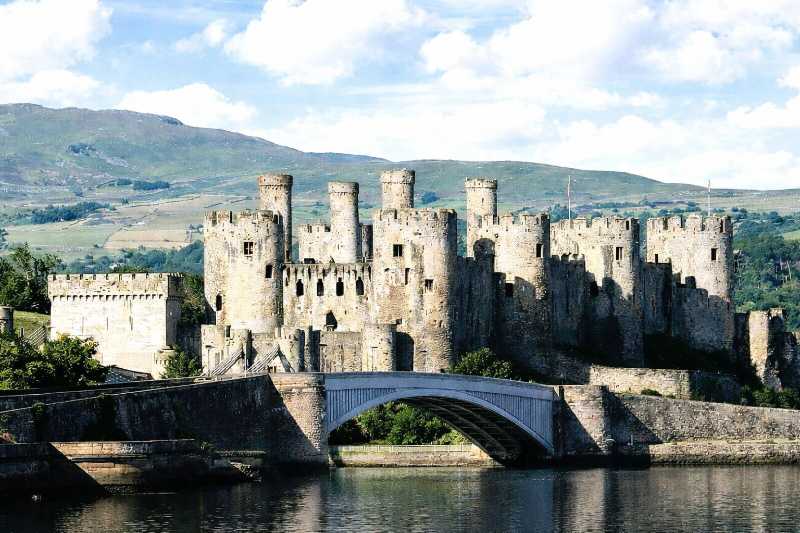
8. Conwy, Wales
Conwy Castle 53.28 N 3.83 W
Wales has many castles, but arguably the most picturesque is Conwy Castle, located on the Welsh north-east coast overlooking the town, harbour and the River Conwy. King Edward I built it between 1283 and 1287 (designed by James of St. George, the royal architect) as part of his conquest of Wales and was part of a larger project to create the walled town of Conwy. It saw its share of battles: It outlasted the siege of Madog ap Llywelyn in 1294-95; it sheltered Richard II in 1399, and it was held by Owain Glyndwr and his supporters in 1401. It was occupied during the English Civil War up to 1646 and purposefully damaged to prevent further use in 1647.
It is a huge structure, rectangular in shape and contains eight towers and two barbicans (fortified gateways). It was restored during the 18th and 19th centuries and is a major Welsh tourist attraction. In 1986, it was listed by UNESCO as a World Heritage Site, stating it to be one of "the finest examples of late 13th-century and early 14th-century military architecture in Europe".
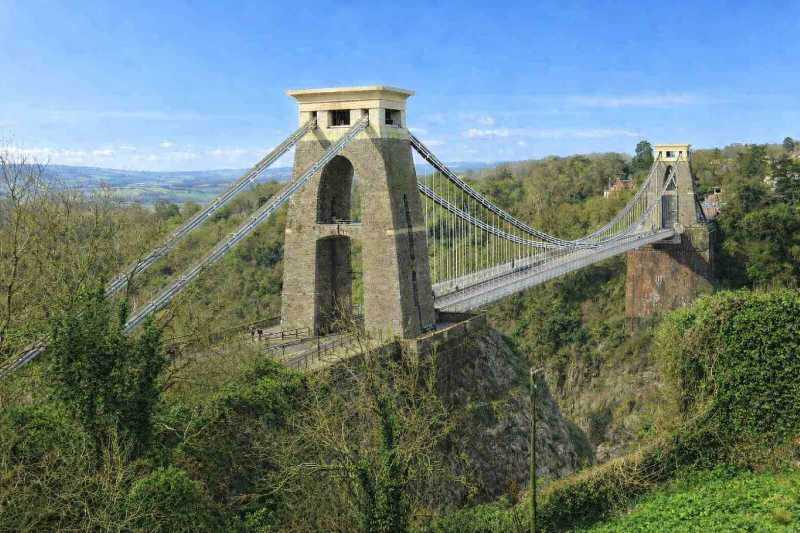
9. Bristol
Clifton Suspension Bridge 51.45 N, 2.62 W
The Clifton Suspension Bridge is a British landmark that connects Bristol and Leigh Woods by spanning the Avon River at Avon Gorge. The main deck is 101 m (331 feet) above the water level. Its main span is 214m (702 ft), which is not that long compared with more contemporaneously built suspension bridges, but this was a significant engineering feat in 1864 when it was completed and opened. It is a Grade I listed structure.
The bridge has some unusual features: The two towers are quite different in appearance; Its towers house roller-mounted saddles, which allow the suspension chains to move as the loads on the bridge increase or decrease; the chains are made from wrought iron, not steel - They are original (which is a remarkable preservation feat). The bridge is only 9.4 m (31 ft) wide, which means it can only ever be a two-lane bridge. It has always been a toll bridge, which pays for its upkeep. In 2024, 8,800 vehicles crossed the bridge each day.
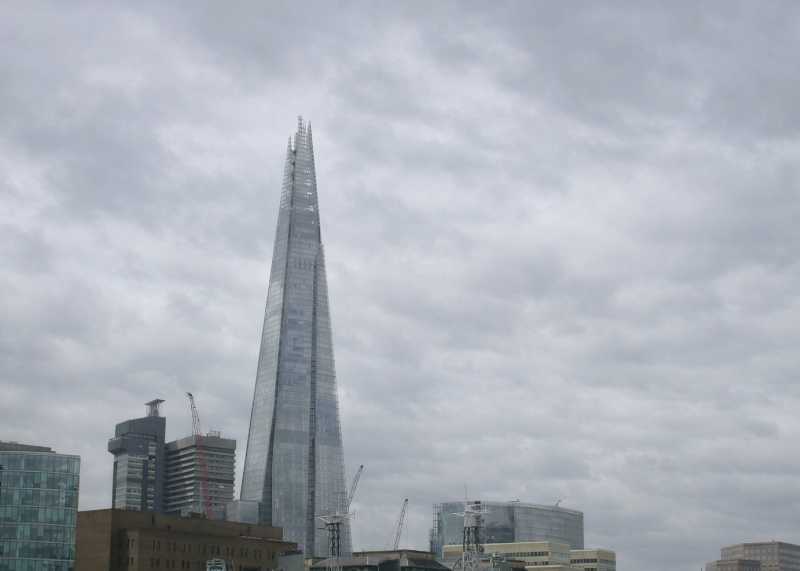
10. London
The Shard 51.50 N 0.09 W
The Shard was built between 2009 and 2012, and when completed, it was the tallest building in the United Kingdom at 310 m (1016 feet). Unlike other London skyscrapers, which are concentrated in the financial district and Canada Wharf, the Shard is on the South Bank of the River Thames opposite the city centre. It has 95 floors, of which 72 are habitable. It is mixed-use with 19 floors of hotel space, 22 floors of residences with most of the rest being office space.
The original name of the building was London Bridge Tower, but it was nicknamed the Shard because of its shape (London has a curious habit of naming its skyscrapers based on their finished shape: the Gherkin, the Cheese Grater, the Scalpel, the Walkie-Talkie). Naming it the Shard was not initially a compliment. English Heritage, (a charity that manages over 400 historic places) claimed that, when the tower was being built, it would be "A shard of glass through the heart of historic London". Nevertheless, the Shard was adopted as its official name in 2013.
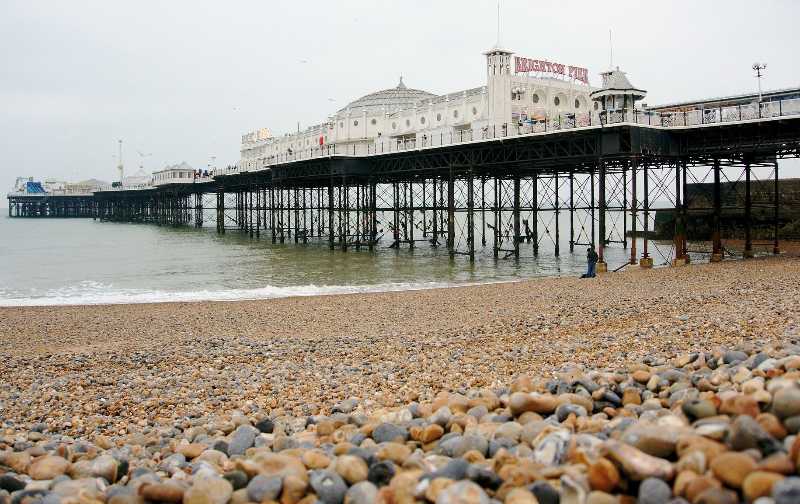
11. Brighton
Brighton Palace Pier 50.81 N 0.13W
The Brighton Palace Pier, better known as Brighton Pier or the Palace Pier, is a Grade II listed pier in Brighton at the end of the Old Steine where it meets Marine Parade. It is frequently used as a symbol for English culture and appears in many British culture contexts. The pier is an amusement pier - it once contained a theatre, but this was damaged in 1973 and demolished. An amusement park now stands in its place.
The pier is one of three that have been built around Brighton, but the only one still standing. It is 525 m (1722 feet) long. It contains 137 km (85 miles) of planking and is illuminated by 67,000 light bulbs. In the early 2020s, the pier attracted over four million visitors per year.
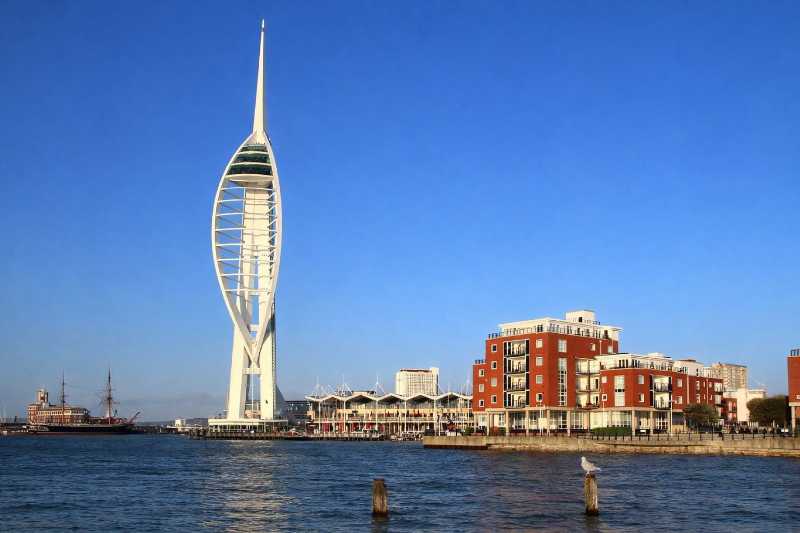
12. Portsmouth
Spinnaker Tower 50.80 N, 1.11W
This tower is a 170 m (560 feet) observation tower on the waterfront of Portsmouth on the English south coast. It is one of Britain's tallest accessible structures outside of London.
The tower has observation desks positioned at 100m, 105m, and 110m, which give panoramic views over Portsmouth and the Solent as well as the South Downs. On one of the viewing levels, there is a glass skywalk, four glass panels, thick, where you can circumnavigate the level looking straight down at the scene below. The two 'billowing' arcs represent sails of a sailing ship and are a tribute to Portsmouth maritime and naval heritage. Because the uprights are slightly on an angle to the perpendicular, the design of the elevators was a challenge. Nevertheless, they can move 350 people per hour at 14 km/hour, reaching the first observation deck in 28 seconds.
The tower was designed and built by local professionals and opened in 1985. The tower attracts over five million visitors each year.
This quiz was reviewed by FunTrivia editor stedman before going online.
Any errors found in FunTrivia content are routinely corrected through our feedback system.