FREE! Click here to Join FunTrivia. Thousands of games, quizzes, and lots more!
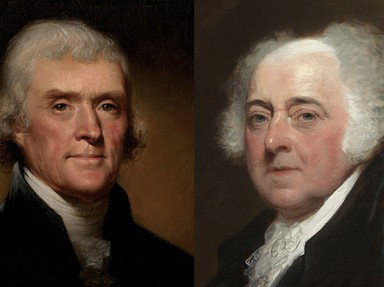
Quiz about The Election of 1800 Jefferson vs Adams

The Election of 1800: Jefferson vs. Adams Quiz


10 questions about the 1800 election and the constitutional crisis which followed. What happens when a sitting president and a sitting vice president run against each other and nobody wins? Have fun!

A multiple-choice quiz by NeuralSpicy. Estimated time: 3 mins.
  1. Home
  2. »
  3. Quizzes
  4. »
  5. World Trivia
  6. »
  7. U.S. Government
  8. »
  9. Campaigns & Elections

Author
NeuralSpicy
Time
3 mins
Type
Multiple Choice
Quiz #
425,345
Updated
Aug 21 26
# Qns
10
Difficulty
Easy
Avg Score
8 / 10
Plays
46
Last 3 plays: Guest 174 (10/10), Guest 97 (5/10), Guest 72 (10/10).
- -
Question 1 of 10
1. What political party did incumbent U.S. President John Adams represent when he ran for re-election in 1800? Hint


Question 2 of 10
2. John Adams was facing off against his own Vice President, Thomas Jefferson. With which party was Jefferson affiliated? Hint


Question 3 of 10
3. During the 1800 United States presidential election and those prior, how did electors choose the vice president? Hint


Question 4 of 10
4. In 1800, John Adams faced opposition and even sabotage from his own party, led by what former ally? Hint


Question 5 of 10
5. What did the presidential candidates do for the first time in 1800 exposing a constitutional flaw? Hint


Question 6 of 10
6. Under the constitutional rules in effect in 1800, how many electoral votes did each elector cast for president? Hint


Question 7 of 10
7. Who tied with Thomas Jefferson in the Electoral College presidential vote of 1800? Hint


Question 8 of 10
8. Which legislative body was forced to settle the deadlock between the leading candidates? Hint


Question 9 of 10
9. Whose strong personal campaign for Jefferson helped him win the final vote? Hint


Question 10 of 10
10. Which constitutional amendment was later adopted largely because of problems exposed by this election? Hint


(Optional) Create a Free FunTrivia ID to save the points you are about to earn:

arrow Select a User ID:
arrow Choose a Password:
arrow Your Email:


Most Recent Scores
Today : Guest 174: 10/10
Today : Guest 97: 5/10
Today : Guest 72: 10/10
Today : Guest 73: 6/10
Today : Guest 73: 8/10
Today : Guest 172: 8/10
Today : Guest 32: 4/10
Today : Guest 47: 8/10
Today : Guest 68: 5/10

Quiz Answer Key and Fun Facts
1. What political party did incumbent U.S. President John Adams represent when he ran for re-election in 1800?

Answer: Federalist Party

By 1800, American politics had already become charmingly messy. John Adams, the second president of the United States, represented the Federalist Party, a party that favored a strong central government, wanted closer ties with Britain, and held a somewhat skeptical view of too much democracy. They tended to attract merchants, bankers, and people who preferred their wigs with lots of powder.

The election itself turned into one of the ugliest campaigns in early American history. Federalists warned that Jefferson would unleash chaos! Godlessness! And even a French-style revolution, with heads rolling!
2. John Adams was facing off against his own Vice President, Thomas Jefferson. With which party was Jefferson affiliated?

Answer: Democratic-Republican Party

Thomas Jefferson belonged to the Democratic-Republican Party, a term that sounds like a garbled version of both major parties of the present day. In reality, it was one party, often shortened simply to the Republicans at the time. It had no direct connection to today's Republican Party, however. Early American political labels are hard to pin down.

Jefferson and his buddy James Madison formed the Democratic-Republican Party in opposition to the Federalists led by big names like Alexander Hamilton and John Adams. The party was all about states' rights and an agrarian economy. They also had strong sympathies for revolutionary France, a point the Federalists liked to point out with a great deal of derision. Jefferson believed in a republic of independent farmers spread across the continent.
3. During the 1800 United States presidential election and those prior, how did electors choose the vice president?

Answer: The second-highest electoral vote-getter

Can you imagine Jimmy Carter as Ronald Reagan's vice president? How about Hillary Clinton or Kamala Harris as Donald Trump's vice president? If it sounds messy, that's why this is the last election to feature this particular arrangement.

But yes, back in the original Electoral College system, electors did not cast one vote for president and another for vice president. They simply cast two votes for different people, and the person with the most votes became president while the runner-up became vice president. That rule had already given the nation a very odd pairing in Adams and Jefferson.
4. In 1800, John Adams faced opposition and even sabotage from his own party, led by what former ally?

Answer: Alexander Hamilton

John Adams was the first and only Federalist president to be elected. By 1800, however, the party was in serious trouble. The Federalist Party was simply not a united political movement anymore. Instead, try to picture a family reunion where half the relatives are no longer speaking to the other half.

Alexander Hamilton, one of the Federalists' leading figures and a former ally of John Adams, had soured deeply on the current president. He considered Adams unpredictable at best and certainly not suited to another term. He didn't keep quiet about his opinion.

One of Hamilton's most famous acts of political sabotage came when he wrote a lengthy pamphlet attacking Adams's character and fitness for office. Hamilton initially intended it for a relatively limited audience within the Federalist camp. That's not what happened though. It became public and was quickly picked up by the Democratic-Republicans.
5. What did the presidential candidates do for the first time in 1800 exposing a constitutional flaw?

Answer: Announce their preferred vice president

The election of 1800 exposed a major flaw in the Constitution's original Electoral College system, because the major presidential candidates were now running on organized party tickets with designated running mates. Thomas Jefferson and Aaron Burr represented the Democratic-Republicans. The Federalist choices were John Adams and Charles Cotesworth Pinckney. The Constitution, however, still required electors to cast two votes for president.

So how would you vote for a Jefferson-Burr ticket? Well, you could try to coordinate all the electors ahead of time so that Jefferson came in first and Burr came in second. Surely that would work. It's almost foolproof.

(That's called foreshadowing.)
6. Under the constitutional rules in effect in 1800, how many electoral votes did each elector cast for president?

Answer: Two

The original Constitution established a rather different Electoral College from the one Americans know today. Each elector cast two votes for president, not one. The candidate receiving a majority of votes became president. The runner-up became vice president. There was no separate vice-presidential ballot. Period. The best laid plans of mice and men...

The arrangement worked fine during the presidencies of George Washington, who didn't suffer much opposition. Once political parties emerged, however, the machine started grinding. Party leaders wanted electors to support a presidential candidate and a running mate, but the Constitution treated the two candidates identically. This created a mathematical trap waiting for someone to step into it.

It was during the fourth presidential election in U.S. history that the trap sprang shut.
7. Who tied with Thomas Jefferson in the Electoral College presidential vote of 1800?

Answer: Aaron Burr

Enough with the foreshadowing. Let's reveal your prize for reading all of the above. Thomas Jefferson and his running mate, Aaron Burr, tied in the Electoral College vote following the election of 1800. They each received 73 electoral votes. This was possible because under the Constitution as it existed back then, electors cast two votes for different candidates without designating which one they actually wanted for president and which for vice president.

The Democratic-Republicans had intended Jefferson to become president and Burr to become vice president. Their plan was for one elector to vote for Jefferson but withhold a vote from Burr, ensuring that Jefferson received one more electoral vote than Burr. Things didn't work out. Instead, both men received the same number of votes, and the election was thrown to the House of Representatives.
8. Which legislative body was forced to settle the deadlock between the leading candidates?

Answer: House of Representatives

When Thomas Jefferson and Aaron Burr tied in the Electoral College in 1800, the Constitution required the election to be decided by the House of Representatives.

The House's voting procedure was unusual. Representatives didn't vote individually. Instead, each state delegation received a single vote. To win, a candidate needed the support of a majority of the states. That turned the whole thing into a political headache. Delegates bargained, maneuverer, and no doubt glared nastily at one another.

For nearly a week, the House voted again and again with no clear victor. Thirty-five ballots came and went. Jefferson's supporters and Burr's backers glared more nastily at one another. The machine of the young republic had come to a stop.
9. Whose strong personal campaign for Jefferson helped him win the final vote?

Answer: Alexander Hamilton

Yes, him again. The election had been thrown to the House of Representatives after Thomas Jefferson and Aaron Burr, Democratic-Republican "running mates" in today's language, tied with 73 electoral votes each. The Federalists controlled enough state delegations in the House to block Jefferson from winning. Some backed Burr in hopes of denying Jefferson the presidency.

The breakthrough in the House of Representatives, after 35 votes over nearly a week, came with some thanks to Mr. Alexander Hamilton. Despite being a Federalist and a long-time opponent of Jefferson, Hamilton considered Burr the greater of two evils. Hamilton lobbied hard for his fellow Federalists to either support Jefferson or abstain. On the 36th ballot, enough Federalists stopped voting for Burr to allow Jefferson to ascend to the presidency.

Burr became vice president as originally intended, though the relationship between Jefferson and Burr deteriorated quickly. Hamilton's opposition to Burr continued as well, eventually ending in their infamous 1804 duel in New Jersey.
10. Which constitutional amendment was later adopted largely because of problems exposed by this election?

Answer: Twelfth Amendment

"The Electors shall meet in their respective states and vote by ballot for President and Vice-President, one of whom, at least, shall not be an inhabitant of the same state with themselves; they shall name in their ballots the person voted for as President, and in distinct ballots the person voted for as Vice-President...." - U.S. Constitution, Amendment XII (excerpt)

Before the 12th Amendment, each elector cast two votes. The candidate with the most votes became president, and the runner-up became vice president. Parties wanted to run coordinated tickets, while the original system had envisioned electors as independent selectors rather than party-ticket voters.

The election of 1800 exposed a major flaw in the original Electoral College system and led to the adoption of the new amendment. Ratified in 1804, it changed the way electors cast their ballots, requiring separate votes for president and vice president. From there it was smooth sailing, and the U.S. electoral process would never ever be called into question again. Ever.
Source: Author NeuralSpicy

This quiz was reviewed by FunTrivia editor stedman before going online.
Any errors found in FunTrivia content are routinely corrected through our feedback system.
8/21/2026, Copyright 2026 FunTrivia, Inc. - Report an Error / Contact Us