FREE! Click here to Join FunTrivia. Thousands of games, quizzes, and lots more!
Quiz about The History Of Santa Claus

The History Of Santa Claus Trivia Quiz


As Christmas is approaching, I adopted this quiz, which is about the life, legends, and myths of Santa Claus. I updated, corrected and wrote the information. I then decided to add photos as a festive touch. I hope you enjoy the history of Santa Claus.
This is a renovated/adopted version of an old quiz by author DakotaNorth

A photo quiz by Kalibre. Estimated time: 2 mins.
  1. Home
  2. »
  3. Quizzes
  4. »
  5. World Trivia
  6. »
  7. Seasonal
  8. »
  9. Christmas

Author
Kalibre
Time
2 mins
Type
Photo Quiz
Quiz #
58,408
Updated
Dec 05 25
# Qns
10
Difficulty
Average
Avg Score
8 / 10
Plays
43
Last 3 plays: jonathanw55 (8/10), zurddog01 (4/10), Guest 47 (10/10).
-
Question 1 of 10
1. In what century was St. Nicholas first mentioned? Hint


Question 2 of 10
2. When is the Feast of St. Nicholas? Hint


Question 3 of 10
3. A church was built in honor of St. Nicholas.


Question 4 of 10
4. A shipload of sailors rescued the bones of St. Nicholas 1087 A.D. Which nationality were they? Hint


Question 5 of 10
5. In 1821, a poem was published that mentioned Santa Claus for the first time. What was the name of that poem? Hint


Question 6 of 10
6. Which group of immigrants is credited with popularising the Christmas tree tradition in the United States during the 1800s? Hint


Question 7 of 10
7. Which two reindeer were first named by Santa in the 1823 poem 'A Visit from St. Nicholas'? Hint


Question 8 of 10
8. Which company's advertising campaign in the 1930s helped cement the modern image of Santa Claus as a jolly man in a red suit? Hint


Question 9 of 10
9. In 1841, a Philadelphia merchant hired a man to dress up like Santa and climb the chimney of his store. What is the name of the merchant? Hint


Question 10 of 10
10. The tradition, beginning in 1955, of tracking Santa's sleigh on Christmas Eve was started by which of these? Hint


(Optional) Create a Free FunTrivia ID to save the points you are about to earn:

arrow Select a User ID:
arrow Choose a Password:
arrow Your Email:


View Image Attributions for This Quiz

Most Recent Scores
Today : jonathanw55: 8/10
Today : zurddog01: 4/10
Today : Guest 47: 10/10
Today : Peachie13: 10/10
Today : mazza47: 10/10
Today : Guest 84: 6/10
Today : momonaco: 5/10
Today : Guest 86: 4/10
Today : FREEDOM49: 5/10

Quiz Answer Key and Fun Facts
1. In what century was St. Nicholas first mentioned?

Answer: 4th century

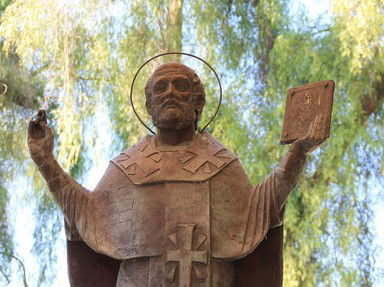
St. Nicholas of Myra, the historical figure behind the legend of Santa Claus, lived during the 3rd and 4th centuries AD. He served as a Christian bishop in the city of Myra (in modern-day Turkey) and became renowned for his generosity, miracles, and defence of the faith.

His reputation spread quickly after he died in 343 AD, and he was already being venerated as a saint in the 4th century. This makes the 4th century the earliest period in which he was first mentioned and remembered in Christian tradition.
2. When is the Feast of St. Nicholas?

Answer: December 6th

The Feast of St. Nicholas is celebrated on December 6 in most Western Christian traditions. It marks the anniversary of his death in 343 AD. In many European countries, children place shoes or stockings out on the eve of the feast to receive small gifts, sweets, or coins, echoing his reputation for secretly helping those in need.

In the Eastern Orthodox Church, the feast is observed on December 19 by communities that follow the Julian calendar. Those using the Gregorian calendar celebrate on December 6. Customs vary widely, from church services and processions to family gatherings and community festivities.
3. A church was built in honor of St. Nicholas.

Answer: True

Yes, a church was built in honour of St. Nicholas. The Church of St. Nicholas in Myra (modern-day Demre, Turkey) was constructed to commemorate him in the city where he served as bishop. It became a major pilgrimage site, especially after he died in 343 AD, as believers travelled to venerate his tomb and celebrate his legacy of generosity and miracles.

Over time, many other churches dedicated to St. Nicholas were built across Europe and beyond. These reflected his widespread popularity as one of Christianity's most beloved saints. From Italy to Russia, his name became attached to countless chapels and cathedrals, symbolising his role as a protector of children, sailors, and the poor.
4. A shipload of sailors rescued the bones of St. Nicholas 1087 A.D. Which nationality were they?

Answer: Italian

In 1087, a group of Italian sailors set sail for Myra, the city in modern-day Turkey where St. Nicholas had been buried since his death in 343 AD. At the time, the region was under threat from the Seljuk Turks, and there were fears that the saint's relics might be desecrated or lost. The sailors broke into his tomb, removed most of the larger bones, and carried them back to Bari.

Their arrival was celebrated as a triumph, and the relics were placed in a newly constructed church, the Basilica di San Nicola. It quickly became a major pilgrimage site. Later, in 1099, Venetian sailors also took smaller relics from Myra and enshrined them in Venice.
5. In 1821, a poem was published that mentioned Santa Claus for the first time. What was the name of that poem?

Answer: The Children's Friend

In 1821, the poem 'The Children's Friend' was published in New York, making it the first time Santa Claus was mentioned in American literature. This illustrated booklet introduced Santa as a figure who travelled in a sleigh pulled by reindeer, delivering gifts to children. Unlike earlier traditions that tied St. Nicholas to church festivals, it emphasised Santa's role in rewarding good behaviour with presents.

The poem's verses and images laid the groundwork for many of the traditions we now associate with Santa. It established the idea of reindeer, sleigh travel, and gift-giving on Christmas Eve. These would later be expanded and popularised by Clement Clarke Moore's 'A Visit from St. Nicholas' in 1823.

This is what transformed Santa from a regional folk figure into a central character of Christmas celebrations across America and eventually the world.
6. Which group of immigrants is credited with popularising the Christmas tree tradition in the United States during the 1800s?

Answer: German immigrants

Decorating evergreen trees during the Christmas season was already a well-established custom in Germany by the 16th century. Families would put candles, fruits, and handmade ornaments on trees as a symbol of life and hope during the winter months. When German immigrants began arriving in large numbers in America, they brought this festive practice with them.

At first, the Christmas tree was seen as a foreign curiosity by many Americans, who were more familiar with customs such as church services and simple home decorations. However, as German communities continued to celebrate with decorated trees, their neighbours gradually became intrigued by their beauty.

By the mid-1800s, Christmas trees had begun to appear in American homes outside of German immigrant circles, spreading across the country.
7. Which two reindeer were first named by Santa in the 1823 poem 'A Visit from St. Nicholas'?

Answer: Dasher and Dancer

The first two reindeer ever named in connection with Santa Claus were Dasher and Dancer. They were introduced in Clement Clarke Moore's 1823 poem 'A Visit from St. Nicholas', more famously known as ''Twas the Night Before Christmas'. In the poem, Santa calls out his team in order, beginning with 'Now, Dasher! Now, Dancer!' followed by Prancer, Vixen, Comet, Cupid, Donner, and Blitzen. This was the very first time Santa's reindeer were given names in print.

Over time, these names became embedded in Christmas tradition, and each reindeer gained its own personality in popular culture. Later additions, such as Rudolph in 1939, were added, but the original eight, led first by Dasher and Dancer, remain the cornerstone of Santa's magical journey.
8. Which company's advertising campaign in the 1930s helped cement the modern image of Santa Claus as a jolly man in a red suit?

Answer: Coca-Cola

Coca‑Cola launched a holiday advertising campaign in 1931 that forever changed how Santa Claus was portrayed. They commissioned artist Haddon Sundblom to paint Santa for their ads. His version showed Santa as a plump, cheerful man with rosy cheeks, twinkling eyes, and a red suit trimmed with white fur.

Sundblom's image was inspired by Clement Clarke Moore's poem 'A Visit from St. Nicholas', but he gave it a warm, realistic style that appealed to families. Before this, Santa's appearance varied. He was sometimes portrayed as tall and thin.
9. In 1841, a Philadelphia merchant hired a man to dress up like Santa and climb the chimney of his store. What is the name of the merchant?

Answer: J.W. Parkinson

In 1841, Philadelphia merchant J.W. Parkinson staged one of the earliest known public appearances of Santa Claus. He hired a man to dress up as Santa and climb down the chimney of his store. This spectacle drew crowds and delighted children. It boosted business and also helped bring the figure of Santa Claus out of folklore and into everyday holiday celebrations.

It marked a turning point in how Santa was viewed by the public. Instead of existing only in poems, stories, and illustrations, he became a living presence that families could see in person. Parkinson's idea spread quickly, as other merchants and department stores adopted similar traditions. Over time, Santa began to appear in shopping centres and stores.
10. The tradition, beginning in 1955, of tracking Santa's sleigh on Christmas Eve was started by which of these?

Answer: NORAD

Every Christmas Eve, the North American Aerospace Defence Command (NORAD) tracks Santa's sleigh as he makes his journey around the world. This tradition began in 1955 when a newspaper misprinted a phone number for children to call Santa, accidentally directing them to NORAD's predecessor, the Continental Air Defence Command.

Rather than disappointing the children, the officer on duty played along and gave updates on Santa's location. From that moment, the idea of Santa tracking became an annual event.

NORAD uses radar, satellites, and online tools to follow Santa's progress across the globe. Families can check his location through websites, apps, and even a special hotline. What started as an accident has grown into a Christmas custom. It allows millions to share in the excitement of Santa's journey on Christmas Eve.
Source: Author Kalibre

This quiz was reviewed by FunTrivia editor trident before going online.
Any errors found in FunTrivia content are routinely corrected through our feedback system.
Related Quizzes
1. Christmas Easier
2. Christmas Entertainment Average
3. The ABCs of Christmas Easier
4. Santa Who? Easier
5. The Night Before Christmas - Poem Average
6. Christmas According to the Bible Tough
7. Happy Holidays for Pets! Average
8. 9 for 10 - Christmas Average
9. Christmas Difficult
10. Christmas Traditions Very Difficult
11. Why I Hate Christmas Average
12. General Christmas Trivia Difficult

12/6/2025, Copyright 2025 FunTrivia, Inc. - Report an Error / Contact Us