FREE! Click here to Join FunTrivia. Thousands of games, quizzes, and lots more!
Quiz about Some Mathematics History

Some Mathematics History Trivia Quiz


Think you know math? Try this quiz to find out.

A multiple-choice quiz by lordaditya. Estimated time: 5 mins.
  1. Home
  2. »
  3. Quizzes
  4. »
  5. Science Trivia
  6. »
  7. Math
  8. »
  9. Specific Math Topics

Author
lordaditya
Time
5 mins
Type
Multiple Choice
Quiz #
241,059
Updated
Mar 29 26
# Qns
10
Difficulty
Difficult
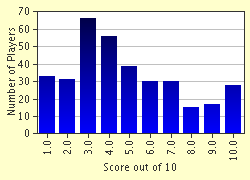
Avg Score
5 / 10
Plays
2461
Last 3 plays: jonnowales (6/10), Guest 76 (4/10), Guest 46 (6/10).
- -
Question 1 of 10
1. What is the title of G.H. Hardy's most famous work on his experiences as a mathematician? Hint


Question 2 of 10
2. Who first proposed the Prime Number Theorem? Hint


Question 3 of 10
3. Who is credited with the sequence:

1,1,2,3,5,8,13,...
Hint


Question 4 of 10
4. Who proposed that e(i*(pi))+1=0? Hint


Question 5 of 10
5. At the start of the last century, who proposed that there were 23 problems to be solved of great importance to mathematics and then listed those problems? Hint


Question 6 of 10
6. Who is credited with "coming up" with the formula for partition numbers? Hint


Question 7 of 10
7. At which university did Riemann study? Hint


Question 8 of 10
8. What is arguably the most important unsolved mathematical problem in the first part of the twenty-first century? Hint


Question 9 of 10
9. Who solved Fermat's Last Theorem? Hint


Question 10 of 10
10. Who said that every even number greater than four can be expressed as the sum of two distinct primes? Hint


(Optional) Create a Free FunTrivia ID to save the points you are about to earn:

arrow Select a User ID:
arrow Choose a Password:
arrow Your Email:


Most Recent Scores
Mar 28 2026 : jonnowales: 6/10
Mar 24 2026 : Guest 76: 4/10
Mar 23 2026 : Guest 46: 6/10
Mar 23 2026 : Guest 78: 9/10
Mar 14 2026 : Guest 109: 3/10
Mar 12 2026 : Guest 157: 8/10
Mar 06 2026 : Guest 66: 1/10
Feb 28 2026 : Guest 70: 9/10
Feb 25 2026 : Guest 175: 3/10

Score Distribution

quiz
Quiz Answer Key and Fun Facts
1. What is the title of G.H. Hardy's most famous work on his experiences as a mathematician?

Answer: A Mathematician's Apology

'My Life as a Mathematician' is a name I made up.

'Elements' was written by Euclid.

'Disquisitiones Arithmeticae' was written by Gauss.

'A Mathematician's Apology' is a famous work dating from 1940.
2. Who first proposed the Prime Number Theorem?

Answer: Gauss

Gauss proposed the very famous theorem as a conjecture, but it was proven later. It is a very powerful theorem as it approximates the Riemann Zeta Function for primes. Riemann's Hypothesis is closely connected to Gauss's Theorem.
3. Who is credited with the sequence: 1,1,2,3,5,8,13,...

Answer: Fibonacci

This is one of the most powerful sequences. The nth term is found by adding the two previous terms. The number of applications of this sequence is majestic. A periodical named The 'Fibonacci Quarterly' began publishing in 1963 and is still ongoing in the twenty-first century. Still not all properties of this deceivingly simple sequence have been found!
4. Who proposed that e(i*(pi))+1=0?

Answer: Euler

This is another powerful equation - so powerful that it completely revolutionalized mathematics after Euler's discovery of it in the 1700s. The concept of the imaginary number and its relationship with sinusoidal functions still amazes many!
5. At the start of the last century, who proposed that there were 23 problems to be solved of great importance to mathematics and then listed those problems?

Answer: Hilbert

Several problems were posed by David Hilbert. Solving any one of the 23 would immortalize your name although most have now been solved.

For the geniuses doing this boring quiz: Give a go at number 8. You might find it a tad challenging! Search for his problem list on some search engine!
6. Who is credited with "coming up" with the formula for partition numbers?

Answer: Ramanujan

Check this out:
How many ways can you partition 1 stone? 1 way, obviously!
How many ways can you partition 2 stones? 2 ways ((1,1),(2)).
How many ways can you partition 3 stones? You do the permutations.

Try finding out a formula for the nth term of the sequence. Just try, if you get it, you are Ramanujan's equal. Now that is a huge deal!
7. At which university did Riemann study?

Answer: Gottingen

Bernhard Riemann was a student at Gottingen University which was, at one time, the hub for mathematical activity. It is still around (in Germany), although Princeton is considered to have taken its place as the world leader in mathematics.

Incidentally, Gottingen once boasted a great faculty: Gauss, Hilbert, Landau, and many others were part of the Gottingen tradition!
8. What is arguably the most important unsolved mathematical problem in the first part of the twenty-first century?

Answer: Riemann's Hypothesis

It has to be Riemann's Hypothesis.

While interest is there for Goldbach's Conjecture and the Twin Prime Problem, these are mere trifles when compared to the giant problem first proposed by Bernhard Riemann. Fermat's Last Theorem once received a large amount of international attention, but it was solved by Wiles.

Despite Hardy's continual efforts to solve the problem, Riemann's initial work, Ramanujan's raw genius, Selberg's persistence, the list goes on and on and no one has solved Riemann's Hypothesis (at the time of writing this quiz).

Go ahead and give this beautiful theorem a try but, beware, you need a high level of mathematical understanding to even get the gist of the problem's significance and implications.
9. Who solved Fermat's Last Theorem?

Answer: Wiles

Wiles solved it in 1995, coming up with the proof centuries after Fermat's proud claim: "I have the most magnificent proof to this theorem, but this margin is too small to contain it!".

But Wiles had a lot of help from previous mathematicians ranging from Gauss to Taniyama (and Shimura) and others. Great problem indeed. Like several other greats, it is easily worded, but not so easily solved.
10. Who said that every even number greater than four can be expressed as the sum of two distinct primes?

Answer: Goldbach

Once again, a very simple problem to state and understand. Solving it is another matter, though.
Source: Author lordaditya

This quiz was reviewed by FunTrivia editor crisw before going online.
Any errors found in FunTrivia content are routinely corrected through our feedback system.
4/2/2026, Copyright 2026 FunTrivia, Inc. - Report an Error / Contact Us