FREE! Click here to Join FunTrivia. Thousands of games, quizzes, and lots more!
Quiz about Cocker Spaniel Photo Parade

Cocker Spaniel Photo Parade Trivia Quiz


The cocker spaniel comes in two main forms - the American and the English. Most of the questions apply to both and any that are specific make that clear.
This is a renovated/adopted version of an old quiz by author JayceePup

A photo quiz by rossian. Estimated time: 3 mins.
  1. Home
  2. »
  3. Quizzes
  4. »
  5. Animal Trivia
  6. »
  7. Dog Breeds
  8. »
  9. Spaniels

Author
rossian
Time
3 mins
Type
Photo Quiz
Quiz #
167,069
Updated
Feb 17 26
# Qns
10
Difficulty
Average
Avg Score
8 / 10
Plays
30
Last 3 plays: invinoveritas (6/10), bernie73 (5/10), Waldkaeuzchen (5/10).
-
Question 1 of 10
1. What species of bird were cocker spaniels originally bred to hunt? Hint


Question 2 of 10
2. Cocker spaniels naturally have which type of tail?


photo quiz
Question 3 of 10
3. In the UK, the cocker spaniel is classed as a gundog. In the USA it is placed in which group? Hint


Question 4 of 10
4. Patellar luxation is a common disorder in cocker spaniels and other dogs. Which part of the body does it affect? Hint


photo quiz
Question 5 of 10
5. What is the name given to the head cover which keeps the cocker spaniel's long ears out of its food and water?

Answer: (One Word (5 letters))
Question 6 of 10
6. Chocolate is one of the UK's Kennel Club accepted names for brown coats in cocker spaniels. What is the other? Hint


photo quiz
Question 7 of 10
7. Cocker spaniels need very little grooming.


Question 8 of 10
8. There are differences between the American and English cocker spaniels. Which of them is both taller and heavier?


photo quiz
Question 9 of 10
9. What temperament can you normally expect from a well-bred cocker spaniel, especially the American spaniel? Hint


Question 10 of 10
10. Which literary figure wrote about her pet cocker spaniel named Flush? Hint


photo quiz

(Optional) Create a Free FunTrivia ID to save the points you are about to earn:

arrow Select a User ID:
arrow Choose a Password:
arrow Your Email:


View Image Attributions for This Quiz

Most Recent Scores
Today : invinoveritas: 6/10
Today : bernie73: 5/10
Today : Waldkaeuzchen: 5/10
Today : Nala2: 5/10
Today : Aph1976: 4/10
Today : Reamar42: 8/10
Today : Guest 174: 10/10
Today : saradu: 10/10
Today : Guest 68: 6/10

Quiz Answer Key and Fun Facts
1. What species of bird were cocker spaniels originally bred to hunt?

Answer: Woodcock

The clue is in the name as cocker spaniels received that name from the game birds they were sent to hunt. They were not classed as a separate breed until the 1890s, with all spaniels known as land spaniels until then. Selective breeding to obtain smaller dogs led to the cocker spaniel being recognised as a separate breed.
2. Cocker spaniels naturally have which type of tail?

Answer: Long and feathery

Cocker spaniels are known for constantly wagging their tails. In the past the tail was often docked, especially for working dogs, to avoid it catching on shrubs with the risk of injury. In many countries, docking is illegal unless for medical reasons. The UK's Kennel Club does not require tails to be docked, while in America docking is standard, but not required.

These spaniels can injure their tails as they are rarely still, but if you see one with a short, stubby tail it won't be natural.
3. In the UK, the cocker spaniel is classed as a gundog. In the USA it is placed in which group?

Answer: Sporting

The cocker spaniel is the smallest of the Sporting breeds, which also includes Labrador retrievers, golden retrievers, and springer spaniels. The British terminology reflects the fact that the dogs were bred to accompany hunters with guns - retrievers bring back the game which has been shot while the spaniels are used to flush out the game.
4. Patellar luxation is a common disorder in cocker spaniels and other dogs. Which part of the body does it affect?

Answer: Knees

If you know anything about anatomy, you probably recognised that the patella refers to the bone covering the knee. In layman's terms patellar luxation is often referred to as slipped kneecaps, which means that the patella has dislocated. The kneecap does move, but should stay within the grooves of the femur.

Depending on the severity of the dislocation, treatment can be physiotherapy to build up the muscles. If the patella can't be manipulated into place, or dislocates frequently, surgery may be the only option.
5. What is the name given to the head cover which keeps the cocker spaniel's long ears out of its food and water?

Answer: Snood

The snood fits around the neck and ears and is basically a tube of material. As well as being fitted during feeding, snoods are used while walking the dogs especially when it's wet or muddy. They also offer protection against small seeds, such as those from grasses, as spaniels are particularly susceptible to infections due to the size of their ears.
6. Chocolate is one of the UK's Kennel Club accepted names for brown coats in cocker spaniels. What is the other?

Answer: Liver

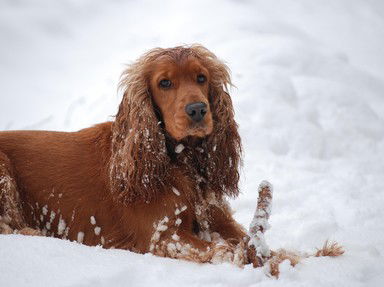
Brown cocker spaniels are officially said to have liver coats, or sometimes chocolate. As the photos have shown, they come in a wide range of colours including black and gold. Breed standards for solid colours state that a small amount of white on the chest is allowed. Black and tan or liver and tan are considered to be solid colours.

Bi-colours including black and white or liver and white, are also allowed and even tri-colours are acceptable.
7. Cocker spaniels need very little grooming.

Answer: False

Cocker spaniels have high maintenance needs due to the thickness of their coats - remember they were originally bred for outdoor hunting. They need to be brushed at least three times a week to remove any tangles and dirt while a professional grooming is recommended every two months.

Their ears are especially vulnerable to infection, being so long, so they need to checked regularly. Show dogs need even more care, but pet dogs also need to be groomed regularly for health and comfort.
8. There are differences between the American and English cocker spaniels. Which of them is both taller and heavier?

Answer: English

While there are similarities, including the fact that both were originally bred to hunt the same prey, the American and English breeds are distinct and treated as such by Kennel Clubs. The English cocker spaniel has longer legs, making it taller by around two inches, or just over five centimetres, on average. It also has a more solid body and bone structure so is heavier.

Other differences are in the shape of their heads, with the American cocker having a shorter muzzle and rounder head than the English cocker. Their temperament can vary too, with the American cocker being described as being calmer and more laid-back while the English cocker is more active and retains more of the prey instincts of its ancestors.
9. What temperament can you normally expect from a well-bred cocker spaniel, especially the American spaniel?

Answer: Merry and loyal

These dogs are usually happy dogs with ever wagging tails and are very loyal to their owners. They need stimulation though and prefer company as they can suffer from separation anxiety. Aggression is not a part of their nature, though, and they have outgoing personalities, rather than being shy. They are normally eager to learn and please their owners.

Talking about temperament is always risky as these are generalisations. If your cocker is stubborn and shy, they are likely to be the exception that proves the rule.
10. Which literary figure wrote about her pet cocker spaniel named Flush?

Answer: Elizabeth Barrett Browning

Flush became well known as Elizabeth wrote a poem about him called 'To Flush, My Dog'. He was a gift to help Elizabeth recover from the grief she felt after the death of her brother in 1840, before her marriage to Robert Browning. The dog was around during their courtship, though, as he is mentioned in their letters to each other. The poem describes him as 'a loving friend' and describes him as having 'silky ears, like a lady's ringlets'.

The dog also inspired Virginia Woolf who wrote a 1933 biography about him, called 'Flush: A Biography', told from the animal's point of view.
Source: Author rossian

This quiz was reviewed by FunTrivia editor agony before going online.
Any errors found in FunTrivia content are routinely corrected through our feedback system.
2/17/2026, Copyright 2026 FunTrivia, Inc. - Report an Error / Contact Us