FREE! Click here to Join FunTrivia. Thousands of games, quizzes, and lots more!
Quiz about Elephants Yeah

Elephants, Yeah! Trivia Quiz


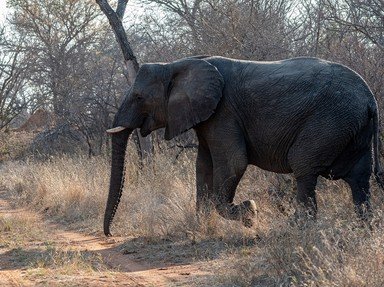
Get ready to use your giant brain to answer these questions. I'm trumpeting through facts about these majestic giants, from their legendary memory to their magnificent trunks. No heavy lifting required, just big answers! Elephants, yeah!

A photo quiz by LeoDaVinci. Estimated time: 3 mins.
  1. Home
  2. »
  3. Quizzes
  4. »
  5. Animal Trivia
  6. »
  7. Wild Mammals
  8. »
  9. Elephants

Author
LeoDaVinci
Time
3 mins
Type
Photo Quiz
Quiz #
422,059
Updated
Jan 24 26
# Qns
10
Difficulty
Easy
Avg Score
8 / 10
Plays
44
Last 3 plays: Kota06 (9/10), Guest 71 (6/10), Lottie1001 (10/10).
-
Question 1 of 10
1. Worldwide, there are only three species of elephant recognized. Which of these is *not* one of them? Hint


Question 2 of 10
2. An elephant's trunk is often likened to a human nose, though the trunk is more prehensile, certainly. In which of these are there more muscles?


Question 3 of 10
3. Elephants are thick skinned, literally, especially when covered in mud. Surprisingly, which of these ailments or hardships is their skin prone to? Hint


Question 4 of 10
4. In the Disney movie "Fantasia" there's a scene where elephants are dancing ballet. What about real-life elephants might have made this possible? Hint


Question 5 of 10
5. Elephants are very social animals and often travel in groups. What kind of societies do elephants live in?


Question 6 of 10
6. In addition to their ears and traditional hearing, including an outer ear canal of 20cm on average, elephants are also able to communicate for long distances. What part of their anatomy assists them in this? Hint


Question 7 of 10
7. Elephants can recognize themselves in a mirror.


Question 8 of 10
8. Which of the following does "22 months" refer to, for an African elephant? Hint


Question 9 of 10
9. Elephants display limited and basic emotions as well as a short memory, due to a smaller-than-expected hippocampus.


Question 10 of 10
10. What attitude do elephants have about bodies of water? Hint


(Optional) Create a Free FunTrivia ID to save the points you are about to earn:

arrow Select a User ID:
arrow Choose a Password:
arrow Your Email:


View Image Attributions for This Quiz

Most Recent Scores
Today : Kota06: 9/10
Today : Guest 71: 6/10
Today : Lottie1001: 10/10
Today : Guest 40: 5/10
Today : borimor: 4/10
Today : Guest 149: 8/10
Today : mjgrimsey: 5/10
Today : pusdoc: 8/10
Today : Guest 38: 10/10

Quiz Answer Key and Fun Facts
1. Worldwide, there are only three species of elephant recognized. Which of these is *not* one of them?

Answer: Javan Elephant

While for many years scientists recognized only two species (African and Asian), genetic research has officially confirmed that there are actually three distinct species of elephants. They separated the African bush elephants from the African forest elephant as they recognized them as two separate groups. This was confirmed with DNA testing in the early 2000s.

The African bush elephant is the largest of the three, and the largest land mammal on Earth. Their ears are the largest of the three species and shaped (coincidentally) like the continent of Africa. This species of elephant is endangered.

The African forest elephant lives in the dense tropical rainforests of Central and West Africa. They have round and more compact ears, and thinner tusks, adapted to living in the foliage of the African forest. It was reclassified as critically endangered in 2021, which is only one step above Extinct in the Wild, which is very concerning.

The only elephant that is currently found in the wild outside of Africa is the Asian elephant. Endangered as well, it is actually different in looks than the other two elephants. The head has a twin dome and the ears are far smaller, and more rounded. The females do not grow prominent tusks (usually) and they have only one protrusion on the end of their trunk for grasping, as opposed to two that both the African elephants have.
2. An elephant's trunk is often likened to a human nose, though the trunk is more prehensile, certainly. In which of these are there more muscles?

Answer: An elephant's trunk

An elephant's trunk is definitely one of the most versatile organs found in the natural world. It contains roughly 40,000 individual muscle units. Some researchers even categorize these into as many as 150,000 smaller subunits depending on how they are measured. Because the trunk contains absolutely no bones or cartilage, these muscles allow it to act as a muscular hydrostat (similar to a human tongue or an octopus tentacle). This unique structure provides the immense strength to uproot entire trees, yet maintains the delicate precision required to pick up a single blade of grass or even a tiny coin from a flat surface.

In comparison, the entire human body contains only about 639 to 850 named muscles, depending on how an anatomist classifies them. This means that a single elephant's "nose" has nearly 60 times the muscular complexity of a human's entire physical form.
3. Elephants are thick skinned, literally, especially when covered in mud. Surprisingly, which of these ailments or hardships is their skin prone to?

Answer: Sunburn

Even though an elephant's skin can be up to an inch thick on its back and hindquarters, it's extremely sensitive to ultraviolet rays. Because elephants lack a protective coat of fur and do not have sweat glands to cool themselves down, they are highly susceptible to painful sunburns. To combat this, they use mud and dust as a natural sunscreen to create a physical barrier between their skin and the sun.

Elephants do not have the same sebaceous (oil) glands that humans do. Their skin is quite dry by nature, so they don't suffer from the clogged pores that lead to acne or pimples. Their "cracks" are actually a good thing-they help trap moisture and mud to keep the skin hydrated. Elephants don't shed skin in large amounts or cycles; instead, they lose microscopic skin cells gradually through daily activities like rubbing against trees or bathing in rivers. Elephants have also evolved specialized pressure-distributing tissues and fatty pads in their feet and under their skin that act like heavy-duty mattresses. These prevent their weight from causing internal bruising or sores.
4. In the Disney movie "Fantasia" there's a scene where elephants are dancing ballet. What about real-life elephants might have made this possible?

Answer: Elephants walk on their tip-toes

Although an elephant's foot looks flat, they are actually what is known as digitigrade, which means they walk on their toes just like cats, dogs, and, yes, ballet dancers. Behind their toe bones is a large, wedge-shaped fatty pad that acts as a shock absorber and heel. This cushion allows them to walk incredibly quietly and supports their massive weight, essentially giving them a permanent built-in ballet shoe.

Interestingly, many elephants have also been observed to be attracted to classical music, especially composers like Bach, Beethoven, and Chopin. They often show enjoyment through relaxed breathing and swaying. However, the preference is not universal, and some elephants do show a propensity for other types of music, including rock and metal.

No elephant has voluntarily worn a tutu.
5. Elephants are very social animals and often travel in groups. What kind of societies do elephants live in?

Answer: Matriarchal

At the heart of every herd is the matriarch, usually the oldest and largest female. She isn't just a leader, she is the "living library" of the group. She remembers the locations of hidden water holes and fertile feeding grounds from decades prior. She decides when the herd moves, where they sleep, and how they respond to threats. She is also capable of mediating disputes within the group and teaching younger elephants how to behave toward one another.

Elephant calves are raised by the village. Young females act as babysitters, helping to protect and guide the babies. This teaches the younger females how to be mothers before they have their own calves.
6. In addition to their ears and traditional hearing, including an outer ear canal of 20cm on average, elephants are also able to communicate for long distances. What part of their anatomy assists them in this?

Answer: Feet

While their massive ears are excellent at catching sound waves in the air, elephants have a sixth sense that allows them to communicate with other herds up to 10 kilometers (six miles) away. They do this by using their feet as highly sensitive superior seismic sensors.

Elephants are able to produce low-frequency rumbles called infrasound, which are below the range of human hearing. They sit at lower than 20 Hz. These sounds carry well through the ground, and elephants (specifically their feet) are trained to detect this.
7. Elephants can recognize themselves in a mirror.

Answer: True

The fact that elephants can recognize themselves in a mirror is one of the strongest proofs we have of their high-level intelligence. In the scientific world, this is known as passing the Mirror Self-Recognition (MSR) test. A few animals have passed this test, like apes, magpies, and dolphins, and this was proven through scientific experimentation.

The most famous study proving this was conducted in 2006 at the Bronx Zoo. Scientists worked with three female Asian elephants and a giant mirror was used. These elephants underwent the "mark test" where a mark was placed on the head of the elephants as well as a sham mark to see if they could identify whether an actual mark was placed.
8. Which of the following does "22 months" refer to, for an African elephant?

Answer: The length of their gestation period

Elephants have the longest pregnancy of any land mammal, lasting approximately 640 to 660 days, so, about 22 months. Asian elephants may have slightly shorter gestation periods, but some also have their babies after 22 months as well. This extended time in the womb is crucial because it allows the calf's brain and complex nervous system to develop fully, meaning that baby elephants have a high level of development.

Elephants actually have a very slow maturation process that mirrors humans; they aren't considered adults until their late teens or early twenties. While they reach sexual maturity between ten and fifteen years of age, they continue to grow in size and social wisdom for many years after that.

Like humans with their milk teeth, elephants are born with milk tusks. However, these small, temporary tusks usually fall out and are replaced by permanent ones, typically around one year of age.

Elephant migrations are almost always tied to the seasons and the availability of water, meaning they typically operate on a 12-month cycle.
9. Elephants display limited and basic emotions as well as a short memory, due to a smaller-than-expected hippocampus.

Answer: False

As expected, an elephant's brain is the largest of any land animal, and their hippocampus (the region linked to emotion and memory) is exceptionally large and complex. Studies have found that their brain contains as many neurons as a human brain (roughly 257 billion), though they are distributed differently, with a high concentration dedicated to sensory processing and emotional memory. Thus, elephants have exceptional long-term recall that is vital for their survival.

Elephants have very complex and deep emotions. Elephants engage in complex mourning rituals and show targeted empathy towards amother elephant who is hurting, either physically or emotionally! Because they are so intelligent, elephants can suffer from psychological trauma similar to humans. Calves that witness their mothers being killed by poachers often wake up screaming in the middle of the night, similar to PTSD experienced by soldiers. In areas with heavy poaching, young bulls who grew up without older mentors or fathers often show heightened aggression and delinquent behavior, which researchers link to a lack of emotional stability in their upbringing.
10. What attitude do elephants have about bodies of water?

Answer: They love water! Elephants are great swimmers.

Elephants have a deeply joyful relationship with water, viewing it as a social playground rather than just a source of hydration. Because elephants lack sweat glands, water is essential for them in order to regulate their body temperature. A visit to a watering hole is often a loud, communal event where members of the herd splash, roll, and splat mud on their bodies.

Despite their massive weight, elephants are naturally gifted swimmers who can stay afloat for hours and swim for long distances. Their massive chest cavities provide significant buoyancy, balancing out the rest of the mass, and they move through the water using a powerful doggy-paddle motion with all four legs. Would you believe that they are able use their trunks as a snorkel, allowing them to submerge their entire bodies while still breathing air from above the surface?
Source: Author LeoDaVinci

This quiz was reviewed by FunTrivia editor rossian before going online.
Any errors found in FunTrivia content are routinely corrected through our feedback system.
1/24/2026, Copyright 2026 FunTrivia, Inc. - Report an Error / Contact Us