FREE! Click here to Join FunTrivia. Thousands of games, quizzes, and lots more!
Quiz about Enigmatic Elephants

Enigmatic Elephants Trivia Quiz


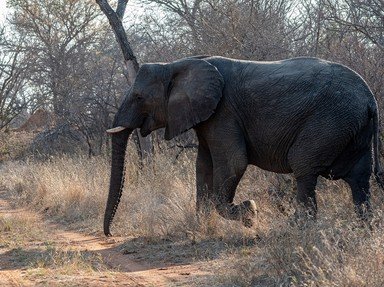
In this Commission 83 quiz, we examine elephants, arguably the most recognisable mammalian species. With emphasis on this animal's anatomy and physiology, let's explore the uniqueness and some fun facts about this gentle giant.

A photo quiz by 1nn1. Estimated time: 3 mins.
  1. Home
  2. »
  3. Quizzes
  4. »
  5. Animal Trivia
  6. »
  7. Wild Mammals
  8. »
  9. Elephants

Author
1nn1
Time
3 mins
Type
Photo Quiz
Quiz #
423,539
Updated
Mar 26 26
# Qns
10
Difficulty
Average
Avg Score
7 / 10
Plays
26
Last 3 plays: QCharmaine (7/10), xchasbox (5/10), tuxedokitten86 (5/10).
Author's Note: The images in this quiz are for illustrative purposes only. They don't necessarily depict a true-life situation,
-
Question 1 of 10
1. There are actually three species of elephant. True or false?


Question 2 of 10
2. Arguably, the elephant's main distinguishing physical feature is its trunk. What actually is the trunk, anatomically? Hint


Question 3 of 10
3. Most but not all elephants have tusks. Do the elephants that do have tusks have a dominant one?


Question 4 of 10
4. What is the structure of the visible part of an elephant ear? Hint


Question 5 of 10
5. What comprises an elephant's diet? Hint


Question 6 of 10
6. Elephants are pachyderms, along with rhinoceroses, hippopotamuses, and tapirs. What exactly does 'pachyderm' mean? Hint


Question 7 of 10
7. Do elephants have sweat glands? Hint


Question 8 of 10
8. The gestational period for an African savannah elephant is the longest among mammals. What is the length of a normal pregnancy? Hint


Question 9 of 10
9. Given that African elephants can live to be over 70 in the wild, at what age are male elephants most successful at mating?


Question 10 of 10
10. Baby elephants are highly evolved when born. How much do they weigh and how tall are they when their mother gives birth? Hint


(Optional) Create a Free FunTrivia ID to save the points you are about to earn:

arrow Select a User ID:
arrow Choose a Password:
arrow Your Email:


View Image Attributions for This Quiz

Most Recent Scores
Today : QCharmaine: 7/10
Today : xchasbox: 5/10
Today : tuxedokitten86: 5/10
Today : bigjohnsludge: 10/10
Today : 1ziggy: 5/10
Today : Guest 216: 5/10
Today : Guest 68: 7/10
Today : Guest 166: 8/10
Today : mlpitter: 6/10

Quiz Answer Key and Fun Facts
1. There are actually three species of elephant. True or false?

Answer: True

The three species of elephants are found in discrete parts of the world; there is no overlap where two species are found in the same area.

There are two species of African elephant. The biggest species of elephant in the world is Loxodonta africana, or the African savannah elephant, which lives in the African grasslands and in the Sahel desert in Mali. Loxodonta cyclotis (African forest elephant) lives in the rainforests of Central and West Africa and is slightly smaller. The larger African savanna elephants' tusks curve outward. The tusks of the smaller African forest elephant are straighter and point downward. This species has more rounded ears.

The Elephas maximus species (Asian elephant), the smallest of the three species, can be found in Nepal, India and Southeast Asia in scrub forests and rainforests.

A male African savannah elephant can grow up to 4 metres (13 feet) in height and weigh up to 7 tonnes, whilst the female of the species can still weigh more than 3.5 tonnes.

The image depicts, from left to right, four elephants representing three species: African savannah elephant, African forest elephant, and Indian elephant, as well as another African savannah elephant. These three species have discrete habitats and would never be seen in the same environment, except possibly in a zoo.
2. Arguably, the elephant's main distinguishing physical feature is its trunk. What actually is the trunk, anatomically?

Answer: It is actually a fusion of the upper lip and an elongated nose

The trunk of an elephant is a versatile instrument. It is boneless and contains 40000-80000 muscles (The entire human body has 600-800). It can lift over 300kg (660 lbs), can detect water 18 km (11 mi) away and can act as a snorkel. A trunk can hold over 10 litres (3 gallons) of water. African elephants have two finger-like projections at the trunk's tip, while Asian elephants have one. This enables the elephant to lift a single feather or a single blade of grass. They are also a communication tool, as elephants often greet one another by intertwining their trunks.

Baby elephants have trouble managing their trunk - they have to learn not to trip over their trunks, and they often suck their trunks for comfort
3. Most but not all elephants have tusks. Do the elephants that do have tusks have a dominant one?

Answer: Yes, elephants are either left- or right-tusked

Elephant tusks are made of dentine, the same material as mammalian teeth, but elephant tusks also contain mineralised collagen, which gives them the characteristics of ivory. Tusks are actually elongated incisor teeth that first appear at around two years of age. Tusks can weigh more than 100kg (220 lb) when fully grown. Elephant tusks continue to grow throughout an elephant's life. Similar to humans, who are right- or left-handed, elephants favour one tusk over the other. The dominant tusk, called the "master tusk," is usually more worn down due to more frequent use.

Elephants use tusks for many purposes, including digging for water in dry environments, stripping bark from trees looking for food, and lifting objects. They use tusks to defend themselves against predators and against each other when they are rivals. They also have a role in social interactions, especially displays of dominance during mating season, where male elephants use their tusks to fight to compete for mates.

Man's greed for ivory is the reason wild elephant populations have been decimated. In the 1970s, there were 1.3 million wild African elephants; In 2024, there were only 400,000 left. The ivory trade is now illegal worldwide. This may play a role in the restoration of the African elephant population.

The photo depicts the ivory trade in Kenya in the 1880s.
4. What is the structure of the visible part of an elephant ear?

Answer: A sheet of cartilage filled with blood and nerve vessels and covered with a thin layer of skin

The visible portion of the elephant ear is called the pinna, the same as in humans, and it plays only a minor role in hearing but has an essential role in thermoregulation. The pinna comprises a very thin covering of skin (1-2 mm), a sheet of cartilage that supports a huge network of intricate network of veins and arteries. Warm blood is pumped from the body through these vessels, and with the aid of the elephant flapping their ears, the blood can be cooled by up to 5 degrees C (9 degrees F) before the blood is returned to the rest of the body. Elephant ears, therefore, serve as thermal windows - their large surface area (up to 20% of the body's total surface area) dissipates excess body heat.

The image depicts a shark, which structurally has no bones but a completely cartilaginous skeleton.
5. What comprises an elephant's diet?

Answer: Herbivorous: Grasses, leaves, shrubs, fruits and roots and occasionally, woody parts of trees

Elephants are herbivores and eat grasses, leaves, shrubs, fruits and roots, though the quantity and variation depend on the season and their current habitat. In the dry season, elephants will eat the more woody parts of trees and shrubs like twigs, branches and especially bark.

The main carbohydrate (energy source) in grass and wood is cellulose, a sugar that few mammals (including humans) can digest. Elephants can, but only through microbial fermentation that occurs in the large intestine. This symbiotic relationship is called hindgut fermentation and relies on bacteria present in the elephant's gut that break down the cellulose and hemicellulose in plant fibres for the animal to utilise. However, this is an inefficient process and over 50% of food intake is excreted. Given that the average elephant needs about 150 kilograms (330 pounds) of food a day to meet demand, that is a lot of dung left behind!

Elephants eat so much that they spend up to three-quarters of their day eating.
6. Elephants are pachyderms, along with rhinoceroses, hippopotamuses, and tapirs. What exactly does 'pachyderm' mean?

Answer: Thick-skinned

Pachyderm is Greek for thick-skinned and was formerly a classification term. However, the elephant is not genetically closely related to the other three species mentioned above, and the term is used informally to describe these large mammals.

The skin of an elephant is thick - it can be as thick as 25mm (1 inch) on the back and trunk, but it can be thin, especially around the ears and around the mouth. The elephant has wrinkled skin that helps them stay cool by trapping moisture in the wrinkles. The animal also stays cool with mud and dust baths, to help to protect it from the sun and insect and parasite bites.
7. Do elephants have sweat glands?

Answer: Yes, in their feet

Elephants have sweat glands only in their feet. If you look closely at an elephant's feet, particularly in the hotter parts of the day (warning: trample risk!), you may see wetness or glistening around an animal's toenails.

It was believed that few sweat glands were necessary because of the major role of the ears in heat dissipation. However, research in 2016 showed that elephants had thermal hotspots. These are specialised areas of skin with densely packed blood vessels close to the skin surface. This allows heat to dissipate. Further, it is believed that the animal has some control in directing blood to these thermal windows.
8. The gestational period for an African savannah elephant is the longest among mammals. What is the length of a normal pregnancy?

Answer: 22 months

The Indian elephant has a lesser gestational period of about 20 months, but this can be variable, with a range of 18-22 months. By comparison, the giraffe has a gestational period of 13-15 months, whilst a blue whale, the largest mammal, has a gestational period of 10-12 months (though some whales have longer gestational periods).

Female elephants reach puberty around 10-12 years of age and can become child-bearing at 14 years, but most are around 16 when they first become pregnant. A female gives birth once every 4-6 years with a single calf, twins being rare but not unknown.
9. Given that African elephants can live to be over 70 in the wild, at what age are male elephants most successful at mating?

Answer: Between 30 to 50 years of age.

Male elephants reach sexual maturity around 15 years of age, but generally do not compete successfully for mates until they are at least 25 years old, as older bulls, 30-50 years old, are preferred by females who have estrus cycles roughly every sixteen weeks.

Male elephants mate when they are in a heightened sexual state. This is called musth and is characterised by massively increased testosterone, aggression and is accompanied by a distinct odour. This lasts 3-6 months in older males (In post-puberty elephants, musth will last only a few days). They only produce enough musth when they are physically capable of competing with dominant older bulls.
10. Baby elephants are highly evolved when born. How much do they weigh and how tall are they when their mother gives birth?

Answer: 90 kg (200 lbs) / 1 metre (3 feet) tall

Elephant calves cannot see very well, but they can stand within an hour of birth. They can recognise their mother through touch, scent, and sound and stay close to them for the first year of life. They can consume up to eleven litres (three gallons) of mother's milk per day.

They need to be upright when weaning, otherwise they will perish (hence the early need for the calf to stand up). Other females in the herd also tend to other cows' calves, elephants being a very matriarchal society. Elephant herds consist of related cows and their young, led by the oldest, experienced female. Males tend to leave at adolescence and live alone or in loose bachelor groups.
Source: Author 1nn1

This quiz was reviewed by FunTrivia editor rossian before going online.
Any errors found in FunTrivia content are routinely corrected through our feedback system.
3/26/2026, Copyright 2026 FunTrivia, Inc. - Report an Error / Contact Us