FREE! Click here to Join FunTrivia. Thousands of games, quizzes, and lots more!
Identify the Insect Trivia Quiz
Whether you love them, hate them, or decide on a species by species basis, insects are everywhere! Can you identify twelve creatures from the class Insecta?
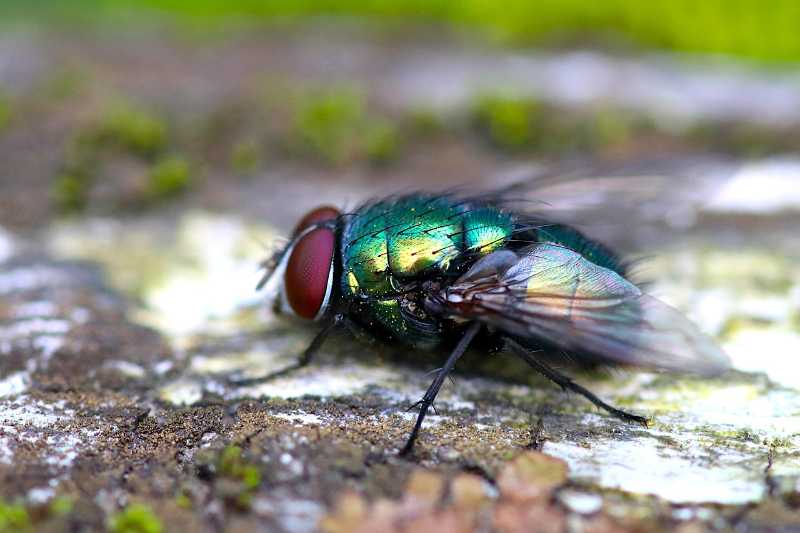
This often less than welcome insect is the green bottle fly of the genus Lucilia which belongs to the overarching family Calliphoridae or - as more commonly referred to - the blowflies. Calliphoridae are often distinguished from other families of fly by their metallic colouring and are a vector for types of bacteria that cause dysentery in humans.
It is not all bad however as the blowflies play an important role in ecosystems as pollinators, a role that is in part enabled by their hairy heads and thoraces.
2. Housefly
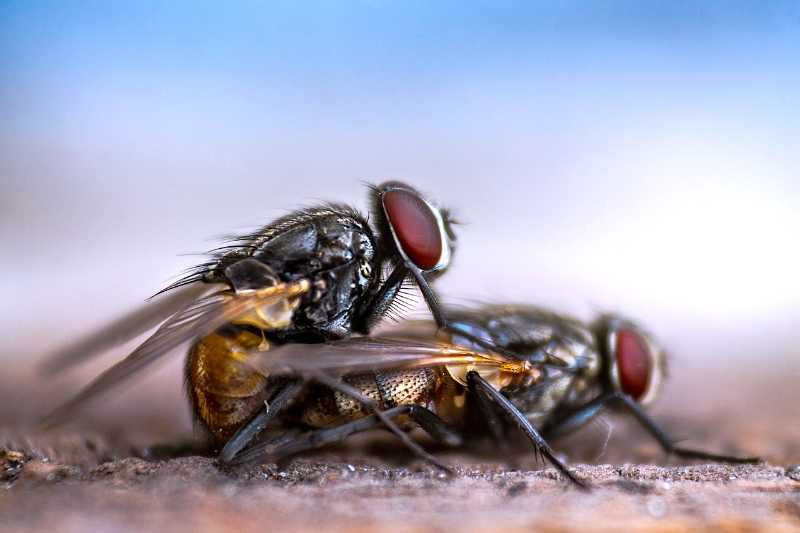
Well this is a picture I never thought I'd see, more like "the birds and the flies" than "the birds and the bees"! The housefly (Musca domestica) can be readily distinguished from other common flies by their proportionally large, red compound eyes in conjunction with a grey/black bodily appearance.
The lifespan of the imaginal (adult) Musca domestica is in the order of a few weeks (typically two to four); this brief lifespan means that breeding must be quick and prolific and, to that end, the housefly reaches sexual maturity within days of emerging from the pupal stage of development. In common with other flies, the larva of a housefly is often referred to as a maggot.
3. Fruit fly
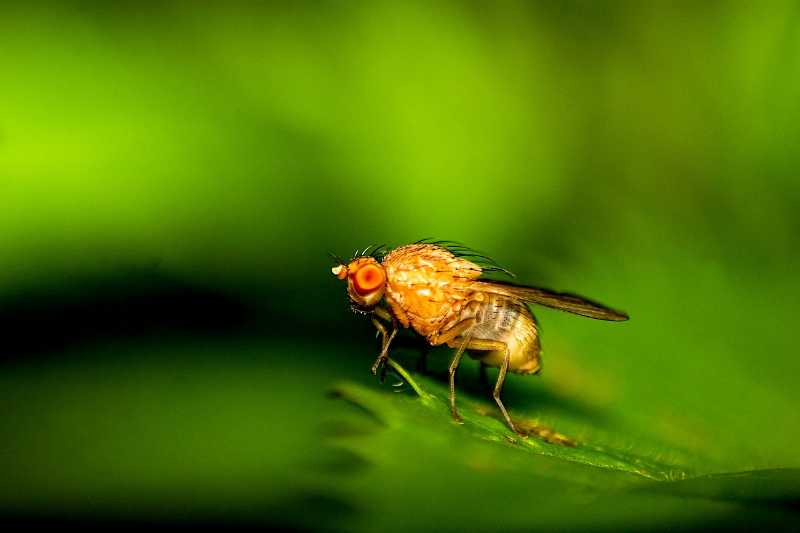
The (lesser) fruit fly is scientifically named Drosophila melanogaster and it can be an unwanted guest in your home if the contents of your fruit bowl are somewhat past their best! It is a commonly used insect in biological and medical research due to its relatively straightforward genetic makeup.
The full list of reasons as to why Drosophila melanogaster is so scientifically useful is extensive but includes - alongside genetic simplicity - short lifecycle or generation time, large number of eggs laid per female and the ability to easily distinguish between males and females of the species.
4. Rose chafer
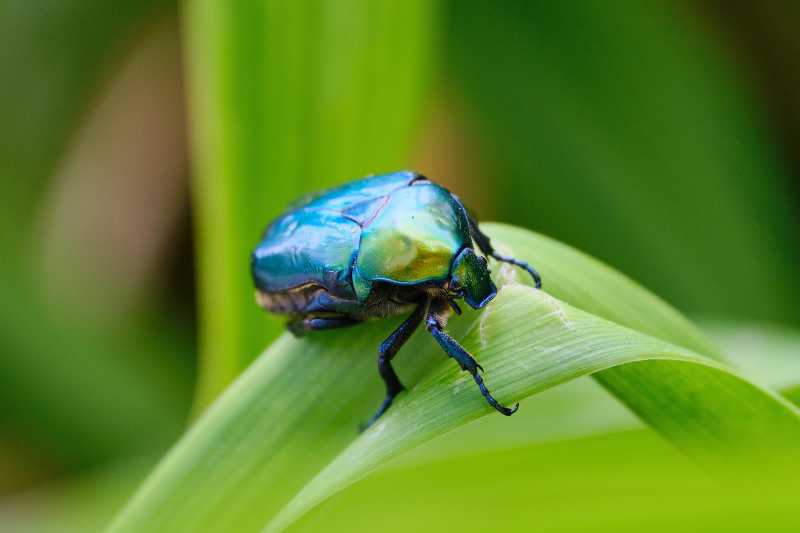
The rose chafer (Cetonia aurata) is also known commonly as the green rose chafer, reflecting the metallic green appearance of this species of beetle. At first glance, the green rose chafer looks very similar to the noble chafer, another member of the scarab beetle family (Scarabaeidae).
The two beetles can however be distinguished by analysing an anatomical feature called the scutellum, a section of the thorax. For the green rose chafer, the scutellum takes the form of an isosceles triangle whereas the structure is shaped like an equilateral triangle in noble chafers. Would you look at that, a practical use for trigonometry!
5. Stag beetle
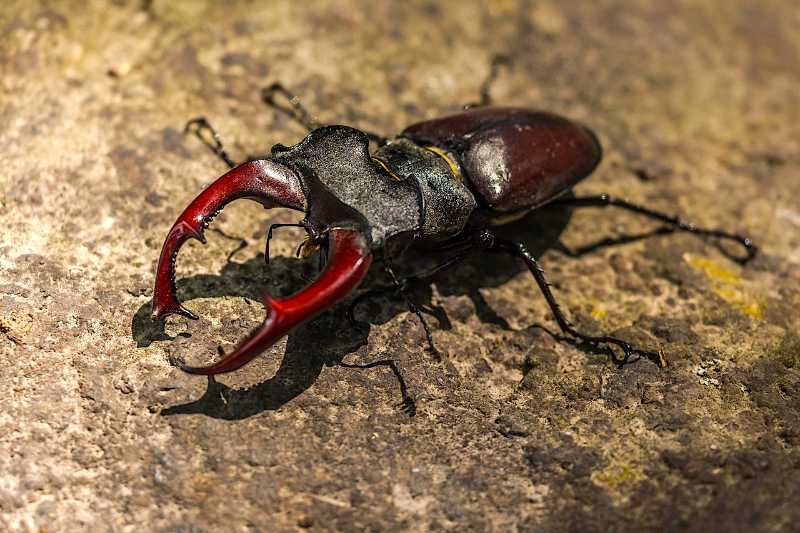
There are approximately 1,200 species that are considered stag beetles or, more rigorously, members of the family Lucanidae. It is the pronounced mandibles that give rise to the insect's common name of stag beetle as they resemble the antlers of a stag (male deer).
The pictured creature is a male European stag beetle (Lucanus cervus) whose red mandibles render the species fairly straightforward to identify. The female of the species is harder to identify as it lacks antlers and the obvious red pigmentation.
6. Firefly
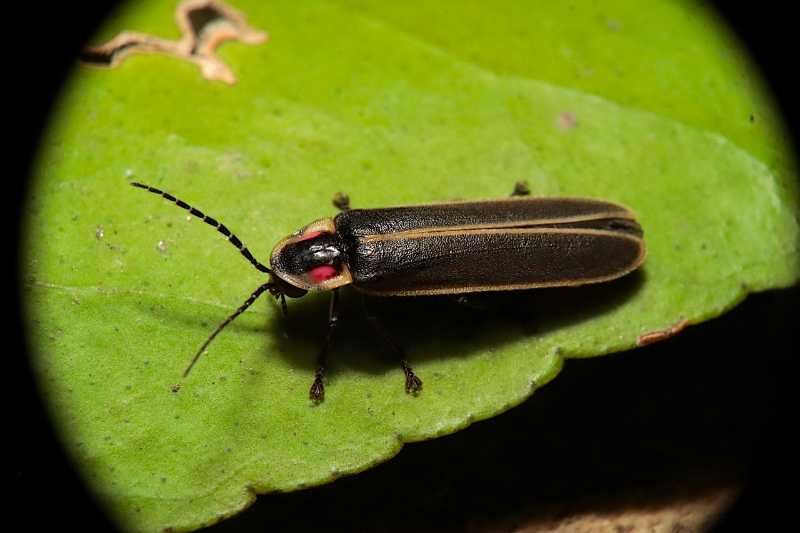
The firefly - also called the lightning bug - belongs to Lampyridae, a large family of beetles; both of these common names relate to the fact that the firefly is capable of bioluminescence (ability to produce light). The site of the chemical process of bioluminescence in the firefly is the insect's photophores which are luciferin-containing organs found on the abdomen.
In simple terms (the actual mechanism takes place over multiple steps), luciferin is oxidised with luciferase acting as a catalyst. This creates oxyluciferin in a higher energy or excited state; when oxyluciferin returns to a lower energy state or ground state, light is released.
7. Peacock butterfly
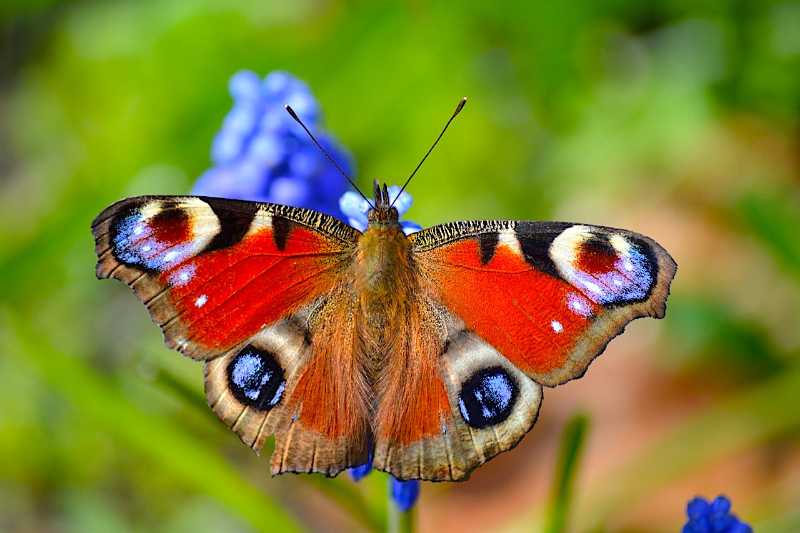
The peacock butterfly has the binomial name of Aglais io and is so named as the dorsal side of its wings have distinctive "eyes" that are reminiscent of those seen on the peacock. Whilst the dorsal side of the wings are strikingly coloured, the ventral side (underside) - typically dull brown in colour - provides us with an example of leaf mimicry; in this case the dull yet textured brown wings look remarkably like a dead leaf.
8. Monarch butterfly
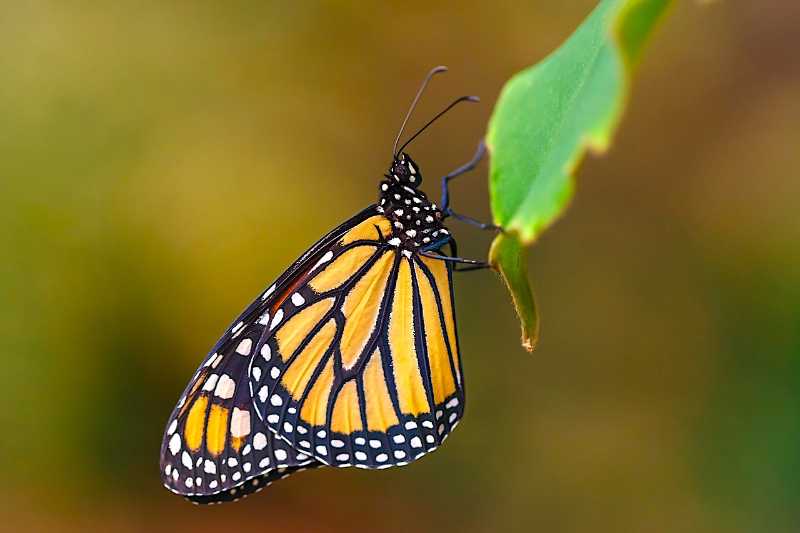
The monarch butterfly (Danaus plexippus) is truly beautiful! The Danaus genus of butterflies can also be referred to as milkweed butterflies as they make use of the leaves of this plant during their life cycle. Eggs are laid by female adults on milkweed leaves (typically on the underside to provide additional protection for the egg) and these eggs hatch into caterpillars.
The caterpillar then attempts to travel as far away from its milkweed leaf as possible to find a suitable site to form a chrysalis.
After pupating for approximately two weeks, the magnificent monarch butterfly emerges.
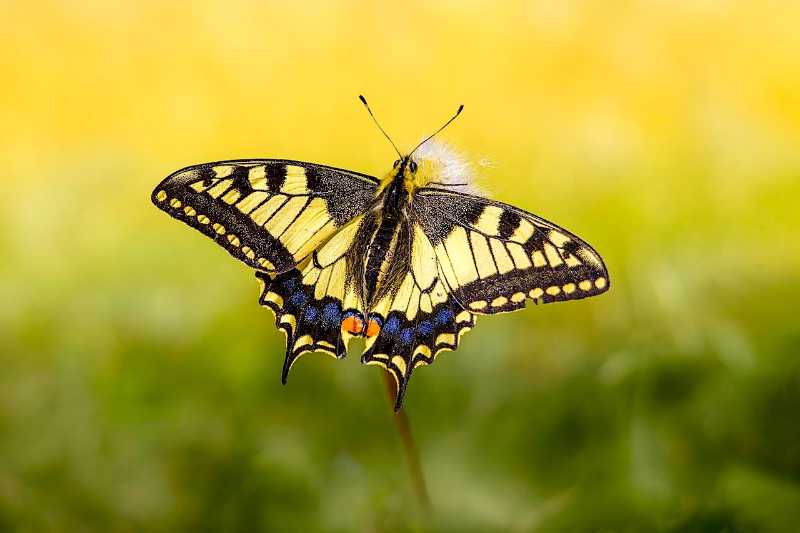
9. Swallowtail butterfly
The name of this delicate butterfly is the swallowtail and the name reflects the "forked" tails of its wings. Whilst the majority of the insect is coloured yellow and black, there is a deviation from this pattern by way of a little splash of blue and red featuring just above the insect's signature tapering tails.
The swallowtail butterfly has the binomial name Papilio machaon and was named by the father of (modern) taxonomy himself, Carl Linnaeus (1707 - 1778).
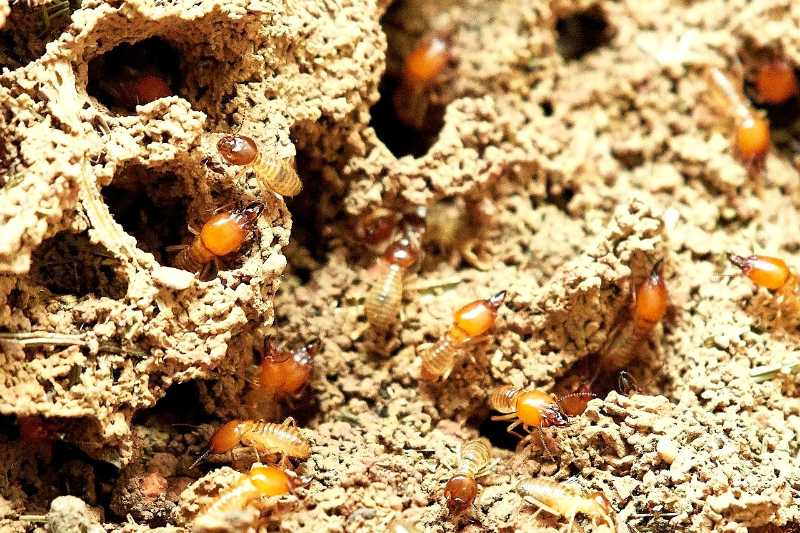
10. Termite
Looking busy in this picture are a number of termites, insects that have the misleading alternative name of "white ants"; termites are not ants, instead they belong to the order Blattodea along with cockroaches (there is a lot of activity in this particular area of taxonomy with much debate to be had about the relationship between cockroaches, termites and their shared ancestors).
Taxonomic intrigue aside, there are a large number of species of termite with the greatest diversity existing in Africa (approximately 1,000 species) and South America (around 400 species).
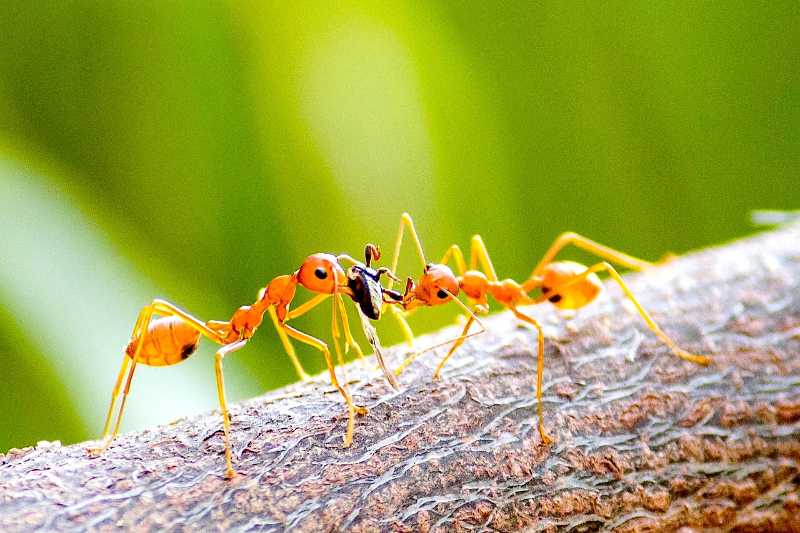
11. Weaver ant
Whilst the source for this image lists these insects as fire ants, a bit of digging reveals them to be weaver ants; the metadata of the original source does however contain a grain of truth as the creature trapped between the two weaver ants is a fire ant! The weaver ant (Oecophylla smaragdina) takes no prisoners and they will work together to successfully predate many different creepy crawlies including, in this case, the fire ant (genus Solenopsis).
Another potential reason for the online confusion between weaver ants and fire ants is that the former are informally referred to as fire ants in parts of Asia.
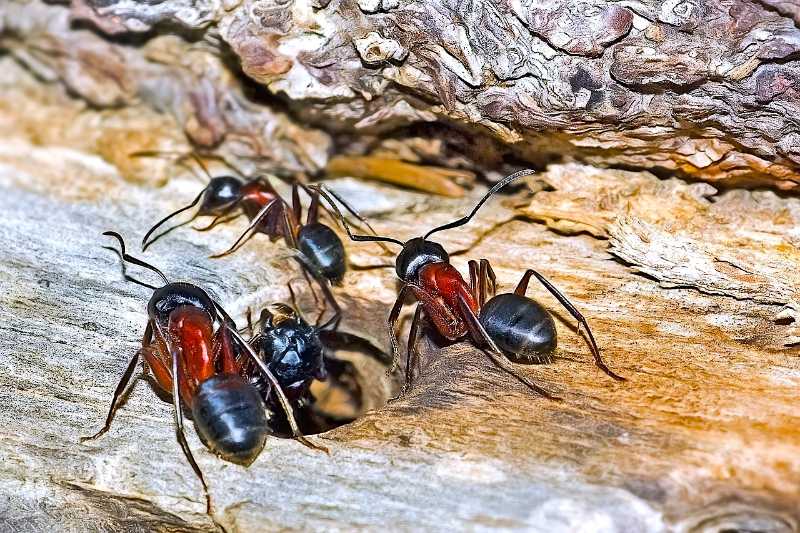
12. Carpenter ant
The (brown-black) carpenter ant has the scientific name Camponotus ligniperda and, as the picture shows, it is the thorax that takes on the red-brown colour and it is the head and abdomen that are coloured black. Their complexion and structure makes this particular species of carpenter ant look dangerous to humans but that is not the case.
They are however known for aggressively defending their nest from invasion and destruction by other species of ant.
This quiz was reviewed by FunTrivia editor rossian before going online.
Any errors found in FunTrivia content are routinely corrected through our feedback system.