FREE! Click here to Join FunTrivia. Thousands of games, quizzes, and lots more!
Quiz about Long Legs Long Neck Flamingo

Long Legs, Long Neck: Flamingo! Quiz


Long legs, long necks, funny bills - and they're bright pink. Why not find out a bit more about these lovely birds, the real-life inspiration for gaudy plastic garden ornaments around the world.

A photo quiz by looney_tunes. Estimated time: 3 mins.
  1. Home
  2. »
  3. Quizzes
  4. »
  5. Animal Trivia
  6. »
  7. Specific Bird Species
  8. »
  9. Flamingoes

Author
looney_tunes
Time
3 mins
Type
Photo Quiz
Quiz #
423,669
Updated
Apr 26 26
# Qns
10
Difficulty
Average
Avg Score
7 / 10
Plays
38
Last 3 plays: Guest 100 (8/10), Guest 184 (4/10), Guest 166 (7/10).
-
Question 1 of 10
1. Which of these is the alliterative term sometimes used to describe a group of flamingos? Hint


Question 2 of 10
2. The beak of a flamingo has feathers on its lower jaw that it uses to filter its food.


Question 3 of 10
3. There are currently considered to be five or six species of flamingo, divided into two or three genera - wouldn't it be nice if taxonomists could all agree? Anyway, which of these currently-recognised species is the most widespread in the wild? Hint


Question 4 of 10
4. What is the essential component of their diet that gives flamingos their color? Hint


Question 5 of 10
5. Which of these has been suggested as a reason why flamingos seem to prefer harsh environments such as this saltwater lagoon?


Question 6 of 10
6. Which of these has NOT been suggested as a reason why flamingos are often seen standing on one leg? Hint


Question 7 of 10
7. Do flamingos feed with their heads held upside down?


Question 8 of 10
8. Which of these best describes the flamingo mating ritual? Hint


Question 9 of 10
9. Which flamingo parent is responsible for building nests and guarding the eggs? Hint


Question 10 of 10
10. What is the name of the substance produced by both male and female adult flamingos to feed chicks? Hint


(Optional) Create a Free FunTrivia ID to save the points you are about to earn:

arrow Select a User ID:
arrow Choose a Password:
arrow Your Email:


View Image Attributions for This Quiz

Most Recent Scores
Today : Guest 100: 8/10
Today : Guest 184: 4/10
Today : Guest 166: 7/10
Today : Guest 97: 5/10
Today : Guest 8: 5/10
Today : cowalsh: 9/10
Today : Waldkaeuzchen: 6/10
Today : Guest 77: 5/10
Today : Guest 97: 4/10

Quiz Answer Key and Fun Facts
1. Which of these is the alliterative term sometimes used to describe a group of flamingos?

Answer: Flamboyance

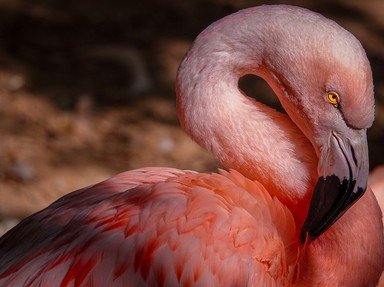
While group terms for animals are not universal, calling a group of flamingos a flamboyance seems quite apt, given their flamboyant appearance! In the introduction I referred to them as pink, and you will see that given as their colour in many sources, but there is actually quite a range of natural colors - the image used for this question has a neck I would consider orange, for example.

The word flamingo comes from several Romance-language words for a flame; they belong to a group of closely-related genera, the Phoenicopteriformes, whose name comes from ancient Greek words for crimson (phoînix) and feather (pterón).
2. The beak of a flamingo has feathers on its lower jaw that it uses to filter its food.

Answer: True

If you can enlarge the image sufficiently, you will see these bristly feathers, called lamellae, running from under the eye down to the tip of the beak. The upper lamellae are pink, while those near the tip are black. Flamingos are filter feeders, which means they take large quantities of water into their oral cavities.

This must be filtered to let the excess water go out, while retaining the tiny plants and animals that are its diet.
3. There are currently considered to be five or six species of flamingo, divided into two or three genera - wouldn't it be nice if taxonomists could all agree? Anyway, which of these currently-recognised species is the most widespread in the wild?

Answer: Greater flamingo

The image shows a greater flamingo and a lesser flamingo standing together in an African lake. These are the two species considered Old World flamingos, with the lesser flamingo (Phoeniconaias minor), found in a region that spans from Africa's Rift Valley to northwestern India, being the most numerous of all flamingo species. The greater flamingo (Phoenicopterus roseus) is, as its name suggests, somewhat larger; it is also much more widespread in the wild, from southern Europe and northern Africa across southern Asia.

The New World flamingos include the Caribbean flamingo (Phoenicopterus ruber) which is found, as the name suggests, on a number of Caribbean islands and the northern parts of South America; the Chilean flamingo (Phoenicopterus chilensis) is located in more southern parts of South America, with the Andean flamingo (Phoenicoparrus andinus) and James's flamingo (Phoenicoparrus jamesi) found in the Andes.

You will note that the taxonomy I chose to use has three genera and six species - this seems to be the latest structure agreed on by most. Flamingos were once considered to be a single genus, Phoenicopterus; in 2014 the Andean flamingo and James's flamingo were reclassified as Phoenicoparrus (and some consider them to be a single species, some have separated them into two species); in 2020 the lesser flamingo was moved to a third genus, Phoeniconaias.
4. What is the essential component of their diet that gives flamingos their color?

Answer: Carotenoids

Carotenoids are a type of related chemicals known for their red and orange colors (carrots have a lot of them, especially beta-carotene). While you may think that the flamingo gets its color from eating shrimp and other small pink delicacies, it is more complicated than that. The carotenoids in their diet are broken down in their liver to produce their feather coloration, and different foods provide different mixes of carotenoids. The strongest coloration comes from ingesting blue-green algae directly, rather than from eating animals which have obtained their store of carotenoids by digesting the algae.

The different food sources available mean that flamingos in different areas tend to have similar levels of color intensity, with New World flamingos generally more brightly coloured than Old World flamingos. But this is not universal! Flamingos are born light grey, and can take several years to develop full color. Captive birds tend to lose their color, which can (to some extent) be restored with carrot juice.
5. Which of these has been suggested as a reason why flamingos seem to prefer harsh environments such as this saltwater lagoon?

Answer: It offers protection from predators.

While flamingos can drink salt water, because they have glands under their eyes that help remove excess salt from their bodies, they prefer fresh water to drink. They are notably found in areas of very salty and/or alkaline water, which their legs are adapted to handle. In Lake Natron (Tanzania), where about three-quarters of all lesser flamingos are born, the water is not only very alkaline, it is also hot - around 60C (140F). These conditions are perfect for the blue-green algae and brine shrimp that are their preferred food, but not so great for their predators.

While adult flamingos are good flyers and can evade predators, chicks are highly vulnerable, so situating nests in a region that deters predators (such as hyenas, lions, jackals and crocodiles) helps protect them from an early death.
6. Which of these has NOT been suggested as a reason why flamingos are often seen standing on one leg?

Answer: To produce an impressive mating display

While flamingos do indeed engage in mating displays (as will be seen a bit further on in this quiz), that is not the reason why they are often seen standing on one leg. But currently there is no consensus among researchers as to the 'real' reason.

It has been suggested that this helps them avoid getting tired legs as they stand all day long. This might be because their body structure allows one-legged standing with less muscular effort than using two legs, especially when resisting sway, or it might just be the capacity to alternate legs.

A second popular theory stems from the observation that they do this more often when standing in the water than when on dry land. The suggestion is that it might help them reduce heat loss into the water by reducing the amount of their body surface that is exposed to it. However, they do it in hot water as well as cold water, which seems to indicate that this is not a complete answer. And they do the one-legged stance on land, too - it may just seem to be more frequent in the water because they spend most of their time there.

The faster flying proposal has little support - in fact, some studies have shown that they take off faster if they start with both legs on the ground.

As an interesting aside, if you look at the photo you will see a bulge near the middle of the flamingo's leg, and might think it is the bird's knee. It is in fact the ankle, which is why their legs seem to bend backwards as they walk!
7. Do flamingos feed with their heads held upside down?

Answer: Yes

As mentioned in an earlier question, they are filter feeders. To get the water into their mouths, they put the head upside down into the water, so that the upper bill is parallel to the bottom of the water, and open the hinged upper beak to create an effective scoop.

They then move their tongue to pull water in and force it out through the sides of the bill - where the lamellae trap food while letting the water (and mud that is almost unavoidably included) to escape. During the process, they often stamp their feet to stir up the sediment in which their food is located, and direct it towards the open bill.
8. Which of these best describes the flamingo mating ritual?

Answer: large groups display together

Flamingo breeding is not exactly seasonal, but rather depends on the conditions - a plentiful food supply following solid rains is a good trigger. The entire colony (which may contain several thousand birds) then breaks up into smaller groups of several dozen birds which engage in a display ritual that ensures everyone is nesting and hatching their eggs at the same time. The displays involve both males and females, and are oriented at the entire group, not at individuals. Both physical movements and vocalisations are involved.

Displays look rather like a dance, with all members of the group performing the same type of action at the same time. These include spreading the wings while stretching the neck, stretching one leg and the wing on the same side simultaneously, head movements that start with stretching forwards before twisting to touch the shoulders, head waggling, head turning, and marching. It's quite a sight!
9. Which flamingo parent is responsible for building nests and guarding the eggs?

Answer: Both parents share both tasks.

As can be seen from the painting, flamingos build their nests in mudflats, usually on a site selected by the female after the pair has bonded. They actually start building the nest even before copulation, and are very territorial, despite the usually crowded nesting area. Nests are usually about 30 cm (a foot) high, with a bowl-shaped hollow in the top where the single egg is laid. The parents take turns sitting on the egg, using their breaks to feed and patrol the area, for the month or so required for incubation.

While most studies have shown flamingos to be monogamous, at least seasonally, some have observed partner-swapping in larger flocks.
10. What is the name of the substance produced by both male and female adult flamingos to feed chicks?

Answer: Crop milk

Crop milk is produced in the upper digestive tract, which includes the crop from which it derives its name. Unlike mammalian milk, it does not contain any carbohydrates, only protein and fat. In the picture you can see a juvenile flamingo asking for some crop milk by rubbing against the neck of an adult. Since the juvenile is probably nearly a year old, it is well and truly past the age of depending on crop milk, but the request may still be met.

Flamingo chicks start to leave the nest after a week, and will request crop milk from any adult they encounter. By the time they are two weeks old, they have left their parents behind and formed groups of their peers referred to as creches - which can grow to have thousands of chicks staying together as a protection from predators. They are extremely vulnerable until they develop a full set of flight feathers, usually around the age of 3-4 months. At that time, the creche starts to dissolve into smaller groups, although flamingos remain highly social birds for their entire lives.
Source: Author looney_tunes

This quiz was reviewed by FunTrivia editor rossian before going online.
Any errors found in FunTrivia content are routinely corrected through our feedback system.
4/26/2026, Copyright 2026 FunTrivia, Inc. - Report an Error / Contact Us