FREE! Click here to Join FunTrivia. Thousands of games, quizzes, and lots more!
Quiz about The Misunderstood Earwig Ear We Go Again

The Misunderstood Earwig: Ear We Go Again Quiz

Family Dermaptera

If you've ever uncovered an earwig nest, it's likely that you instinctively looked around to see if there was a flamethrower handy. But before you turn your garden into an inferno of burning insect flesh, see how much you really know about them. Enjoy!

A photo quiz by JJHorner. Estimated time: 3 mins.
  1. Home
  2. »
  3. Quizzes
  4. »
  5. Animal Trivia
  6. »
  7. Invertebrates
  8. »
  9. Insects

Author
JJHorner
Time
3 mins
Type
Photo Quiz
Quiz #
424,054
Updated
May 04 26
# Qns
10
Difficulty
Average
Avg Score
8 / 10
Plays
21
Last 3 plays: Aph1976 (4/10), Ava108 (5/10), GoodwinPD (10/10).
-
Question 1 of 10
1. Parasitic earwigs have been known to lay eggs in the ears of their hosts.


Question 2 of 10
2. What characteristic behavior, rarely found in insects, do earwigs display? Hint


Question 3 of 10
3. What's the primary function of the forceps-like appendages at the rear of earwigs? Hint


Question 4 of 10
4. Earwigs are found on all continents except Antarctica.


Question 5 of 10
5. How do earwigs typically spend their time during the day? Hint


Question 6 of 10
6. Earwigs belong to the order Dermaptera, which literally means "skin wings". This begs the question, are there earwigs that can actually fly?


Question 7 of 10
7. What is the name of the scary-looking pincers sported by all the most stylish earwigs? Hint


Question 8 of 10
8. The lined earwig (Duru taeniatum) is known to do what when threatened? Hint


Question 9 of 10
9. How do male and female earwigs differ in appearance? Hint


Question 10 of 10
10. The female hump earwig (Anechura harmandi) invests a lot into motherhood. What is her likely fate when her young mature? Hint


(Optional) Create a Free FunTrivia ID to save the points you are about to earn:

arrow Select a User ID:
arrow Choose a Password:
arrow Your Email:


View Image Attributions for This Quiz

Most Recent Scores
Today : Aph1976: 4/10
Today : Ava108: 5/10
Today : GoodwinPD: 10/10
Today : kittykisses07: 5/10
Today : spaismunky: 10/10
Today : rossian: 10/10
Today : Guest 174: 10/10
Today : Iva9Brain: 10/10
Today : Kota06: 6/10

Quiz Answer Key and Fun Facts
1. Parasitic earwigs have been known to lay eggs in the ears of their hosts.

Answer: False

A long-standing bit of folklore may have given earwigs their... interesting name, but the idea that they crawl into ears to lay eggs is a total myth. Earwigs are not parasitic and do not seek out humans or animals as hosts. Like any creature small enough to fit, an earwig in theory COULD wander into an ear while someone is sleeping outdoors, but it is not intentional and certainly not part of any reproductive behavior.

They're much happier minding their own business. That's good news for anyone who has been living in fear of these insects... which look much nastier than they are.
2. What characteristic behavior, rarely found in insects, do earwigs display?

Answer: Maternal care

Earwigs are one of the few types of insects that show true maternal care. And YOU thought they looked mean. A female earwig will guard her eggs, clean them to prevent growth of fungi, and even move them if conditions become less than ideal. Once the eggs hatch, she continues to protect and tend to her young, sometimes feeding them and keeping them close until they are ready to survive on their own. Mama loves her little nymphs.

Most insects lay their eggs and then go away. Female earwigs take their job seriously. Some even adopt orphaned broods, giving them the same maternal care they show their own kin. That may be little comfort when you move a rock and discover a burrow, but it's something to consider before setting the garden on fire.
3. What's the primary function of the forceps-like appendages at the rear of earwigs?

Answer: Defense and mating displays

Yeah, they look like something a tiny medieval army might deploy during a castle siege, but they won't hurt you anymore than a minor clothespin incident. They serve a few purposes, but defense is the big one. When threatened, an earwig will arch its body and brandish those forceps like it means business. Males also use them during mating displays and sometimes in little scuffles with rivals. They're not venomous and won't break your skin, but to other insects, the message is pretty loud: BACK OFF!

There's a bit of romantic drama baked into those pincers, too. Male earwigs tend to have more curved cerci than females, and they use them to grasp the ladies during mating. It's not candlelight and poetry, but... well, I'm not going to kink-shame anyone.
4. Earwigs are found on all continents except Antarctica.

Answer: True

Yes, earwigs have been more places than you have. They're not picky eaters and can handle a range of environments as long as there's moisture and some shelter involved. You'll find members of the order Dermaptera across North and South America, Europe, Asia, Africa, and Australia.

They've spread everywhere, often hitching rides with humans, settling into gardens, forests, and all sorts of damp hiding spots along the way. About the only place they don't call home is Antarctica, which even the more sensible humans generally avoid (shout-out to my peeps at Amundsen-Scott).
5. How do earwigs typically spend their time during the day?

Answer: They hide

If you're hunting earwigs in the middle of a sunny afternoon, you probably won't find many. That's because they're largely nocturnal and spend their daylight hours tucked away in cool, damp hiding spots. So under rocks, inside rotting logs, beneath piles of leaves, or even in the cracks of garden soil. They're not being antisocial. Just avoiding predators and staying moist.

Once the sun dips down, though, it's time to get to work. Earwigs come out to roam and feed, nibbling on plant material, fungi, and sometimes other small insects. Gardeners tend to have mixed feelings about them as a result. While they can chew up tender plants, they also help control aphids and other pests that chew up tender plants.

I guess the bottom line is, if they're eating more plant-eating bugs than actually BEING plant-eating bugs, your garden wins. However, I really don't know what you're going to do with that information.
6. Earwigs belong to the order Dermaptera, which literally means "skin wings". This begs the question, are there earwigs that can actually fly?

Answer: Yes

Oh, sure. They can fly. They just don't like it, and they're really bad at it.

So about these 'skin wings'. In many species those wings are fully functional, although 'fully' might be doing some heavy lifting there. Folded up beneath their short, leathery forewings is a delicate, fan-like set of hindwings that can unfold in an almost origami-like way. It's genuinely impressive... when it actually happens. The catch is that most people never see it, because earwigs almost never bother to fly. They're capable, just not very motivated.

Flying is energy-intensive, and earwigs are built more for crawling through tight, damp spaces than cruising through open air. Also, their wing-folding mechanism is rather complex, so taking off isn't exactly second nature, even to them. It's like watching me fold a fitted sheet.

As for how they fly? It's more like clumsy jumps and brief flutters. It's kind of an embarrassment, actually.
7. What is the name of the scary-looking pincers sported by all the most stylish earwigs?

Answer: Cerci

If you said 'cerci', then you know more than I did a week ago. They're a pair of appendages found on the rear of many insects actually, but earwigs have taken the idea to a whole new level. In these insects, cerci are hardened and shaped into forceps that can curve, pinch, and wave around in a way that looks far more intimidating than it really is, at least to us. Still, they get the job done for defense, the occasional insect-sized showdown, and of course l'amour.
8. The lined earwig (Duru taeniatum) is known to do what when threatened?

Answer: Spray a well-aimed chemical mixture

This particular earwig doesn't just rely on its pincers to make a point. (See what I did there?) When threatened, the lined earwig can release a defensive chemical spray from glands in its abdomen. It's not what you'd call a high-pressure stream like a bombardier beetle, but it's effective enough to deter predators who were thinking about making it their next snack. The spray has a noticeable odor and can be directed with great accuracy for such a small insect.

That chemical defense adds another layer to the earwig's already bad-boy toolkit. There's a lot of drama going on in your garden when you're not looking.
9. How do male and female earwigs differ in appearance?

Answer: Males typically have more curved pincers than females

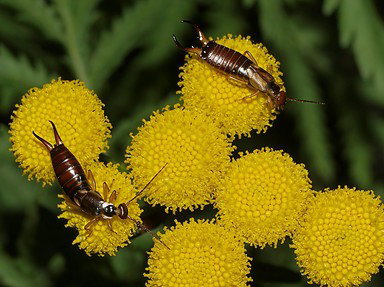
Yes, boy earwigs and girl earwigs have different appendages, and it's the males who have more curves. Now at a glance, they don't look very different. You really have to get into the details.

Male earwigs usually have noticeably more curved cerci, the forceps-like pincers, while females tend to have straighter, more parallel ones. It's a subtle but pretty reliable clue, especially if you've got a couple side by side, as in the picture above. Personally, I've never grabbed a handful of earwigs and started comparing cerci, but... well, there it is.

That curve isn't just for style. Males use their more dramatic pincers in contests with other males and during mating, where grip and shape matter. (Is it getting warm in here?) Females, meanwhile, keep things more practical with simpler cerci that still manage the same job. Well, mostly.
10. The female hump earwig (Anechura harmandi) invests a lot into motherhood. What is her likely fate when her young mature?

Answer: They will consume her

Do you like fairy tales? I mean, the old, original versions with all the guts and gore? Welcome to the life of a female hump earwig. They care for their eggs and young with the usual dedication of other earwigs: guarding them, cleaning them, and even feeding them. As the young mature, though, things take a Grimm turn. The young often end up consuming their own mother. This behavior, known as 'matriphagy', provides the offspring with a rich nutritional boost at an important stage in their development.

The process appears to be somewhat programmed, with the mother's condition declining as the young grow stronger and more independent. In the grand scheme of things, her body becomes her final investment in the future.

And that's all I've got to say about earwigs.
Source: Author JJHorner

This quiz was reviewed by FunTrivia editor rossian before going online.
Any errors found in FunTrivia content are routinely corrected through our feedback system.
5/4/2026, Copyright 2026 FunTrivia, Inc. - Report an Error / Contact Us