FREE! Click here to Join FunTrivia. Thousands of games, quizzes, and lots more!
Quiz about Youre a Housefly Now What

You're a Housefly. Now What? Trivia Quiz

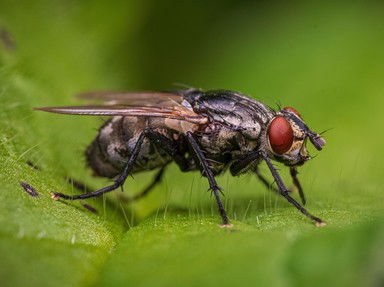
Musca domestica

Congratulations. You're a newborn housefly. This quiz will deal with many of the unique challenges you'll face as you grow up, including what to expect when you're expectorating. Enjoy!

A multiple-choice quiz by JJHorner. Estimated time: 5 mins.
  1. Home
  2. »
  3. Quizzes
  4. »
  5. Animal Trivia
  6. »
  7. Invertebrates
  8. »
  9. Insects

Author
JJHorner
Time
5 mins
Type
Multiple Choice
Quiz #
423,610
Updated
Apr 01 26
# Qns
10
Difficulty
Average
Avg Score
8 / 10
Plays
30
Last 3 plays: MaziFax (10/10), idlern (7/10), cowalsh (8/10).
- -
Question 1 of 10
1. You stretch your weird little head through the remains of the membranous egg, and you're free! Congratulations, you're a... housefly? Well, not quite. Despite the name, you're not ready for flying just yet. You've got some growing up to do first, kid. The first thing you have to get used to is the rude names. As a housefly larva, what are humans going to call you? Hint


Question 2 of 10
2. You look, but as a larva, you can't really see much. In fact, you can only detect patches of light and darkness, and the light fills you with dread. Eek! You need to get away from it by crawling deeper into the dark squishy mess you're in. While you can't see that mess, boy can you smell it... and canine excrement never smelled so good, so good in fact, that you find fluid gushing out of your mouthparts. What is being released by your calorie-starved body? Hint


Question 3 of 10
3. Hey, you're starting to get the hang of this. You don't have lungs, but you're breathing fine through spiracles in the back of your body and eating... and eating. You can't get enough of this grade-A quality excreta. In fact, you're growing at an alarming rate, and your skin's getting a little tight. You're about ready to enter your second instar. What's happening to you? Hint


Question 4 of 10
4. Who knew dog poop was so good for you? You've eaten well and grown through three instars, and it's only been a week. Now you find yourself crawling towards a drier place. Your skin changes color and hardens into a protective case while you perform a biological superhero trick. What is your hardened case called? Hint


Question 5 of 10
5. You sleep. And change. Histolysis... histogenesis... You don't know what these words mean because you're just a pile of goop right now. And that goop is reassembling itself. When you wake up, there's a temporary fluid sac on your new head. You don't know what it is, because you're a housefly, but you instinctively know what to do with it. What do you do with it? Hint


Question 6 of 10
6. Emergence sure was a pain, wasn't it? You spent two days hanging around, watching your wings dry. Wait! You have wings! How cool is that? Time to put them to use. You're starving! You spent the first half of your life eating, and during the second half you've either been a pile of goop or waiting to dry. It's time to eat. You take flight and land on something promising. To tell if it's food or not, you take a taste. Where are your taste receptors (chemosensilla) located? Hint


Question 7 of 10
7. Ooh, this rotting crab apple is definitely tasty, but you have no teeth! What's a poor housefly to do? Luckily, you already know the answer. You do what comes naturally. What do you do? Hint


Question 8 of 10
8. You take a personal inventory. Oh, look! You're a lady housefly! And your biological clock is ticking! A good man is hard to find, though. You smell the air through your antennae. Oh! There are males close by, and your body is already priming itself for mating. What have your olfactory senses latched onto? Hint


Question 9 of 10
9. You enter the lek (the mating zone where the boys hang out). You're not even there long enough to introduce yourself when a male zooms down, slams into your back mid-air, and pins your body and your wings with his legs. Romance is dead. There's a brief exchange of sensory information, but the choice is yours. If you're cool with everything, you remain still. What do you do if you're not? Hint


Question 10 of 10
10. Well, you accepted him, and together you hang out in front of me on the railing of my back deck. After about 30-60 minutes of Loverboy's aedeagus engaging the dorsal valve of your ovipositor (is it getting warm in here?), he leaves. Typical. He didn't just inject the usual sperm cells, but a whole cocktail of chemicals that is now affecting your brain. You find yourself needing to locate a place to do what? Hint


(Optional) Create a Free FunTrivia ID to save the points you are about to earn:

arrow Select a User ID:
arrow Choose a Password:
arrow Your Email:


Most Recent Scores
Today : MaziFax: 10/10
Today : idlern: 7/10
Today : cowalsh: 8/10
Today : SisterSeagull: 7/10
Today : Guest 76: 4/10
Today : bernie73: 5/10
Today : legs1313: 4/10
Today : vvicjeff: 7/10
Today : Nala2: 7/10

Quiz Answer Key and Fun Facts
1. You stretch your weird little head through the remains of the membranous egg, and you're free! Congratulations, you're a... housefly? Well, not quite. Despite the name, you're not ready for flying just yet. You've got some growing up to do first, kid. The first thing you have to get used to is the rude names. As a housefly larva, what are humans going to call you?

Answer: Maggot

The egg from which you just escaped was laid in a place where... well, the rest of us don't generally enjoy as you do. Warm, moist, and rich in organic material, this is a five-star nursery if you're a future fly and gag-inducing brown slop for the more sensitive humans.

And yes, humans see you and go straight to 'maggot'. It's not generally a term of endearment, but biologically speaking, it's just the standard term for fly larvae. That's you.

Your mom laid batches of these tiny white eggs, each one no bigger than a grain of sand, and you didn't waste much time. Given the right conditions, your mom's eggs can hatch in as little as 8 to 24 hours.

There's no time to waste. You have things to do, and precious little time to do them.
Breaking out of the egg is not particularly graceful. There is no dramatic cracking like a chick pecking its way into daylight or anything like that. It's more of a quiet rupture, a soft splitting of the egg membrane as you wriggle forward. You don't have eyes to admire the view. You don't have legs to stretch. You don't even have a FunTrivia account. You're just a tapered tube, maggot!

Welcome to the world, my little squirmy friend!
2. You look, but as a larva, you can't really see much. In fact, you can only detect patches of light and darkness, and the light fills you with dread. Eek! You need to get away from it by crawling deeper into the dark squishy mess you're in. While you can't see that mess, boy can you smell it... and canine excrement never smelled so good, so good in fact, that you find fluid gushing out of your mouthparts. What is being released by your calorie-starved body?

Answer: Digestive enzymes

Your body is running on fumes but, as we'll learn throughout this quiz, you've got quite a few tricks up your sleeve... or you would if you had sleeves. Instead of chewing like any boring old animal, you take a more... fluid approach.

You see, you secrete digestive enzymes directly onto your surroundings. That is, you leak fluid, mostly out of your mouthparts, and the material around you starts breaking down externally, turning into something you can absorb without worrying about the complex digestive systems so many others like to brag about. Efficient. Externally digested food.

That irresistible organic smell acts as a chemical signal screaming 'food' to every cell in your very simple body. You do not savor it. You do not reflect on it. You respond. Instantly. The enzymes flow, the material softens, and suddenly the world is a little more edible than it was a moment ago.
3. Hey, you're starting to get the hang of this. You don't have lungs, but you're breathing fine through spiracles in the back of your body and eating... and eating. You can't get enough of this grade-A quality excreta. In fact, you're growing at an alarming rate, and your skin's getting a little tight. You're about ready to enter your second instar. What's happening to you?

Answer: You're molting

Your outer covering, called a cuticle, is not like a human's favorite stretchy sweater that is forgiving of a few too many large meals. It's more like a rigid suit of armor with no interest in accommodating your little growth spurts. Mom isn't around anymore to take you to the "Husky" section of Sears with the other chubby kids (or maybe that was just me... "lots of room in crotch" is not the compliment you think, MOM!)

So... well, you split it open and wriggle out, revealing a fresh, slightly roomier version underneath. Again, it's not the stuff of glamor shoots. However, it is very necessary.

This process is called molting. It marks your big transition between larval stages, or instars, as those in the biz like to call them. You'll go through three of these stages. During each one of them, you'll be a little bit bigger and a whole lot hungrier.

Once you end your third instar, my little larval M. domestica, things are going to get weird.
4. Who knew dog poop was so good for you? You've eaten well and grown through three instars, and it's only been a week. Now you find yourself crawling towards a drier place. Your skin changes color and hardens into a protective case while you perform a biological superhero trick. What is your hardened case called?

Answer: Puparium

The puparium isn't a dainty and delicate silk wrap or butterfly couture. Nope. This is your own last larval skin, chemically reinforced and hardened into a capsule. Brown, oval, meant for business.
From the outside, it looks like nothing much is happening. From the inside, things are getting goopy and weird.

Your little body doesn't get a gentle upgrade here. Uh-uh. You dissolve. Enzymes break down much of your internal tissues into soup, and not the yummy kind. Not everything is lost, though. Little groups of cells called imaginal discs have been eagerly waiting for just this moment.

These little guys are the blueprints that have been inside you your whole life, such as it is. Now they wake up and start building. Legs. Wings. Compound eyes. Antennae. You're being re-assembled like Gary Rendell in "Walking to Aldebaran".

(Anybody?)

Regardless, systems reorganize. Structures emerge where there were none before. Muscles form, the nervous system gets rewired. It's madness there inside the puparium! That featureless larval existence you just got good at is gone forever.
5. You sleep. And change. Histolysis... histogenesis... You don't know what these words mean because you're just a pile of goop right now. And that goop is reassembling itself. When you wake up, there's a temporary fluid sac on your new head. You don't know what it is, because you're a housefly, but you instinctively know what to do with it. What do you do with it?

Answer: Fill it until your enclosure breaks open

That silly little sac on your silly little head is called a ptilinum, and it is your built-in escape tool. You pump it full of fluid, inflating it like a water balloon on your forehead. It pushes outward, over and over, pressing against the front end of the puparium. Things are getting tense, man.

Eventually, the cap at one end of your puparium gives way, or at least that's how the engineers designed it. If it doesn't? Well, it's been a good life. Sorry.

But you're one of the lucky ones. It pops open like a lid along the built-in seam. You push through, emerging into the world as a soft, pale adult fly. The ptilinum retracts soon after, tucking back into your head and leaving behind a faint line called the ptilinal suture. I bet you didn't think you'd know that little factoid when you woke up today.

Congratulations. You're officially a housefly. But you're not quite ready for normal housefly activities yet. You need to harden and dry. You're a mess.
6. Emergence sure was a pain, wasn't it? You spent two days hanging around, watching your wings dry. Wait! You have wings! How cool is that? Time to put them to use. You're starving! You spent the first half of your life eating, and during the second half you've either been a pile of goop or waiting to dry. It's time to eat. You take flight and land on something promising. To tell if it's food or not, you take a taste. Where are your taste receptors (chemosensilla) located?

Answer: On your feet

Those little feet of yours are not just for landing and casually strolling across sticky surfaces that would gross out the average human. They are packed with chemosensilla. What are they? Glad you asked!

Chemosensilla are specialized sensory hairs that can detect chemicals. In other words, you taste by stepping on stuff. Well, that's pretty convenient, isn't it? Every landing is a flavor sensation.
Is it food? Is it not food? Only one way to find out! Tap dance lightly and let your weird biology do the rest.

No need to commit to a bite right away. No need to bring anything closer. You just touch down and get feedback instantly. Sweet, salty, interesting, suspicious. Your housefly nervous system processes the signal, and you decide whether to stick around or take off in search of something more appealing.

My arms taste incredible to house flies, I'll have you know.
7. Ooh, this rotting crab apple is definitely tasty, but you have no teeth! What's a poor housefly to do? Luckily, you already know the answer. You do what comes naturally. What do you do?

Answer: You vomit saliva

That rotting crab apple is putting out all the right signals. Soft, fermented, past its prime. Perfect. You land, you taste with your feet, and... oh, you know this is the good stuff.

So you do what comes naturally: you throw up.

Okay, that sounds rude. It sounds inefficient. But really, it's brilliant. You regurgitate a drop of saliva onto the surface of the apple. This saliva is packed with enzymes that start breaking things down on the spot, turning solids into a more manageable, drinkable slurry. You're a juicer with six legs!

Once the surface softens into something suitably sippable, you use your spongelike mouthparts to lap it up. Chewing isn't your thing. This is a rotting crab apple Slurpee.

You use your labellum, that soft pad at the end of your proboscis, to absorb that tasty rotten apple. Mmm.
8. You take a personal inventory. Oh, look! You're a lady housefly! And your biological clock is ticking! A good man is hard to find, though. You smell the air through your antennae. Oh! There are males close by, and your body is already priming itself for mating. What have your olfactory senses latched onto?

Answer: Pheromones

The boys release pheromones. They're chemical signals that serve like tiny airborne advertisements. No poetry, no subtlety, no romance. Just a message broadcast into the air that says, "Hey, baby. You like my cuticular hydrocarbons? I made them myself. Wanna dance?"

Okay, the pheromone (Z)-9-heptacosene is produced by the male housefly's genitalia. What it's actually saying is probably more... abrupt. But you get the idea.

Regardless, your antennae are finely tuned to pick up on this, translating faint chemical traces into a very direct behavioral response. It is not even a conscious decision.

Your nervous system grabs that signal and runs with it. Your orientation shifts. Movement follows. What was once a world of crab apples and dog poop is now a map with a big red X on it, showing you where the boys are.

There's no time to try on dresses and make yourself pretty. Just a trail of pheromones leading you straight to the next chapter of your very busy and very short life.
9. You enter the lek (the mating zone where the boys hang out). You're not even there long enough to introduce yourself when a male zooms down, slams into your back mid-air, and pins your body and your wings with his legs. Romance is dead. There's a brief exchange of sensory information, but the choice is yours. If you're cool with everything, you remain still. What do you do if you're not?

Answer: Kick him and vibrate your wings

If you're not buying what he's selling, you fight back. You kick with your legs and vibrate your wings, creating a clear physical rejection signal. It's kind of rude, but it gets the message across. I mean, realistically, if you ask to buy a woman a drink, and she starts kicking you and flapping her arms wildly, you can reasonably assume that she's not interested.

Your response is immediate and effective. The male will have to disengage, and you regain control of your flight. That's it. No means no.

Lek behavior in flies is weird, as any human who has witnessed it can confirm. It's fast, competitive, and... well, it's just absolute chaos. Males gather and wait for opportunities, and when one appears, they act quickly. Despite the tough-guy approach, though, the female still has the final say. If the signal is not right, the answer is a swift and unmistakable rejection delivered mid-air.
10. Well, you accepted him, and together you hang out in front of me on the railing of my back deck. After about 30-60 minutes of Loverboy's aedeagus engaging the dorsal valve of your ovipositor (is it getting warm in here?), he leaves. Typical. He didn't just inject the usual sperm cells, but a whole cocktail of chemicals that is now affecting your brain. You find yourself needing to locate a place to do what?

Answer: Lay eggs

Well, that whirlwind romance didn't last too long, although the dorsal valve of your ovipositor might feel otherwise. One moment it's absolute chaos; the next, you are parked on a railing, alone, wondering if it was something you said.

Except a whole lot did happen. Along with sperm, he passed along a very special biochemical cocktail.

And the chemicals in that cocktail are not just going to hang around doing nothing. They actively influence your behavior, reducing your interest in further mating (sorry, you're probably done) and ramping up your need to find a suitable place to deposit your eggs.

Your mission, should you choose to accept it, is to find a warm, moist, nutrient-rich environment where the next generation can hit the ground squirming.

You are now scouting. Garbage, manure, decaying organic matter. Anything humans find gross is prime real estate. Each landing is a quick evaluation. You run through a checklist. Is it moist enough? Rich enough? Safe enough?

When you find the right spot, you lay clusters of tiny white eggs, each the size of a grain of sand, and the whole quiz starts again.
Source: Author JJHorner

This quiz was reviewed by FunTrivia editor rossian before going online.
Any errors found in FunTrivia content are routinely corrected through our feedback system.
4/1/2026, Copyright 2026 FunTrivia, Inc. - Report an Error / Contact Us