FREE! Click here to Join FunTrivia. Thousands of games, quizzes, and lots more!
Quiz about Dont Let This Quiz Bug You

Don't Let This Quiz Bug You

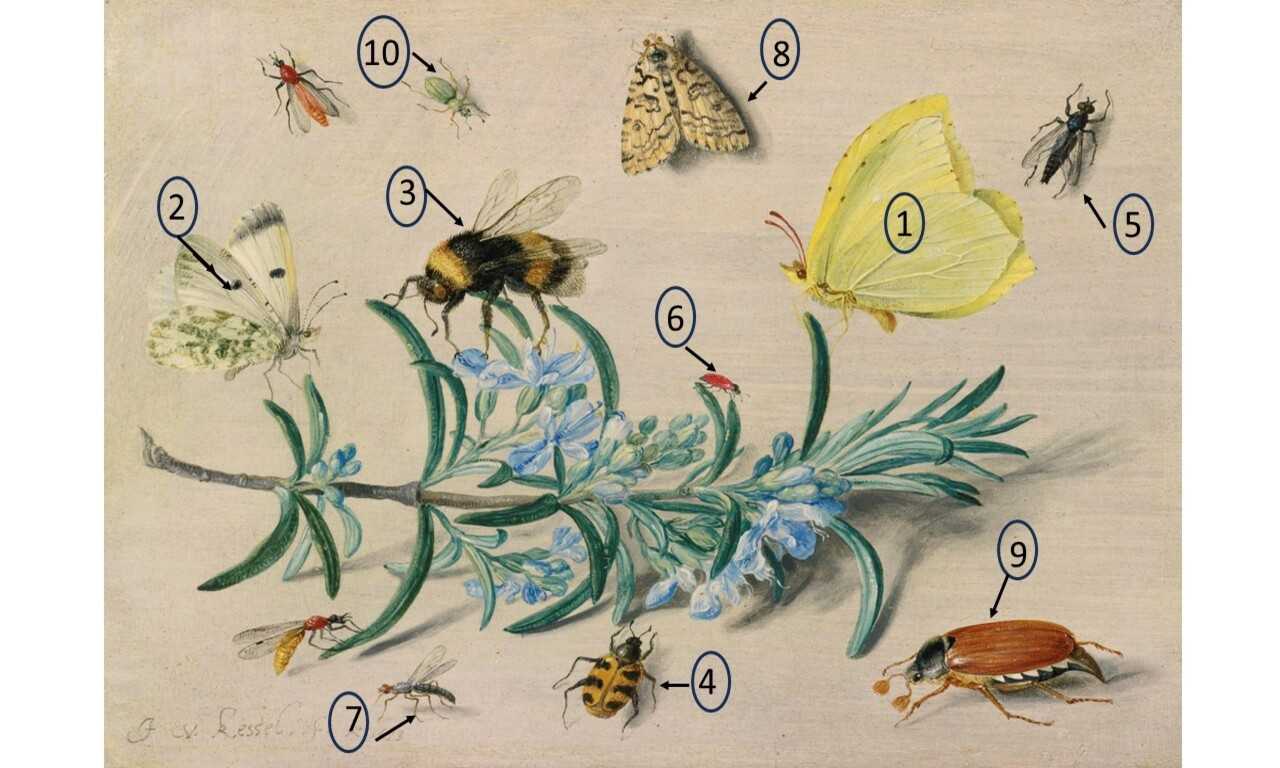
Label some insects

Years ago, an artist named Jan van Kessel the Elder painted a series of scientific drawings about insects. Match the appropriate insect name to the depiction of it in the artwork. And learn a bit about these fascinating animals.

A label quiz by stephgm67. Estimated time: 3 mins.
  1. Home
  2. »
  3. Quizzes
  4. »
  5. Animal Trivia
  6. »
  7. Invertebrates
  8. »
  9. Insects

Author
stephgm67
Time
3 mins
Type
Label Quiz
Quiz #
424,066
Updated
May 07 26
# Qns
10
Difficulty
Average
Avg Score
7 / 10
Plays
46
Last 3 plays: OkieMike (6/10), Guest 4 (7/10), Guest 70 (8/10).
Click on image to zoom
Red-headed ash borer Brimstone butterfly Carrion beetle March fly Cabbage white butterfly June beetle Ladybird beetle Pale green weevil Geometer moth Bumblebee
* Drag / drop or click on the choices above to move them to the answer list.
View Image Attributions for This Quiz
1.   
2.   
3.   
4.   
5.   
6.   
7.   
8.   
9.   
10.   

Most Recent Scores
Today : OkieMike: 6/10
Today : Guest 4: 7/10
Today : Guest 70: 8/10
Today : Guest 73: 4/10
Today : Guest 174: 7/10
Today : Guest 93: 7/10
Today : Jaydel: 8/10
Today : Superfi: 7/10
Today : Guest 216: 10/10

Quiz Answer Key and Fun Facts
1. Brimstone butterfly

The brimstone butterfly is a bright yellow butterfly commonly found in Europe and parts of Asia. In fact, this insect (Gonepteryx rhamni), with its buttery color, is often credited with why people called them butterflies. Males, especially, are a vivid color while females are much paler, and are almost greenish-white. When the brimstone closes its wings, it looks exactly like a pointed light green leaf, complete with realistic veins and small brown spots that mimic decay. This camouflage is so effective that birds often overlook them even when the butterfly is sitting in plain sight.

These butterflies are known for living longer than most, sometimes up to a year. They will spend the winters as adults, hiding in foliage, and then show up again in the spring. This makes them one of the first butterflies people see each year and they are a harbinger of spring.
2. Cabbage white butterfly

The cabbage white butterfly (Pieris rapae) is a small, common butterfly found in many places around the world. They are found especially around gardens where they are often viewed as a nuisance because their larvae (cabbage worms) have a big appetite for leafy vegetables. The butterfly has white wings with small black spots with the male having one spot on each wing while the female has two.

Male cabbage whites also produce a distinct scent to attract mates that many humans describe as smelling like lemons. However, this scent also serves a dual purpose as it can act as a chemical signal to other males to stay away from their territory. The insects will also bask in the sun, using their white wings to act as a sort of solar panel to reflect the heat onto their bodies.
3. Bumblebee

The bumblebee, with its scientific name of Bombus, is a fuzzy insect with black and yellow stripes that is known for its very important role in pollination. Some flowers hold their pollen tightly inside tiny tubes. To get it out, bumblebees will grab the flower and vibrate their flight muscles at a specific frequency, creating a high-pitched "buzz" that literally explodes the pollen out onto their bodies. Some of this pollen is taken back to the bee's nest to feed larvae and much of it rubs off on the next flower, thereby pollinating it.

Bumblebees are warm-blooded insects. They can shiver their muscles to generate internal heat, allowing them to fly when it is as cold as 0°C (32°F). This is why they are often the first bees seen in the morning and the last ones in the evening. They can also calculate the most efficient route between hundreds of different flowers to conserve energy.
4. Carrion beetle

The carrion beetle (in the family Silphidae), which lives all over the world except Antarctica, is an insect that feeds on dead animals. Many have black bodies with bright orange or red markings. Some are known as burying beetles because they will find a small animal carcass and literally dig the soil out from under it. They are able to find the carrion because they have an incredibly sensitive sense of smell. Using their club-tipped antennae, they can detect the chemical signals of decay from far away within minutes of an animal's death. The carcass will eventually sink into the ground, and the beetles cover it up to hide it from larger scavengers.

Unlike almost all insects that lay eggs and leave, carrion beetles are devoted parents. After burying a carcass, the male and female work together to strip away fur or feathers and ball the meat up. They then stay to feed their larvae regurgitated food until the young can eat on their own.
5. March fly

The March fly (family Bibionidae) is a distinctive, slow-moving insect that often appears in large numbers during the early spring months. Unlike the common housefly, they are quite slender with long, dangling legs and bright red eyes. They are generally harmless to humans, as they neither bite nor sting. Actually, their larvae live in the soil and feed on decaying plants, which helps break down organic matter.

These insects have over 700 species found across almost every continent. In North America, they are especially common in wooded areas, moist meadows, and even suburban lawns from coast to coast. The males have a fascinating quirk in that they have massive eyes that are actually split into two parts with one half for looking down at the ground and the other for looking up at the sky to spot females. This specialized vision makes them excellent trackers during their mating season.
6. Ladybird beetle

The ladybird beetle (Coccinellidae family), often called a ladybug, is a small and round insect that is usually bright red or orange with black spots. While many people believe that spots represent a ladybird's age, the number of spots actually identifies its species. Some have two, others have seven, and some even have zero spots. Also, those hard colored covers protect delicate flying wings which they open to take flight.

An aphid would consider a ladybird a fierce, sophisticated predator because a single ladybird can consume up to 5,000 aphids in its lifetime. On the flip side, if a ladybird itself feels threatened by a predator, it can leak a foul-smelling, bitter-tasting yellow fluid from its leg joints. This isn't actually blood, but a toxic chemical called hemolymph that warns birds and lizards that the beetle is definitely not a delicious treat.
7. Red-headed ash borer

The red-headed ash borer (Neoclytus acuminatus) is a type of beetle with a reddish head and a body marked with stripes. Because these beetles spend their time boring into wood and crawling through tight crevices in bark, those markings (which are actually made of tiny, fine hairs) can often get faded over time. Not only do they have the coloring and shape of a wasp, but they also move in a jerky, frantic way to trick birds and other predators into thinking they have a stinger.

As their name suggests, they primarily lay their eggs in ash trees, though they aren't picky and will also use oak, hickory, or fruit trees. Amusingly, (although probably not to the homeowner) these insects can "hitchhike" in on a piece of firewood. Once the wood warms up inside the house, the beetles think it's spring and emerge.
8. Geometer moth

The geometer moth (family Geometridae) is the adult form of the world-famous inchworm. The name "geometer" literally translates from Greek as "earth-measurer," which refers to the way their larvae move by looping their bodies into an arch and "measuring" the ground as they walk. While the youngsters have this unique gait, the adult moth is the champion of camouflage.

The moth is brown or gray which it makes it hard to spot when resting during the day. It also has intricate patterns on its wings which helps it blend in with tree bark or leaves. In several of the species, the females are completely wingless or have tiny, useless wing stubs. They crawl up tree trunks and emit pheromones to attract the winged males, a strategy that saves energy for egg-laying rather than risky flight.
9. June beetle

The June beetle (genus Phyllophaga) is often called a June bug. It is an oval, brownish-red insect commonly seen flying around lights on summer evenings. These members of the scarab beetle family have very hard wing covers that are often shiny and it appears as if they are clumsy flyers. This is because those wing covers are cumbersome and their flight muscles are not highly refined so they tend to fly in a straight line until they hit something. Once they crash and fall on their backs, they often struggle for a long time to flip themselves over.

June beetles spent most of their lives underground as larvae. In this state, they are known as white grubs and they eat grass roots (which can definitely stress lawn owners). As adults, their diet consists of leaves.
10. Pale green weevil

The pale green weevil (Polydrusus impressifrons) is a small beetle known for its light green color and its short but slender snout. The color helps it blend into leaves as a safety factor while its snout is used for feeding and sometimes for laying eggs. These weevils are not picky eaters. While they are often called "leaf weevils", they are famous for visiting over fifty different types of trees, including oaks, birches, maples, and fruit trees. They usually emerge in late spring and early summer, perfectly timed with the unfurling of tender new leaves.

It seems they have learned a trick from the American opossum! If a predator gets too close, the weevil will instantly freeze, pull its legs tight against its body, and tumble off the leaf. By falling into the grass and staying perfectly still as if it's dead, it becomes almost impossible to find.
Source: Author stephgm67

This quiz was reviewed by FunTrivia editor rossian before going online.
Any errors found in FunTrivia content are routinely corrected through our feedback system.
5/7/2026, Copyright 2026 FunTrivia, Inc. - Report an Error / Contact Us