FREE! Click here to Join FunTrivia. Thousands of games, quizzes, and lots more!
Quiz about Trash Pandas Ringtails and Other Procyonids

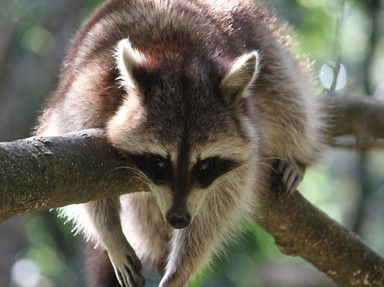
Trash Pandas, Ringtails, and Other Procyonids Quiz

The Raccoon Family

Raccoons, kinkajous, ringtails, coatis, and more, the members of the Procyonidae family take center stage in this quiz. How much do you know about these charming New World carnivores that stalk our garbage cans at night?

A photo quiz by JJHorner. Estimated time: 3 mins.
  1. Home
  2. »
  3. Quizzes
  4. »
  5. Animal Trivia
  6. »
  7. Wild Mammals
  8. »
  9. Carnivores

Author
JJHorner
Time
3 mins
Type
Photo Quiz
Quiz #
423,336
Updated
Mar 06 26
# Qns
10
Difficulty
Average
Avg Score
8 / 10
Plays
290
Awards
Top 5% quiz!
Last 3 plays: marianjoy (10/10), Guest 90 (5/10), Guest 104 (8/10).
-
Question 1 of 10
1. What feature, common to many procyonids, helps them balance when climbing in trees? Hint


Question 2 of 10
2. Which North American procyonid (Procyon lotor) is famous for its black mask and ringed tail and is commonly found in cities and suburbs? Hint


Question 3 of 10
3. Which small, adorable, slender procyonid of the southwestern United States, lovingly called Bassariscus astutus by taxonomists, is known for its big eyes, long bushy tail, and catlike climbing ability? Hint


Question 4 of 10
4. Which sensory trait is especially well-developed in procyonids like raccoons and plays a big role in how they locate food? Hint


Question 5 of 10
5. Where are you most likely to find many procyonids like racoons when resting or raising young? Hint


Question 6 of 10
6. What Central and South American procyonid (Nasua narica) lives in social bands called troops and is often seen foraging in daylight with its ridiculous snout? Hint


Question 7 of 10
7. And you thought this was going to be a fun quiz. Yes, that's a raccoon skull. What dental pattern, typical of procyonids, demonstrates their opportunistic, omnivorous diet? Hint


Question 8 of 10
8. Which smaller, mountain-dwelling procyonid (Nasuella olivacea) lives in high-elevation forests of the Andes? Hint


Question 9 of 10
9. What is the typical developmental state of procyonid offspring at birth? As you ponder that, here's a picture of a juvenile raccoon. Hint


Question 10 of 10
10. What cute but creepy tree-dwelling procyonid (Potos flavus) is sometimes called the "honey bear" and can be found from Central America to central South America? Hint


(Optional) Create a Free FunTrivia ID to save the points you are about to earn:

arrow Select a User ID:
arrow Choose a Password:
arrow Your Email:


View Image Attributions for This Quiz

Most Recent Scores
Apr 17 2026 : marianjoy: 10/10
Apr 13 2026 : Guest 90: 5/10
Apr 10 2026 : Guest 104: 8/10
Apr 07 2026 : RedHook13: 9/10
Apr 07 2026 : malidog: 7/10
Apr 07 2026 : piet: 10/10
Apr 05 2026 : vlk56pa: 10/10
Apr 03 2026 : Guest 172: 9/10
Apr 03 2026 : Guest 92: 9/10

Quiz Answer Key and Fun Facts
1. What feature, common to many procyonids, helps them balance when climbing in trees?

Answer: A long, often bushy tail

If you've ever seen a raccoon or ringtail tiptoe along a branch or my backyard fence, you might notice that big tail is doing a lot of work. Many procyonids have long, bushy tails that act like built-in balance poles. They use them to shift weight and stabilize their bodies as they climb, descend, or perform calisthenics on your trash cans at 2 a.m. The tail is particularly useful when traversing narrow branches or uneven surfaces. That's arboreal living in a nutshell.

This trick is used across the procyonid family. Raccoons, coatis, and ringtails (pictured) all use their tails to help adjust their center of gravity and keep their dignity. They are not prehensile, but they don't need to be. Length, mass, flexibility, and a little physics conspire to get the job done.

In social species like coatis, the tail is also used for communication and identification. When a whole group of the fuzzballs is moving through trees, raised tails help individuals keep track of each other. It's practical, expressive, and even a tad stylish. Procyonid chic is all the rage this year.
2. Which North American procyonid (Procyon lotor) is famous for its black mask and ringed tail and is commonly found in cities and suburbs?

Answer: Common raccoon

Our friend, the common raccoon, has fully committed to the urban lifestyle. Trash cans are their idea of a night on the town, and chimneys make the perfect home for keeping up with the Joneses. The famous black mask is not for stealth so much as brand recognition. You see it and immediately know someone just figured out how to open up a cooler. Okay, fine. AND it also helps absorb excess light so they can perceive contrast better at night. In any event, few wild mammals have adapted so smoothly to the mess that is human life.

Biologically speaking, Procyon lotor is a generalist. This is a polite way to say it'll eat pretty much anything and live pretty much anywhere but, if you reside in North America, you probably know that. They have no concept of boundaries and no desire to learn about them. As for food, well, they've got fruit, insects, leftovers, pet food, and there's one strange guy on YouTube who throws cold hot dogs to a frenzied crowd of waiting raccoons every night. Whatever keeps the garbage cans upright, I guess.
3. Which small, adorable, slender procyonid of the southwestern United States, lovingly called Bassariscus astutus by taxonomists, is known for its big eyes, long bushy tail, and catlike climbing ability?

Answer: Ringtail

The ringtail looks like a cross between a lemur and a housecat. I want one. Now.

Big eyes dominate its face, because this animal is deeply nocturnal. Midnight is a swell time for them to start their busy shift. The eyes come paired with excellent climbing skills, helped along by that long, bushy, ringed tail that works as a balance aid when scrambling up cliffs, trees, or rocky canyon walls.

I really must have one.

While it's in the raccoon family, ringtails are much smaller and lighter, which only adds to their agility (and adorability). They can rotate their hind feet nearly 180 degrees, letting them run down vertical surfaces headfirst like a squirrel. In the wild, they like rocky habitats, deserts, and woodlands. So, on top of everything else, they're easy to please.

They are especially fond of crevices and hollow logs. In some parts of the Southwest, they've also figured out that old buildings kinda look like hollow logs if you squint your eyes just right.

This adorable animal (which one day will be mine) is mostly solitary and very quiet, which explains why people who live alongside them have no clue that they're even there. They eat an omnivorous diet of fruits, insects, rodents, and whatever else seems edible at the time. Arizona liked them so much it named the ringtail the state mammal, which is a badge of honor for an animal that most residents haven't actually seen.

Come to me, my Liebchen.
4. Which sensory trait is especially well-developed in procyonids like raccoons and plays a big role in how they locate food?

Answer: A keen sense of touch in the forepaws

Raccoons don't just grab things. They investigate them like tiny, mad scientists. Their forepaws are loaded with sensitive nerve endings, making their sense of touch amazingly sharp. In fact, scientists assure us that a large portion of a raccoon's brain is devoted to processing tactile information, as opposed to my brain, one-third of which is devoted entirely to cheese. When a raccoon dunks its food in water, it's not being obsessive-compulsive. Moistening the paws actually heightens sensitivity, letting them feel textures and shapes more clearly.

This tactile superpower helps them identify edible items in the dark, which is prime procyonid operating time. Whether rummaging through leaf litter, streambeds, or my trash bins, they rely heavily on what their paws tell them. Vision and smell matter too, but touch is their big feature.
5. Where are you most likely to find many procyonids like racoons when resting or raising young?

Answer: Tree hollows, rock crevices, or human environments

Raccoons are opportunists with a strong appreciation for prefabricated construction. When it is time to rest or raise a litter, they typically choose tree cavities, hollow logs, rock crevices, or the space under my deck. Attics, chimneys, crawl spaces, abandoned buildings. If it is enclosed, elevated, and reasonably dry, it just made it to Mr. Raccoon's short list.

They don't usually dig their own deep burrows, and they are not in the business of weaving treetop nests, thank you very much. Instead, they rely on existing shelters. In forests, a hollow oak can become home sweet home. In suburbs, an attic with poor sealing makes for a fine view. Females in particular seek secure dens to keep their little kits safe from predators and weather.
6. What Central and South American procyonid (Nasua narica) lives in social bands called troops and is often seen foraging in daylight with its ridiculous snout?

Answer: White-nosed coati

The white-nosed coati travels with an entourage; at least the ladies do. Unlike its more solitary relatives in the Procyonidae family, this species forms social groups called troops, often made up of females and their young. (Males tend to live alone once they reach adulthood, only joining troops during the breeding season.)

Troops move through the forests like Boy Scouts on the Appalachian Trail, tails held upright like fuzzy little periscopes, improbable snouts down as they root around for insects, fruit, and small vertebrates. Daylight is their preferred shift, which makes them far easier to spot than their night-loving cousins who, despite their advantages, haven't learned to recognize Ring cameras.

Nasua narica ranges from the southwestern United States down through Mexico and into Central and the northern tip of South America. It is instantly recognizable thanks to that long, flexible-and frankly ridiculous-snout and white facial markings. The snout is not just decorative (and ridiculous). It is a highly effective probing tool for flipping leaf litter and digging into soil in search of snacks.
7. And you thought this was going to be a fun quiz. Yes, that's a raccoon skull. What dental pattern, typical of procyonids, demonstrates their opportunistic, omnivorous diet?

Answer: Bunodont (rounded) molars

Procyonids, including raccoons and coatis, come equipped with bunodont molars. That means their molars have low, rounded cusps rather than sharp blades. They're more a set of teeth built for crushing and grinding instead of slicing. If you're having a problem picturing it in your mind, go up to a mirror and say "ahhhhh". You've got them, too. They're essential equipment for those who want a little taste of everything. Fruit, insects, small vertebrates, eggs, leftovers from my picnic. If it can be mashed and processed, those molars will do well.

This rounded tooth design is classic omnivore architecture. Carnivores such as cats lean heavily on sharp carnassials for shearing meat, while rodents specialize in constantly growing incisors for gnawing. Procyonids and humans sit comfortably in the middle. The world is our buffet.
8. Which smaller, mountain-dwelling procyonid (Nasuella olivacea) lives in high-elevation forests of the Andes?

Answer: Mountain coati

The mountain coati looks like a dog and a bear got drunk one night and... well, one thing led to another, and it made for a very awkward breakfast. It's the weird quiet cousin of the procyonid family. You know, the one living in the mountains trying to get its head together. While its relatives forage around in tropical forests and suburban neighborhoods, Nasuella olivacea prefers the cool, misty cloud forests of the northern Andes. Colombia and Ecuador are particular hot spots, where steep slopes and dense foliage are just home sweet home if you're a mountain coati.

Smaller than the more familiar white-nosed coati, the mountain coati has a relatively shorter and less ridiculous snout and a thick coat that makes sense when you live thousands of feet above sea level. Even equatorial life can get chilly up there. Temperatures dip, fog rolls in, and the terrain demands a critter with more agility than I can manage getting my coffee in the morning. Like other coatis, it is an omnivore, rooting through leaf litter and probing soil for insects, fruit, and other small animals.

It is less studied than its boring lowland relatives, partly because cloud forests aren't the easiest places to conduct field work. Steep trails, sudden rain, and limited visibility, don't make for ideal lab conditions. As a result, much about its behavior and population is a bit of a mystery.
9. What is the typical developmental state of procyonid offspring at birth? As you ponder that, here's a picture of a juvenile raccoon.

Answer: Altricial young, hairless and entirely dependent on parental care

Procyonids like raccoons, coatis, and ringtails start life in a very unfinished state. Their young are altricial, meaning they are born blind, relatively hairless, and completely reliant on their mother for warmth, protection, and milk. At birth, a baby raccoon is super-tiny and completely helpless, tucked safely inside a den while its mother handles all the work.

This strategy isn't uncommon among carnivorans. Instead of arriving ready to sprint across the landscape, procyonid young spend weeks developing in the safety of tree hollows, rock crevices, or sheltered structures. Eyes open after a short time, coordination improves gradually, and eventually the kits begin wobbling around like me heading to the bathroom after the cat wakes me up at 5:00 in the morning.

Maternal care is pretty intensive during those early weeks. The mother nurses, grooms, relocates the litter as needed, and defends the den site. Only later do the young begin exploring and learning to forage like our friend here.
10. What cute but creepy tree-dwelling procyonid (Potos flavus) is sometimes called the "honey bear" and can be found from Central America to central South America?

Answer: Kinkajou

I've looked at the pictures online, and while the image here is pretty tame, the kinkajou really does look like it was designed by someone who couldn't quite decide between teddy bear and night demon. Big reflective eyes. Rounded ears. A soft golden brown coat. And then, surprise! A long prehensile tail that acts like a fifth limb as it swings through the canopy.

Potos flavus is almost entirely arboreal and deeply nocturnal, drifting through tropical forests from southern Mexico all the way into the Amazon basin. The nickname honey bear comes from its fondness for sweet foods, especially fruit and nectar. It will also raid beehives, which is adorable in theory and pretty chaotic in practice. Its ridiculously long tongue helps it lap up nectar much like a tiny rainforest giraffe.
Source: Author JJHorner

This quiz was reviewed by FunTrivia editor rossian before going online.
Any errors found in FunTrivia content are routinely corrected through our feedback system.
4/21/2026, Copyright 2026 FunTrivia, Inc. - Report an Error / Contact Us