FREE! Click here to Join FunTrivia. Thousands of games, quizzes, and lots more!
A Shell Game Trivia Quiz
Molluscs are animals that have a soft body and usually have a protective shell. Many people collect their shells. Sort the following molluscs into three groups - gastropods (one shell), bivalves (two shells) or other (no shell or internal shell).
A classification quiz
by MotherGoose.
Estimated time: 3 mins.
Molluscs are a large group of animals that have no backbone. Instead they usually have a shell for protection, with a soft body, a large muscular foot for moving, and a mantle which encloses the internal organs and secretes the shell. Typically they are live in water, either salt water or fresh water, but some are found on land.
Molluscs are divided into three main groups - gastropods (which usually have one shell), bivalves (two shells) and cephalopods (may or may not have a shell). In molluscs that have a shell, the shell is usually external or outside the body but sometimes it is internal or located inside the body.
The word "mollusc" can be spelled two ways - mollusc (British spelling) or mollusk (American spelling). The word comes from two Latin words meaning "soft" and "thin-shelled".
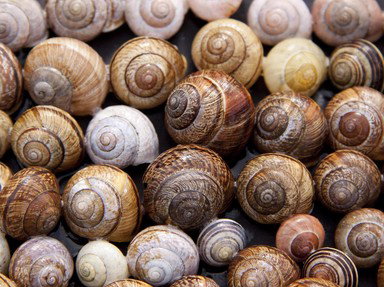
Garden snails are gastropods that are found on land. They have a single shell for protection. They need moisture to survive and tend to be found in cool, shady and damp places, and under rocks and mulch. Despite that, however, snails can be found almost everywhere, even in deserts. If their environment becomes too dry or hot, then they can seal themselves inside their shells to prevent water loss.
2. Clam
Answer: Bivalve (two shells)
Clams belong to the group of molluscs called bivalves. The word "bivalve" means "two valves" because the shell comes in two parts. The valves are held together by a ligament which acts as a hinge so that the shell can be opened and closed. Clams are able to be eaten but not all of them taste good.
The giant clam is the largest of all the animals we call molluscs. They can grow as big as 1.3 metres (4 feet) in length, and can weigh as much as 300 kilograms (660 lbs).
3. Octopus
Answer: Other
The octopus belongs to a group of molluscs called cephalopods. This word comes from two Greek words meaning head (cephalo) and foot (pod). An octopus has eight feet (or tentacles) which are attached to its head. The word octopus means eight feet in Greek - eight (octo) and foot (pus).
The commonly used plural of octopus is octopuses, octopi or octopodes. Octopuses is the most correct. Octopuses do not have shells at all. Not being restricted by a shell means that they can squeeze themselves into or through some incredibly small spaces.
Octopuses are very intelligent creatures. Scientists have found that they are very clever at solving puzzles, using items as tools and escaping from their tanks.
An octopus named Otto at an aquarium in Germany was taught by his keepers to squirt water at visitors. Otto was bothered by a bright light above his tank so he used the behaviour he had learned and squirted water at the light until he "killed" the light. In doing so, he short-circuited the power supply to the whole aquarium. He did this on a number of occasions until staff worked out what was going on. Otto was also seen to rearrange the items in his tank, throw rocks at the glass, and even juggle hermit crabs.
4. Oyster
Answer: Bivalve (two shells)
Oysters are bivalves because they have a shell consisting of two halves. Oysters are very useful molluscs as they can be used for food, they produce valuable pearls which are used for jewellery, and their pearly shell can be used for decorative items like buttons.
In nature, a pearl is created when a tiny piece of sand gets stuck inside an oyster shell. The sand irritates the oyster which reacts by covering it with a substance called nacre, which hardens to form a smooth pearl. Pearl farms create pearls by imitating this process. They put a small "seed bead" inside the oyster shell to encourage the oyster to produce a pearl.
5. Cuttlefish
Answer: Other
Despite their name, cuttlefish are not fish. They belong to the group of molluscs that we call cephalopods, which means they are closely related to the octopus and squid.
They have an internal (inside) shell called a cuttlebone. The cuttlebone allows them to float up or sink down in the water. Cuttlebones are often washed up on the beach or you can buy them in a pet supply shop. They are good for pet birds, such as budgerigars (parakeets) and parrots, because they are a good source of calcium and they help keep their beaks trimmed.
Cuttlefish have three hearts, blue-green blood, and ten legs (eight shorter legs and two long feeding tentacles). They have special cells in their skin which can change colour instantly to blend in with their surroundings and can also change the texture of their skin to look like sand or rocks. This helps them hide from predators (other animals that would eat them). For this reason, they are sometimes called the "chameleons of the sea".
6. Scallop
Answer: Bivalve (two shells)
Scallops are bivalves with fan-shaped shells. As scallops grow, their shells develop rings. The age of a scallop can be estimated by counting the rings on its shell in the same way that we can tell the age of a tree by its rings.
Scallops move by "jet propulsion", that is, by rapidly opening and closing their shells, sucking in water and pushing it out to propel them forward.
Like oysters, scallops can make pearls but they are very rare. Scallop pearls can come in almost any colour and some are very bright colours, such as deep purple, plum (reddish-purple), pink, brown, maroon and orange.
7. Mussel
Answer: Bivalve (two shells)
Mussels are bivalves. Although they are able to move slowly, they usually spend their lives in one place, clinging to things like rocks and wooden piers. They usually live in clusters that are referred to as a "bed" of mussels.
Mussels are delicious to eat but it is very important that they are cleaned, stored and cooked properly otherwise they can make you very sick. This is true for all kinds of seafood but particularly true for mussels.
Believe it or not, the names "muscle" (the muscles in your body) and "mussel" (the mollusc) come from the same Latin word meaning "little mouse". The Ancient Romans thought that the movement of muscles under the skin looked like the scampering of little mice. They thought the animal inside the shell also looked like a little mouse, so they gave them the same name. At some time in the past, a few centuries ago, the different spellings arose.
8. Squid
Answer: Other
Squid belong to the group of molluscs that we call cephalopods, which means they are closely related to the octopus and cuttlefish. They have 10 legs that come in pairs (8 shorter legs and 2 long feeding tentacles). They have a shell which is called a pen, but it is inside their body. It supports their muscles and organs in the same way our skeleton supports our muscles and organs.
Squid have some unusual features. Like their relative, the cuttlefish, they have three hearts and their blood is blue. They have an ink sac to store ink, called sepia, produced by their ink gland. When a squid is threatened by a predator (an animal that would eat them), it can squirt out the ink to cloud the water, which gives it a chance to escape. Humans use squid ink as an ink, a dye, food colouring, and in traditional Chinese medicines. We also eat squid and restaurants usually call it calamari (the Italian word for squid).
9. Cowrie
Answer: Gastropod (one shell)
A cowrie is a gastropod which has a single shell. Cowrie and cowry are both correct spellings but cowrie is the more common one.
Cowries are highly prized by shell collectors because of their beautiful colours, patterns and glossiness and they are among the most expensive shells in the world. The most valuable of all shells is the Fulton's or Maltese Cross cowrie. It has a cross-like pattern on its shell. The price for this rare cowrie can be as high as $US 25,000, depending on size and condition.
For hundreds of years the common money cowrie (a small yellow shell) was used as currency (money) across Africa, Asia and Oceania (Australia, New Zealand and the islands of the Pacific ocean).
10. Conch
Answer: Gastropod (one shell)
A conch is a gastropod consisting of a single shell. The name conch comes from the Greek word for shell. A person who collects and studies shells is called a conchologist and the area of study is conchology.
Conch shells have been used as musical instruments for thousands of years by many cultures, including the people of the Pacific islands (such as Hawaii, Fiji, Samoa, Tonga, and New Zealand), India, the Aztecs and Indigenous Americans. They are also used in decorative items and jewellery, as a source of food, and as an ingredient in fertilizer. It is a very common food in the Caribbean and Bahamas.
11. Periwinkle
Answer: Gastropod (one shell)
Periwinkles are very small molluscs with a shell similar to that of a garden snail. They are gastropods that live in salt water and are mostly found in rock pools in the tidal zone. This means that they live on the seashore and spend part of the time submerged in salt water and part of the time exposed, depending on the tides.
They attach themselves to rocks by secreting a substance which acts like a glue. When conditions are dry, the periwinkle can seal itself inside its shell by pulling shut a little door called an operculum (a Latin word meaning a lid or cover). Periwinkles can survive a dry period of up to 17 weeks.
12. Abalone
Answer: Gastropod (one shell)
Abalone are gastropods. They have a single oval-shaped shell that has holes along one side. The holes help them with their breathing and getting rid of wastes. They live on rocks so the outside of their shell is rough and dull so that they blend in with the rocks to help hide them from other animals that would prey on them. However, the inside of their shell is very beautiful, being a pearly or iridescent mix of blue, green, purple, pink and silvery-white.
Abalone are known by a variety of names. They are called ear shells because they resemble an ear. In Australia, the animal is eaten and is referred to as muttonfish. In New Zealand they are called paua. Jewellery made from the shell is widely known as paua shell and is very popular.
This quiz was reviewed by FunTrivia editor looney_tunes before going online.
Any errors found in FunTrivia content are routinely corrected through our feedback system.