FREE! Click here to Join FunTrivia. Thousands of games, quizzes, and lots more!
Quiz about A Waltz Through Time in the United States

A Waltz Through Time in the United States Quiz


Take these main events in the history of the United States and place them in the correct order. I hope you can easily waltz through the task!

An ordering quiz by ponycargirl. Estimated time: 3 mins.
  1. Home
  2. »
  3. Quizzes
  4. »
  5. For Children Trivia
  6. »
  7. History for Kids
  8. »
  9. US History for Kids

Author
ponycargirl
Time
3 mins
Type
Order Quiz
Quiz #
422,990
Updated
Feb 09 26
# Qns
10
Difficulty
Very Easy
Avg Score
9 / 10
Plays
99
Last 3 plays: Guest 174 (9/10), Guest 136 (10/10), Guest 173 (0/10).
Mobile instructions: Press on an answer on the right. Then, press on the question it matches on the left.
(a) Drag-and-drop from the right to the left, or (b) click on a right side answer, and then click on its destination box to move it.
Put the events given in the correct order. The dates have been given as a point of reference.
What's the Correct Order?Choices
1.   
(1497)
Declaration of Independence is ratified
2.   
(1513)
Battle of Fort Sumter takes place
3.   
(1607)
Statue of Liberty is dedicated
4.   
(1664)
Jamestown is founded
5.   
(1776)
Lewis and Clark's Corps of Discovery begins
6.   
(1804)
19th Amendment is passed
7.   
(1861)
Juan Ponce de Leon claims Florida for Spain
8.   
(1886)
John Cabot explores North American coast
9.   
(1904)
U.S. takes over the Panama Canal Zone
10.   
(1920)
New Amsterdam is captured by the English


Most Recent Scores
Today : Guest 174: 9/10
Today : Guest 136: 10/10
Today : Guest 173: 0/10
Today : Guest 68: 8/10
Today : danson1949: 9/10
Today : Guest 45: 8/10
Today : Trish192: 9/10
Today : Guest 34: 6/10
Today : mikeyblueeyes: 10/10

Quiz Answer Key and Fun Facts
1. John Cabot explores North American coast

John Cabot was not the first European to set foot in North American - Leif Erikson and the Vikings were in Canada about five hundred years before. The Vikings, however, did nothing to influence the later European colonization of the region.

John Cabot's expedition was sponsored by King Henry VII of England in 1497. Although Cabot was actually hoping to find a westward route to Asia, he found North America instead, landing in the area of modern day Newfoundland, Canada. According to the tradition of the day, when he planted the English flag there, and claimed the land for the King, he established England's future territorial claim to the entire continent.

Cabot is also credited with discovering and publicizing the Grand Banks. He reported that there were so many fish in the water that they could be caught with baskets. Soon many European countries flocked to the area.
2. Juan Ponce de Leon claims Florida for Spain

Juan Ponce de Leon's claim of Florida for Spain represents the first documented European landing in what is the United States today. He named the peninsula La Florida - or land of flowers - and mapped much of the coast.

Now, you may be thinking that the land had already been claimed by England, and you are correct. At the time, however, there was a vast area between the lands that Cabot and Ponce de Leon had claimed, so it would take some time for them to actually come to odds over who actually owned the land.

Ponce de Leon, by the way, is the explorer who is credited with searching for the legendary Fountain of Youth. There is no historical evidence that this is true; it is probably more important to note that he discovered the Gulf Stream, the ocean current which the Spanish used to aid in their return home.
3. Jamestown is founded

Jamestown was the first successful English colony in North America. Named for King James I of England, the settlement was established by the Virginia Company, a group of investors. They were given a charter which allowed them to finance ships and send settlers and supplies to the colony while searching for wealth in the form of gold, silver, and timber.

Jamestown had a rather rough beginning. During the Starving Time, from 1609-1610, the population of the settlement fell from an estimated 500 people to 60. By 1612, however, John Rolfe introduced the cultivation of tobacco, and Jamestown finally had a cash crop that guaranteed its success.

By the way, Jamestown was the capital of Virginia for about 100 years. In 1619 the House of Burgesses, the first representative government in the Americas, was established.
4. New Amsterdam is captured by the English

In 1609 Henry Hudson, an English captain, led a voyage of discovery to North America for the Dutch East India Company; he claimed land around the Hudson River for the Dutch. By 1624 a new company, the Dutch West India Company, established a colony named New Netherland in the area, with Peter Minuit purchasing Manhattan Island in 1626. The colony's base on the island was called New Amsterdam.

The Dutch controlled a thriving fur trade business in the area, which was adjacent to the English colonies of New England and Virginia. Of course, after the events of the English Civil War (1642-1651) and the eventual Restoration of Stuart rule (1660), King Charles II wanted nothing more than to take that land so that England could continue to expand its control of the Atlantic Coast.

In 1664 New Amsterdam was surrendered to the English without much of a fight. They arrived with a strong naval force and the people, unhappy with the rule of the Dutch West India Company, refused to fight. The city was renamed in honor of the Duke of York, the future James II.
5. Declaration of Independence is ratified

In June of 1776 Richard Henry Lee, a delegate to the Second Continental Congress from Virginia, suggested that the colonies issue a formal statement explaining why they wanted to separate from England. A Committee of Five - Thomas Jefferson, John Adams, Benjamin Franklin, Roger Sherman, and Robert Livingston - was chosen to draft a document. Jefferson, however, was chosen by the group to be the document's main author.

In the Declaration of Independence, which largely reflected ideas from the philosophers of the Enlightenment, Jefferson made points regarding unalienable rights, consent of the governed, and grievances against the king. After Jefferson's first draft was reviewed and revised by the Committee, it went to the Second Continental Congress. The group made approximately 86 changes to the document before it was ratified on July 4, 1776.

On August 2, 1776, the formal signing of the document took place, with the famous John Hancock being the first to put his name on the final copy. Approximately 56 delegates signed the document; interestingly, Robert Livingstone, one of the Committee of Five, had been called back to New York, and never signed the Declaration of Independence. He was the first Secretary of Foreign Affairs under President George Washington. Richard Henry Lee, however, did sign the famous declaration; he became a U.S. Senator from Virginia.
6. Lewis and Clark's Corps of Discovery begins

President Thomas Jefferson wisely jumped on the opportunity to acquire the Louisiana Purchase from Napoleon in 1803, almost doubling the size of the United States at the time. Stretching from the city of New Orleans at the Gulf of Mexico in Louisiana in the south, and almost all of the present state of Montana to the north, there was approximately 828,000 square miles (2,144,511 square kilometers) of land that needed to be explored.

Meriwether Lewis, Jefferson's private secretary and Lewis' former commanding officer, William Clark, were chosen to lead a expedition which would explore and map the region. Lewis and Clark hoped to find a water route that led to the Pacific Ocean, become more familiar with the geography of the region, and establish a positive relationship with Native Americans with whom they came into contact.

When Napoleon was originally approached with an offer for land, President Jefferson hoped to be able to buy the city of New Orleans in order to control its strategic location on the Gulf of Mexico and Mississippi River. What a deal they received! They paid $15 million for the property, which averaged out to around 3 cents an acre!
7. Battle of Fort Sumter takes place

The first battle of the American Civil War took place at Ft. Sumter, South Carolina, on April 12-14, 1861. After President Abraham Lincoln was elected in 1860, many southern states became worried that he would stop the spread of slavery in the United States. South Carolina became the first state to secede from the Union, and claimed all federal property within its borders.

At the time, Fort Sumter protected the city of Charleston. Union soldiers had been stationed there in late 1860, but were essentially cut off from supplies by Confederate forces. When President Lincoln attempted to resupply the fort, Confederates saw it as an act of aggression. They demanded that the fort be turned over to them - which is was after a thirty-four hour bombardment.

This is considered to be the first battle of the American Civil War. It should be noted, however, that there were no casualties on either side.
8. Statue of Liberty is dedicated

A gift from France, the Statue of Liberty symbolizes the relationship between the two countries - that is, their shared beliefs in democracy, freedom, and liberty. Édouard René de Laboulaye, a French philosopher, suggested the gift to honor the United States for its abolition of slavery. At the time, the French people were ruled by the despot, Napoleon III, and he hoped to inspired the French people to work toward a more democratic type of government.

The statue, which measures 151'1" (46 meters) from the bottom to the foot to the top of its head, was constructed using copper sheeting - about the thickness of 2 pennies pressed together by sculptor Frédéric Auguste Bartholdi. Its internal structure was built by Gustave Eiffel, who is best known for the Eiffel Tower in Paris.

Liberty Enlightening the world is the official name of the statue, although she is also called Lady Liberty. The seven rays on her crow represent the seven seas and continents.
9. U.S. takes over the Panama Canal Zone

Countries had been talking about the construction of the Panama Canal for a long time. In fact, a project had been discussed in 1513 after Balboa crossed the Isthmus of Panama to reach the Pacific Ocean. The first attempt, made in 1693-1700 by the Kingdom of Scotland, was quickly abandoned.

After the successful completion of the Suez Canal in 1881, however, the project was overtaken by the French company, Compagnie Universelle du Canal Interocéanique. By 1889, however, the project was bankrupt. The United States, under the leadership of President Theodore Roosevelt, purchased the French assets and equipment, and changed the design to a lock based canal in 1904; the canal was completed in 1914.

Finally, with the connection of the Pacific and Atlantic Oceans, the journey by sea from the east coast of the United States to the west coast was approximately 8,000 nautical miles shorter!
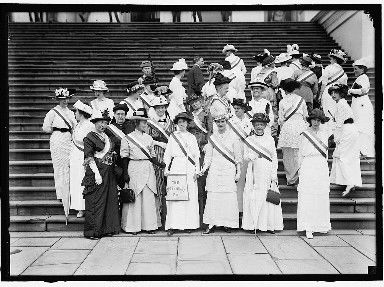
10. 19th Amendment is passed

By the time the 19th Amendment was finally passed on August 18, 1920, women in the United States, like Elizabeth Cady Stanton Susan B. Anthony, had been working for seventy years to gain the right to vote! The amendment was introduced to Congress in 1878, so it took quite a bit of work to finally get it passed.

By the time the amendment was passed by Congress there were already several states that allowed women the right to vote. While still a territory, Wyoming passed the Woman's Suffrage Act of 1869; it was hoped that the law would give the state publicity that might attract more women to settle in the territory. Some of the lawmakers are remembered for truly believing that given women equal voting was simply the right thing to do.

Can you believe it? When Wyoming was up for statehood in 1890 some members of Congress suggested that they may have to remove their suffrage clause before it would be possible. Wyoming lawmakers replied that they would stay out of the Union before complying with the request!
Source: Author ponycargirl

This quiz was reviewed by FunTrivia editor MotherGoose before going online.
Any errors found in FunTrivia content are routinely corrected through our feedback system.
2/9/2026, Copyright 2026 FunTrivia, Inc. - Report an Error / Contact Us