FREE! Click here to Join FunTrivia. Thousands of games, quizzes, and lots more!
Egg-citing Animals! Trivia Quiz
Animals have been reproducing by laying eggs for a long time. The first eggs were jelly like and laid in water over 500 million years ago. Land animals began laying eggs in protective shells approximately 340 million years ago.
A collection quiz
by ponycargirl.
Estimated time: 3 mins.
Last 3 plays: daisygirl20 (10/10), genoveva (10/10), shahbhavik (10/10).
Your task is to choose the modern animals in the group that lay eggs, either on land or in the water.
There are 10 correct entries. Get 3 incorrect and the game ends.
Reproduction that involves two animal parents leads to three ways of producing young. There are viviparous animals, those that develop in the mother's body and are born alive, such as humans. some animals, such as certain snakes and sharks, are ovoviviparous, which means the eggs develop and hatch in the mother's body, resulting in a live birth. This quiz, however, will focus on oviparous animals that produce eggs which are laid and hatch outside the mother's body.
Chickens are believed to have been the first domesticated egg laying animal sometime around 7,000-10,000 years ago. Did you know that a hen takes about 25 hours to produce one egg? While some breeds, like Leghorns, the ordinary white breed often seen on US farms, may produce as many as 300 eggs a year, others will lay every other day or maybe just twice a week. Their productivity is dependent upon their age, the amount of daily light, and overall health. Chicken eggs contain approximately 6 grams of protein and all nine essential amino acids that the human body needs but is unable to produce on its own. The color of the egg shell depends on the breed of chicken; however, the taste and nutritional value are believed to be all the same.
Duck eggs are larger than chicken eggs, weighing in at 2.5-3 ounces (71-85 grams) in comparison to the chicken's average size of 2 ounces (57 grams). They are also more difficult to crack, which gives them a longer shelf life. And - while they contain more fat and cholesterol than chicken eggs, they are also higher in Vitamins A & D and in Omega-3 fatty acids. Highly prized by bakers because of their protein and fat content, mallard duck eggs are also used in South-east Asia to make Balut, a fertilized duck egg that is incubated for several days and then steamed or boiled and eaten right out of the shell. Really! It's considered to be a delicacy there!
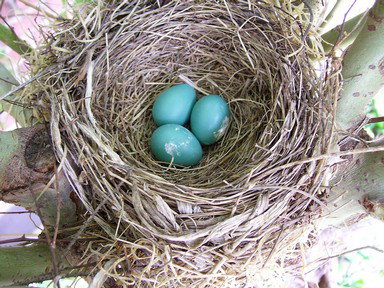
Scientists believe that birds developed into egg laying creature because they were so small that they wouldn't have been able to fly if they carried developing babies in their bodies. Robin eggs are bright blue due to a pigment called viliverdin, which comes from the mother's blood stream and is deposited into the shell as it forms. The mother lays one egg a day and typically has a total of 3-4 eggs in her nest by the time she is finished laying. Even though the eggs aren't laid on the same day, they typically all hatch at the same time, in 12-14 days! Be sure to NOT try to eat robin eggs, though. They are so small that it would take a lot of them to make a satisfying meal, which just might put robins on the endangered list. In addition, they are legally protected by law in the United States, and they carry risk of bacterial contamination.
If there is a male animal that should be up for the Father of the Year award, it's the Emperor penguin. The males and females return to the same location every year, and upon arrival either find their past mate or discover a new one. Each female only lays one egg a year, which is passed to the male after being laid so that she can return to the water to feed since there is no place on the icy surface to make a nest. The eggs weigh approximately 16-17 ounces (470-460 g) and are 4.7 inches x 3.1 inches (12 cm x 8 cm) in size. This exchange must be very carefully orchestrated; if the egg would happen to crack, the life cycle is finished for the season. That is why the eggshell is thicker in comparison to other animal eggs. It is the responsibility of the male, then, to take care of the egg, which he balances on his feet for 65-75 days! Part of his lower anatomy consists of a special brood patch that keeps the egg warm. During this time the fathers group together to protect themselves from the cold and take care of their egg. They are so busy, they don't even eat.
The number of eggs laid by a Nile crocodile varies by the mother's age and size; she can, however, lay anywhere from 25-80 eggs that are a bit larger than duck eggs at one time! Mothers dig a hole in the sand or dirt to deposit the eggs, and then guard the nest for 55-100 days as they watch for them to hatch. The reason for the time variation is the temperature of the location. If it is cooler it will take longer for the hatchlings to develop, and most of them will be females. When they are ready to hatch, the babies call to their mother, who collects them in her mouth and takes them to the water. What do you think about eating a crocodile egg? Well, people in Asia, Africa, and Australia apparently think they are as good as a duck or a chicken egg. They must, however, be thoroughly cooked in order to avoid bacterial contamination.
Although the female snapping turtle seems to have nothing to do with the eggs after she lays them, she does always try to choose the right place for her clutch, sometimes traveling a bit of a distance to find just the right sand or soil. Her eggs are said to resemble ping pong balls, and measure about an inch (26-28 mm) in diameter. Typically she will lay 20-40 eggs, which take about 80-90 days to incubate. Like the Nile crocodile, the gender of the hatchlings is dependent on the temperature of the nest. The location of the clutch is of vital importance because there are many predators, including skunks, foxes, and snakes, that enjoy a tasty turtle egg. Estimates suggest that only about 1% of the hatchlings survive long enough to become reproductive adults.
The Chinook salmon, also called King salmon, makes quite a pilgrimage in order to lay her eggs, which are called roe. After spending a number of years in the ocean, feeding and growing, she makes her way back to the stream where she was born, sometimes swimming hundreds of miles. When she reaches her birthplace, she makes nests called redds in the gravel of the stream, and then she deposits 3,000-14,000 eggs; the male follows her and fertilizes the eggs as they are laid. The mother salmon guards her eggs for a time as they incubate for 90-150 days, but typically dies before the young, called alevins, hatch. Chinook salmon are another animal with a high mortality rate, with only about 1% reaching adulthood; humans seem to be a major contributing factor in this number, as the eggs are popularly eaten as caviar or used for fishing bait.
Cane toads are very invasive creatures, and their eggs are part of the reason why. The female lays her eggs in a clear, jelly-like string. This string can contain anywhere from 8,000-35,000 eggs, which she typically lays twice a year. In 24-72 hours the eggs begin to hatch into tadpoles. Even though the eggs contain a toxin that protects them from some predators, they can fall victim to other cane toad tadpoles or even toadlets.
And - finally to our last two egg layers. They are monotremes, which are mammals that lay eggs. Scientists believe that the earliest ancestors of mammals laid eggs; while some changed to give live birth, there are others that kept their original system because there wasn't any reason to change it. Monotremes, however, are considered to be true mammals because they have other mammalian characteristics. The platypus is one of the monotremes on our list. Platypus eggs first begin to develop for about 28 days inside the mother; then she lays 1-3 eggs that are about .7 inches (1.7 cm) in diameter in an underground nesting burrow. The mother keeps them close to her body and warm. After 10 days they begin to hatch; the hatchlings are compared to the size of a lima bean at this time, and are totally dependent on care from their mother. As they grow, the nestlings become juvenile platypuses after 3 or 4 months when they leave the burrow for the first time. They will stay in the burrow until they are almost as large as an adult.
At this point I must note that I did stumble upon a bit of a controversy concerning the term puggle. While some sources say that either platypus or echidna hatchlings are puggles, others stress that the term is only properly used for baby echidnas. They are also monotremes that hatch from eggs which are about the size of a grape. The mother typically deposits one egg into a pouch on her belly; the eggs incubates there for about ten days before it hatches. Puggles are about the size of a jellybean when they hatch, and stay in their mother's pouch for about 6-8 weeks until their spines become too prickly.
Scorpions are arachnids, and while some arachnids lay eggs, a scorpion mother gives birth to live offspring, and will even carry them on her back until their first molting. The hammerhead shark is a cartilaginous fish, and is part of the 60% of sharks that also give birth to live young. The anteater, dormouse, and vampire bat are all mammals and give birth to live offspring.
This quiz was reviewed by FunTrivia editor looney_tunes before going online.
Any errors found in FunTrivia content are routinely corrected through our feedback system.