FREE! Click here to Join FunTrivia. Thousands of games, quizzes, and lots more!
Quiz about Around Britain Through the Alphabet

Around Britain Through the Alphabet Quiz

An A-Z trip round the UK

In this quiz you will be taken to 25 places (no British place name as far as I am aware begins with X, so one decision was easy enough) each beginning with a different letter.

A multiple-choice quiz by thomas1975. Estimated time: 6 mins.
  1. Home
  2. »
  3. Quizzes
  4. »
  5. Geography Trivia
  6. »
  7. Europe
  8. »
  9. United Kingdom

Author
thomas1975
Time
6 mins
Type
Multiple Choice
Quiz #
424,756
Updated
Jul 02 26
# Qns
25
Difficulty
Average
Avg Score
17 / 25
Plays
36
Last 3 plays: Guest 72 (11/25), Minister (10/25), Guest 84 (7/25).
- -
Question 1 of 25
1. For the letter A we head west; indeed if going by public transport our destination would be Britain's westernmost railway station. Which splendidly scenic Scottish town is this? Hint


Question 2 of 25
2. We head next to the south coast of England. Which seaside resort has pleasure gardens, a conference centre and a series of wooded valleys known as chines, among other things? Hint


Question 3 of 25
3. We now move east to a place considered by some to Britain's oldest town. Which C, promoted to city status as part of the Platinum Jubilee celebrations of 2022, is this? Hint


Question 4 of 25
4. We head now to Norfolk. We arrive at a station whose buildings are made of Carrstone and which has signs and other paraphernalia in the old 'Network Southeast' style, which serves a pretty market town dating back to Anglo-Saxon times. Where have we just arrived? Hint


Question 5 of 25
5. We now head south to Cambridgeshire. Our next destination is dominated by its massive cathedral. Which town, where a famous rebel made his last stand in the aftermath of the Norman conquest, are we visiting now? Hint


Question 6 of 25
6. Back to Norfolk. Our next destination is a small market town, something of a local transport hub, and home to a jumps racecourse. This little town is?


Question 7 of 25
7. We head to an important suburb of London. Here we can see the Cutty Sark tea clipper, can visit the Maritime Museum and observatory and can stand with one foot in the eastern hemisphere and one in the western hemisphere. Which London suburb goes in the blank?

Answer: (one word, G)
Question 8 of 25
8. For the letter H we remain in London. Our chosen H is home to a famous cemetery, where among others Karl Marx is buried, and is also supposedly where Dick Whittington heard the voice telling him to "turn again Whittington". Where have we arrived? Hint


Question 9 of 25
9. For the letter I we head north to Scotland. We are in the place that calls itself 'Capital of the Highlands'. Where, on the shores of a body of water home to one of the most famous of all cryptids, and also the hometown of writer Josephine Tey, have we fetched up now? Hint


Question 10 of 25
10. For the letter J we head to one of Britain's extremities. Which little town, which derives its name from that of a Dutch ferryman, are we visiting now?


Question 11 of 25
11. This little town seems to have two of everything - two market places, two guildhalls, two giant churches etc. Which K have we arrived in that is really two towns in one? Hint


Question 12 of 25
12. "When you are tired of _________ you are tired of life". Can you name the large city beginning with L that completes this quote from Samuel Johnson of dictionary fame?

Answer: (Capital)
Question 13 of 25
13. We reach the middle of the alphabet but we are emphatically not centrally located for this one - we are as far west as this quiz will take us. If you were near the western end of the Ardnamurchan Peninsula (the westernmost part of mainland Britain) where, beginning with M, is a place you would find a good restaurant? Hint


Question 14 of 25
14. Our next destination is a county town, home to almost half the population of its county. Home among other things to a building called The Forum which houses various things including the Millennium Library, which N is this? Hint


Question 15 of 25
15. We now head to the old university town in which the Thames briefly splits into two (The Isis and The Cherwell). Where are we now? Hint


Question 16 of 25
16. Back to Norfolk. Until the Black Death in the mid-14th century this place was bigger than nearby Fakenham. Nowadays it is a combination of nature reserve and working farm. Which P are we visiting? Hint


Question 17 of 25
17. Our next location is a former train station in Buckinghamshire. It was part of 'Metroland', served by what was then the Metropolitan Railway until the 1930s, and by the Great Central Railway until the 1960s.


Question 18 of 25
18. We head next to a market town on the river Trent. It is most famous for its boarding school, where such luminaries as CB Fry and children's author Roald Dahl were educated. Hint


Question 19 of 25
19. We now head to Gloucestershire. Our S location was the birthplace of a famous cricketer turned artist (think wicket keepers and small dogs). Which S is our Cotswolds town? Hint


Question 20 of 25
20. We now turn to London. This suburb has two tube stations serving it, is home to a famous Lido, and also to Graveney School. Hint


Question 21 of 25
21. We turn now to the Lake District. One of the northernmost bodies of water there begins with the letter U - can you name it? Hint


Question 22 of 25
22. For the letter V we are using a Latin place name. The modern name of the place refers to someone who was martyred there. Hint


Question 23 of 25
23. Novelist Thomas Hardy created a fictional world for his characters which he gave a name that once belonged to the part of the country he grew up in. Which name did he use for the world in which you might visit Sandbourne, Casterbridge or Marlott Vale? Hint


Question 24 of 25
24. With the prefix 'Great' I become a major town in Norfolk, with no prefix I a small seaside town on the Isle of Wight. Where am I? Hint


Question 25 of 25
25. We reach the end of the alphabet, and though we do not reach an extremity of Britain we do at least end in a county that does contain such. Which is the alphabetically last place name in Britain?


(Optional) Create a Free FunTrivia ID to save the points you are about to earn:

arrow Select a User ID:
arrow Choose a Password:
arrow Your Email:


Most Recent Scores
Today : Guest 72: 11/25
Today : Minister: 10/25
Today : Guest 84: 7/25
Today : renasniece: 15/25
Today : gwendylyn14: 7/25
Today : Guest 170: 10/25
Today : Fifiona81: 23/25
Today : Guest 88: 7/25
Today : CAPugLuvr: 9/25

Quiz Answer Key and Fun Facts
1. For the letter A we head west; indeed if going by public transport our destination would be Britain's westernmost railway station. Which splendidly scenic Scottish town is this?

Answer: Arisaig

The railway line that passes through Arisaig is among Britain's most scenic, featuring the Glenfinnan viaduct among other wonders. Arisaig is a starting point for boat rides to some of the western isles. I have been on holiday there earlier this year, and can confirm first hand how beautiful an area it is.

The three wrong answers are all in Scotland, though Aberdeen is on the eastern side of Scotland. Ayr is a coastal town, but less far west. Ardgour is the northern terminus of a ferry service that crosses Loch Linnhe.
2. We head next to the south coast of England. Which seaside resort has pleasure gardens, a conference centre and a series of wooded valleys known as chines, among other things?

Answer: Bournemouth

Bournemouth, originally in Hampshire but later reclassified as Dorset, is a beautiful town with a good train service from London. In addition to the things I noted in the question it is also notable for its yellow buses. The three wrong answers are all southern English seaside towns, though Bude is on the north coast of Cornwall.
3. We now move east to a place considered by some to Britain's oldest town. Which C, promoted to city status as part of the Platinum Jubilee celebrations of 2022, is this?

Answer: Colchester

Under its Latin name of Camulodunum, Colchester was the first capital of the Roman province of Britannia. The three wrong answers are all also in Essex - Clacton is a little east of Colchester, Chelmsford, the county town, is more or less central. and Chingford, on the edge of Epping Forest, is only just outside London.
4. We head now to Norfolk. We arrive at a station whose buildings are made of Carrstone and which has signs and other paraphernalia in the old 'Network Southeast' style, which serves a pretty market town dating back to Anglo-Saxon times. Where have we just arrived?

Answer: Downham Market

Downham Market, south of King's Lynn, is well worth a visit. The three wrong answers are all also in Norfolk - Dereham is a large town in the centre of the county, Dunton a tiny place near Fakenham and Docking a small town in the northwest of the county.
5. We now head south to Cambridgeshire. Our next destination is dominated by its massive cathedral. Which town, where a famous rebel made his last stand in the aftermath of the Norman conquest, are we visiting now?

Answer: Ely

Ely is another beautiful place, well worth a visit. The three wrong answers are all in eastern England. The famous rebel is Hereward the Wake, and there is a railway line out of Ely named in his honour.
6. Back to Norfolk. Our next destination is a small market town, something of a local transport hub, and home to a jumps racecourse. This little town is?

Answer: Fakenham

Fakenham is a meeting point for a number of bus routes. In the days before Dr Beeching did his worst it had two railway stations, Fakenham West and Fakenham East. Market day is Thursday should you wish to experience it. Foulsham is a pleasanter place than its name might suggest, and is also in Norfolk, between Fakenham and Norwich.
7. We head to an important suburb of London. Here we can see the Cutty Sark tea clipper, can visit the Maritime Museum and observatory and can stand with one foot in the eastern hemisphere and one in the western hemisphere. Which London suburb goes in the blank?

Answer: Greenwich

Although there is a now a station at Cutty Sark, on the Docklands Light Railway, I would still recommend getting off at Island Gardens and using the Greenwich foot tunnel, one of two locations where you can walk under the river Thames.
8. For the letter H we remain in London. Our chosen H is home to a famous cemetery, where among others Karl Marx is buried, and is also supposedly where Dick Whittington heard the voice telling him to "turn again Whittington". Where have we arrived?

Answer: Highgate

Highgate it is. There is a stone marking the spot where Whittington allegedly turned again. The three wrong answers are all also in London.
9. For the letter I we head north to Scotland. We are in the place that calls itself 'Capital of the Highlands'. Where, on the shores of a body of water home to one of the most famous of all cryptids, and also the hometown of writer Josephine Tey, have we fetched up now?

Answer: Inverness

Inverness is on the shores of Loch Ness, home to the fabled Nessie. The three wrong answers are all also in Scotland.
10. For the letter J we head to one of Britain's extremities. Which little town, which derives its name from that of a Dutch ferryman, are we visiting now?

Answer: John O'Groats

John O'Groats is close to two important headlands beginning with D - Duncansby Head and Dunnet Head. The waters here contain a great number of sea birds - guillemots, puffins and eider among them.
11. This little town seems to have two of everything - two market places, two guildhalls, two giant churches etc. Which K have we arrived in that is really two towns in one?

Answer: King's Lynn

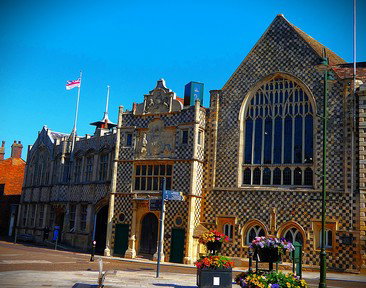
King's Lynn, the third largest town in Norfolk, really is two towns in one. The photo that heads this quiz is of one of its iconic buildings, the Guildhall of the Holy Trinity which serves as the town hall. Situated on the east bank of the Great Ouse (which is the side from which all that rivers tributaries join it) King's Lynn had direct boat access to eight counties (as well as the North Sea) at a time when boats were the best way to transport large loads.

The other three places are English and of varying degrees of importance.
12. "When you are tired of _________ you are tired of life". Can you name the large city beginning with L that completes this quote from Samuel Johnson of dictionary fame?

Answer: London

London started life as the Roman trading post of Londinium. Its location soon saw it become the province of Britannia's largest city and it quite quickly became the new provincial capital. It fell into disuse for a period after the Romans left in the early 5th century, before regaining its status later.
13. We reach the middle of the alphabet but we are emphatically not centrally located for this one - we are as far west as this quiz will take us. If you were near the western end of the Ardnamurchan Peninsula (the westernmost part of mainland Britain) where, beginning with M, is a place you would find a good restaurant?

Answer: Mingary Castle

Mingary Castle, near the town of Kilchoan, is a wonderful place both in terms of being a restaurant and in terms of scenery. My last two birthday meals have both been there. Mingarry with two rs is also in the far west of Scotland, but not quite on the Ardnamurchan peninsula. The Mull of Kintyre is much further south, while Motherwell is close to Glasgow and therefore pretty central.
14. Our next destination is a county town, home to almost half the population of its county. Home among other things to a building called The Forum which houses various things including the Millennium Library, which N is this?

Answer: Norwich

Norwich is home to about 350,000 people, while the county of Norfolk has a total population of about 800,000. I would recommend a visit. The other three options are all significant places but none fits this question.
15. We now head to the old university town in which the Thames briefly splits into two (The Isis and The Cherwell). Where are we now?

Answer: Oxford

Yes it is Oxford, whose wonders include the Bodleian Library and the Ashmolean Museum. Orford is a tiny place on the river Orwell in Suffolk, Outwell is also tiny and is near Wisbech, Cambridgeshire, and Oxenholme is in the Lake District.
16. Back to Norfolk. Until the Black Death in the mid-14th century this place was bigger than nearby Fakenham. Nowadays it is a combination of nature reserve and working farm. Which P are we visiting?

Answer: Pensthorpe

Pensthorpe is a truly remarkable place, and I would recommend anyone to visit it. You will see things there you could see nowhere else. Pott Row is also in Norfolk, but as far as I am aware has no great significance. Penistone is in South Yorkshire, and Padstow is in Cornwall.
17. Our next location is a former train station in Buckinghamshire. It was part of 'Metroland', served by what was then the Metropolitan Railway until the 1930s, and by the Great Central Railway until the 1960s.

Answer: Quainton Road

Quainton Road, just west of Aylesbury, was actually a bifurcation point for the Metropolitan at the height of its expansionism. The mainline went to Verney Junction, while the Met had also acquired the Wotton Tramway, which started life as the Duke of Buckingham's private railway, and which had a western terminus at Brill, 51 miles from Baker Street - the furthest distance from London reached by any London Underground line at any stage of their history.

The Quantock Hills are a range of hills in Somerset.
18. We head next to a market town on the river Trent. It is most famous for its boarding school, where such luminaries as CB Fry and children's author Roald Dahl were educated.

Answer: Repton

Repton's market town origins are confirmed by the continuing presence of its Market Cross. The school continues to do pretty well. Roehampton is a southwest London suburb where qualifying for the Wimbledon tennis championships takes place, Roedean has a very famous school but it is a girl's school, and Redbridge is a station on the Hainault loop of the Central line.
19. We now head to Gloucestershire. Our S location was the birthplace of a famous cricketer turned artist (think wicket keepers and small dogs). Which S is our Cotswolds town?

Answer: Stroud

Stroud is a pretty little town. The famous cricketer turned artist is of course Jack Russell. The other S places listed are all in or near London.
20. We now turn to London. This suburb has two tube stations serving it, is home to a famous Lido, and also to Graveney School.

Answer: Tooting

Tottenham is in north London, Tattenham Corner is part of Epsom Racecourse, although there is also a rail terminus of that name, and Tatton is a parliamentary constituency, once represented by George Osborne.
21. We turn now to the Lake District. One of the northernmost bodies of water there begins with the letter U - can you name it?

Answer: Ullswater

Ullswater is near the northern edge of the Lake District. It is a quirk of this area that in spite of its overall name there is not a single body of water there that has 'lake' as part of its name.

Ullapool is in the far north of Scotland, though there would certainly be plenty of water near it. There was an Ullathorne Road near where I grew up in London, and Norwich City football club once had a player named Robert Ullathorne. Upminster is the eastern terminus of the District line.
22. For the letter V we are using a Latin place name. The modern name of the place refers to someone who was martyred there.

Answer: Verulamium (modern name St Albans)

Alban refused to recant his Christianity and was murdered in the third century for that reason. He was subsequently canonized and Verulamium, his home town, was renamed St Albans in his honour. The other Latin place names are all genuine but they do not have the English names I have given them here - Viroconium is modern day Wroxeter in the midlands, Velitrae is modern day Velletri, near Rome, Italy, and Veii is also Italian.
23. Novelist Thomas Hardy created a fictional world for his characters which he gave a name that once belonged to the part of the country he grew up in. Which name did he use for the world in which you might visit Sandbourne, Casterbridge or Marlott Vale?

Answer: Wessex

The historical Wessex produced the only monarch the English have ever labelled The Great - Alfred (though he was not too good at keeping a watch on baking products!). The places in Hardy's Wessex are all reinventions of real places - of the three I mentioned Sandbourne is Bournemouth and Casterbridge is Dorchester.

The three incorrect answers are current counties whose names all reflect them having belonged to the Saxons.
24. With the prefix 'Great' I become a major town in Norfolk, with no prefix I a small seaside town on the Isle of Wight. Where am I?

Answer: Yarmouth

Great Yarmouth is in a very flat part of the world. The Peggotty family who play a major role in the novel "David Copperfield" are from there. Yarm is a market town in Yorkshire, the Yare is the river that flows through Great Yarmouth, and there was once an Earl of Yarborough who gave his title to a type of bridge hand.
25. We reach the end of the alphabet, and though we do not reach an extremity of Britain we do at least end in a county that does contain such. Which is the alphabetically last place name in Britain?

Answer: Zennor

Zennor is on the north coast of Cornwall. It is fairly close to the tourist destinations of Penzance and St Ives. As far as I am aware there is no actual place called Zampa, but Adam Zampa is a leg spin bowler for Australia, specialising in limited overs cricket.
Source: Author thomas1975

This quiz was reviewed by FunTrivia editor agony before going online.
Any errors found in FunTrivia content are routinely corrected through our feedback system.
7/2/2026, Copyright 2026 FunTrivia, Inc. - Report an Error / Contact Us