FREE! Click here to Join FunTrivia. Thousands of games, quizzes, and lots more!
UK Freshwater Bodies Trivia Quiz
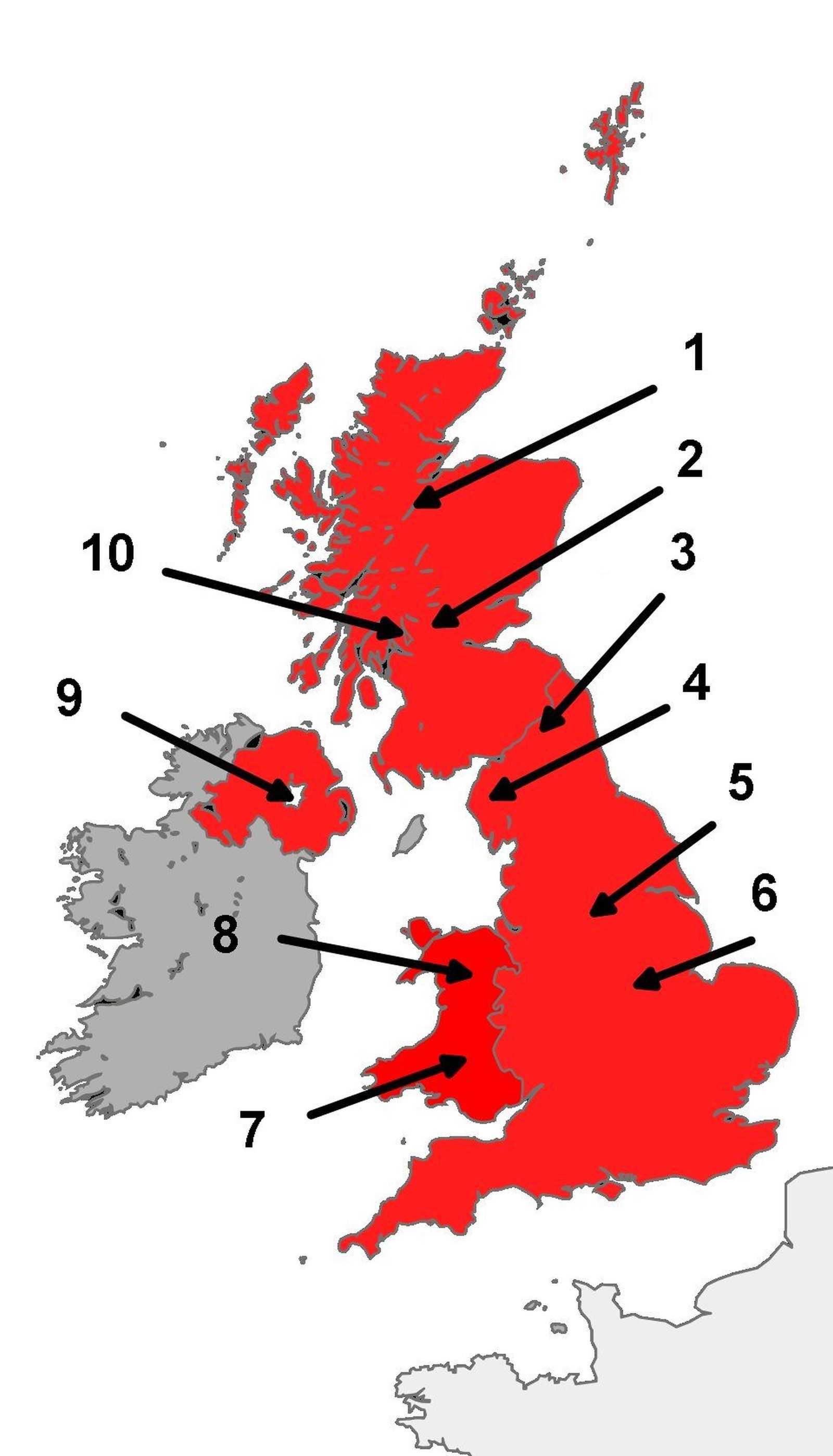
Do you know your llyns from your lakes or your loughs from lochs? This quiz is about matching this selection of freshwater bodies to their locations in the UK.
Last 3 plays: rivenproctor (10/10), Lottie1001 (10/10), Iva9Brain (10/10).
Click on image to zoom
Llyn TegidLlangorse LakeLoch LomondLake of MenteithRutland WaterKielder WaterWindermereLough NeoghLoch NessLadybower Reservoir* Drag / drop or click on the choices above to move them to the answer list. View Image Attributions for This Quiz
Freshwater bodies tend to have country-specific names in the UK. So it should be no surprise that Loch Ness is in Scotland. It is one of four freshwater lochs that form part of the Caledonian Canal. The Canal connects Corpach near Fort William on the west coast of Scotland to Inverness and the Beauly Firth on the east coast.
Although only fourth largest (by surface area), for water volume it tops the list with over twice the volume of the second largest. It is also reportedly home to the Loch Ness Monster.
2. Lake of Menteith
Probably best known as Scotland's only lake, it was called Loch Menteith until the 19th century. Why it changed is not clear. Some blame it on Sir Walter Scott's 1810 novel "The Lady of the Lake", others point to an Ordnance Survey map from 1862. It also goes by the name Loch Inchmahome, possibly after the largest island (called Inchmahome) which housed Inchmahome Priory.
The Priory served as a temporary refuge in 1547 to Mary, Queen of Scots.
3. Kielder Water
Just south of the Scottish border, Kielder Water is the largest (by volume) artificial lake in the UK and bigger (by surface area) than all natural lakes in England with the exception of Windermere. It was built between 1975 and 1981 to meet expected demand, with around 95 residents being displaced. It is also the site of England's largest hydro-electric plant.
4. Windermere
The five largest natural lakes in England are in the Lake District. Windermere tops the list with Ullswater, Bassenthwaite Lake, Derwent Water and Coniston Water making up the rest. Windemere was the location when a water speed record was set by Sir Henry Seagrave in 1930.
He died during an attempt to raise the record later that year. A speed limit of 10 knots (12 mph or 19 km/h) was set in 2000, so more water speed records on Windermere seem unlikely.
5. Ladybower Reservoir
Ladybower Reservoir is the lowest of three connected artificial reservoirs, the other two being Howden Reservoir and Derwent Reservoir, mostly all in Derbyshire. The Y-shaped Ladybower Reservoir was built between 1935 and 1943. It uses a clay-cored earth embankment dam in contrast to the solid masonry dams used for the other two.
It also features two bell-mouthed spillway overflows ("plug holes") to control water levels. In dry years, such as 2018 and 2022, the submerged village of Derwent is exposed.
6. Rutland Water
Largest of the UK's artificial lakes, Rutland Water was built between 1971 and 1975. Most of its water is pumped from the Rivers Nene and Welland. It now has a biological Site of Special Scientific Interest, a Ramsar wetland site and is a Nature Conservation Review site as well as hosting watersports and the 'Rutland Belle' pleasure cruiser.
The fossil of an ichthyosaur (an extinct marine reptile) was found there in 2021 so it has a marine history as well.
7. Llangorse Lake
Second largest natural lake in Wales, Llangorse Lake in the Brecon Beacons National Park is also a place to spot the afanc (lake monster of Llangorse). Mentioned in a 15th century poem, it has been speculated that it was a large pike. One caught there in 1846 was supposedly 31 kg (68 lbs) in weight, which would be a world record.
The lake is noted for unusually high numbers of fish and birds and is a Site of Special Scientific Interest as well as a coarse fishing mecca and site of the only Welsh crannog (artificial island).
8. Llyn Tegid
Largest natural lake in Wales, Llyn Tegid is also called Bala Lake in English. Llyn Tegid has more than three times the surface area of Llangorse Lake. It is fed by the River Dee and had its level regulated through sluices by the engineer Thomas Telford at the beginning of the 19th century in order to provide water for the Ellesmere Canal (since renamed as Llangollen Canal).
With river pollution around urban centres, the River Dee is now essential for water supplies as far as Liverpool. The Bala Lake Scheme of the 1950s saw more sluices fitted to Llyn Tegid to support this aim, lowering the lake level in the process. It also helped moderate flood events. Llyn Tegid also has a legend about an afanc or lake monster.
9. Lough Neogh
Lough Neogh can be found in Northern Ireland. It is the largest freshwater body on the island of Ireland and of Britain, having ten times the surface area of Windermere, although only half the volume of Loch Ness. Lough Neagh's mean depth is only 9 m (30 ft).
The lough supplies around 40% of Northern Island's water supply. Unfortunately Lough Neogh is now regarded as one of the world's most eutrophic water-bodies. Toxic algal blooms have become a regular summer occurrence.
10. Loch Lomond
Scotland's largest (by surface area) freshwater loch is Loch Lomond. In Britain it is surpassed only by Lough Leagh and Lough Erne, both in Northern Ireland. It has about a third of Loch Ness' volume but still second in Scottish loch volume rankings. It also had crannogs for around 5,000 years and was not immune from Viking raids. The Vikings sailed up the saltwater Loch Long and dragged their boats across the narrow neck of land at Tarbet to raid some of Loch Lomond's islands during the early mediaeval period.
The loch forms part of the Loch Lomond and The Trossachs National Park and is popular for leisure activities. It also has a hydro-electric pump-storage scheme which was built between 1945 and 1950, partly by German prisoners of war due to post-war labour shortages.
This quiz was reviewed by FunTrivia editor agony before going online.
Any errors found in FunTrivia content are routinely corrected through our feedback system.