FREE! Click here to Join FunTrivia. Thousands of games, quizzes, and lots more!
Quiz about Operation Overlord

Operation Overlord Trivia Quiz


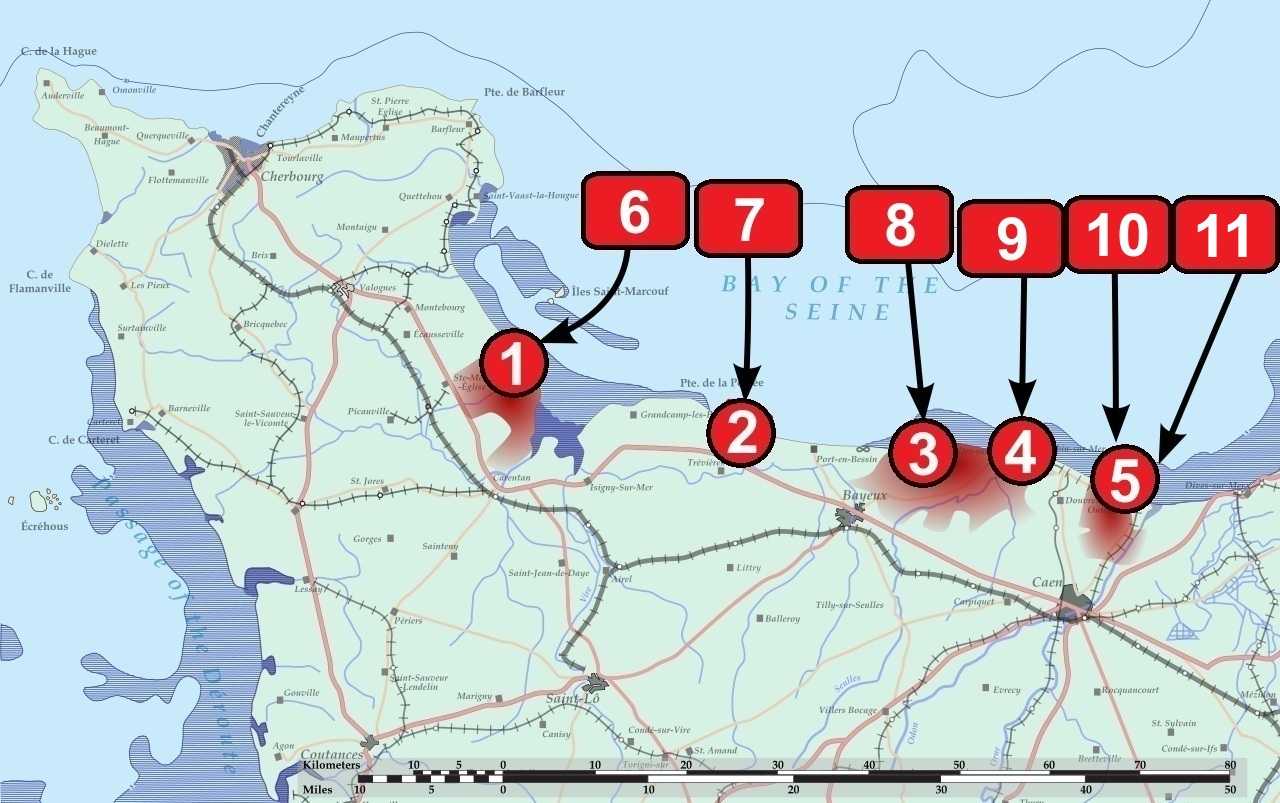
The Allied landings in Normandy on June 6, 1944, marked the beginning of the end of World War II. Can you match the British, Canadian, and American divisions to the beaches they attacked on that pivotal day?

A label quiz by reedy. Estimated time: 3 mins.
  1. Home
  2. »
  3. Quizzes
  4. »
  5. History Trivia
  6. »
  7. European War
  8. »
  9. D-Day

Author
reedy
Time
3 mins
Type
Label Quiz
Quiz #
424,617
Updated
Jun 24 26
# Qns
11
Difficulty
Tough
Avg Score
6 / 11
Plays
18
Last 3 plays: Balonyman (5/11), woodychandler (11/11), dinipie (0/11).
Click on image to zoom
Sword Beach Gold Beach Utah Beach U.S. 1st & 29th Infantry Divisions British 50th Infantry Division Omaha Beach U.S. 4th Infantry Division Canadian 3rd Infantry Division British 6th Airborne Division Juno Beach British 3rd Infantry Division
* Drag / drop or click on the choices above to move them to the answer list.
View Image Attributions for This Quiz
1.   
2.   
3.   
4.   
5.   
6.   
7.   
8.   
9.   
10.   
11.   

Most Recent Scores
Today : Balonyman: 5/11
Today : woodychandler: 11/11
Today : dinipie: 0/11
Today : Reamar42: 11/11
Today : Kalibre: 0/11
Today : Guest 174: 11/11
Today : harley74: 1/11
Today : psnz: 9/11
Today : Guest 172: 0/11

Quiz Answer Key and Fun Facts
1. Utah Beach

Deployed along the Cotentin Peninsula, elements of the 709th Static Infantry Division formed the main German defense opposite Utah Beach. Under General Karl-Wilhelm von Schlieben, this formation consisted largely of lower-quality troops, including older soldiers, conscripts, and non-German auxiliaries ("Osttruppen"), spread thinly across a wide frontage. These units occupied fortified strongpoints along the coastline, equipped with machine guns, anti-tank weapons, minefields, and a mix of mostly outdated or captured artillery integrated into the Atlantic Wall.

Further inland, additional formations - including elements of the 243rd Infantry Division, the 91st Air Landing Division, and the 6th Parachute Regiment of the 2nd Parachute Division - were positioned to reinforce the sector. While some of these troops were well trained, the overall defense suffered from dispersion, limited mobility, and weak coordination. With no substantial armoured presence at the shoreline and reserves reliant on disrupted movement and communications, the German response lacked cohesion.
2. Omaha Beach

At Omaha, the defense was anchored by the 352nd Infantry Division, a more capable and experienced unit commanded by General Dietrich Kraiss. Unlike many coastal formations, this division had been moved forward from reserve positions and was well prepared for combat. German forces occupied high ground overlooking the beach, allowing them to direct sustained fire from machine guns, mortars, and artillery against the landing zones below.

The defensive network was dense and carefully organized, with reinforced bunkers, interlocking fields of fire, and extensive obstacles positioned to disrupt any amphibious assault. Strong natural terrain advantages combined with effective troop deployment gave the defenders a formidable position, enabling them to inflict heavy casualties and delay the Allied advance for much of the day.
3. Gold Beach

German forces at Gold Beach were drawn mainly from the 716th Static Infantry Division, with additional support from elements of the 352nd Infantry Division on the eastern flank. The 716th occupied fixed defensive positions along the coast, relying on a mixture of infantry strongpoints, artillery positions, and anti-tank defenses to cover likely landing areas and nearby towns such as Arromanches.

Although these units generally lacked mobility and were not as well trained as front line formations, their defensive layout allowed them to mount organized resistance in key sectors. Where stronger elements of the 352nd were present, the defense was more effective, though it remained uneven across the beach.
4. Juno Beach

Defenses along Juno Beach were also largely the responsibility of the 716th Static Infantry Division, which concentrated its forces around coastal towns and key access routes inland. German positions were built into concrete strongpoints and reinforced urban areas, supported by artillery and a range of defensive obstacles placed both on the beach and further inland.

Despite limitations in troop quality, the density of positions in some sectors allowed German forces to resist effectively during the initial stages of the landings. Their use of terrain and built-up areas created localized strongpoints that slowed the assault, particularly in the early phases.
5. Sword Beach

Responsibility for defending Sword Beach rested primarily with elements of the 716th Static Infantry Division, supported inland by the 21st Panzer Division near Caen. Coastal defenses included fortified positions with artillery and anti-tank weapons, arranged to protect key landing zones and access routes.

The presence of the 21st Panzer Division added a critical element of mobility to the German defense. While not positioned directly on the beach, this armoured formation retained the ability to counterattack once the scale of the landings became clear, providing a potential threat beyond the immediate shoreline defenses.
6. U.S. 4th Infantry Division

Landing during the early hours of D-Day, the U.S. 4th Infantry Division - led by Major General Raymond Barton - came ashore slightly south of its intended position, an error that proved advantageous by placing it opposite weaker defenses. Under the steady leadership of Brigadier General Theodore Roosevelt Jr., the division pressed forward with minimal hesitation, quickly securing exits from the beach. Resistance was limited compared to other sectors, allowing troops to advance inland and link up with elements of the 82nd and 101st Airborne Divisions.

Over the following days, the division drove north through the Cotentin Peninsula, taking part in the campaign to seize Cherbourg, an objective vital to Allied supply operations. It remained engaged throughout the advance across France and into Germany, later fighting in demanding engagements such as the Hürtgen Forest and the Ardennes Offensive, establishing a reputation for steady and effective combat performance.
7. U.S. 1st & 29th Infantry Divisions

At Omaha Beach, the 1st Infantry Division formed a central part of the assault, operating alongside the 29th Division and Ranger units under Major General Clarence Huebner. Troops landing on the eastern sectors encountered intense and sustained fire from elevated German positions, leading to heavy losses and widespread disorganization in the opening hours. Small groups of soldiers gradually fought their way forward, using terrain for cover and exploiting gaps in the defenses.

By late morning, these efforts began to yield results as units secured routes off the beach, allowing reinforcements to move inland. In the weeks that followed, the division took part in the hard fighting around Saint-Lô and later advanced into Germany, where it contributed to key operations including the capture of Aachen and combat during the Battle of the Bulge.

Assigned to the western sectors of Omaha, the 29th Infantry Division, under Major General Charles Gerhardt, faced some of the most intense resistance of the day. Leading elements, particularly the 116th Infantry Regiment, suffered heavy casualties before reaching cover, and the assault quickly became fragmented under sustained fire. Leadership often devolved to small-unit commanders as soldiers regrouped along the shoreline.

Despite these setbacks, determined efforts by scattered groups led to the gradual reduction of German strongpoints and a slow push inland. In the weeks that followed, the division fought through the bocage countryside and played a central role in the prolonged and costly battle for Saint-Lô, remaining in continuous and demanding operations throughout the Normandy campaign.
8. British 50th Infantry Division

At Gold Beach, the 50th (Northumbrian) Infantry Division, commanded by Major General Douglas Graham, advanced ashore against a mix of static defenses and reinforced positions. The assault was supported by effective naval bombardment and specialized armoured vehicles from the 79th Armoured Division, which helped clear obstacles and suppress defensive fire. These advantages enabled British troops to break through coastal defenses and move inland relatively quickly.

By the end of the day, the division had captured Bayeux, marking the first major French town liberated. As operations continued, it worked to connect with neighbouring Allied forces and press toward Caen, encountering increasing resistance. After sustained fighting in Normandy, the division was eventually withdrawn and reorganized, ending its role as a front line assault formation.
9. Canadian 3rd Infantry Division

Landing along heavily defended sectors centered on coastal towns, the 3rd Canadian Infantry Division, led by Major General Rod Keller, faced difficult conditions from the outset. Rough seas delayed parts of the assault, leaving early waves exposed to concentrated fire from well-prepared German positions embedded in urban defenses. Despite this, Canadian troops fought through strongpoints and secured exits from the beach.

As momentum built, the division pushed inland farther than most Allied formations on D-Day, though not all planned objectives were achieved. In the weeks that followed, it became deeply involved in the fighting around Caen, including operations against Carpiquet Airfield, and contributed to the broader Allied advance from Normandy through sustained and determined combat.
10. British 3rd Infantry Division

On the eastern flank of the landings, the British 3rd Infantry Division, commanded by Major General Tom Rennie, came ashore near Ouistreham with strong support from naval fire and specialized armoured units. Initial resistance from German coastal defenses was overcome relatively quickly, allowing British forces to secure key positions and advance inland within the first hours.

The advance then shifted toward Caen, but progress slowed as German resistance stiffened and counterattacks developed, including those involving the 21st Panzer Division. Although the division linked up with airborne forces later that day, it was unable to capture Caen immediately and instead became engaged in prolonged operations around the city during the Normandy campaign.
11. British 6th Airborne Division

Arriving by parachute and glider in the early hours before the beach landings, the 6th Airborne Division, under Major General Richard Gale, secured critical ground east of the Orne River. Its mission included capturing key bridges - most notably Pegasus Bridge - and neutralizing enemy artillery positions such as the Merville battery, while blocking German movement toward the landing areas. Despite scattered drops, airborne units rapidly achieved most of their objectives through speed and surprise.

Holding this ground proved just as important as capturing it. Throughout D-Day and the days after, the division maintained a defensive perimeter against repeated German probes, helping to secure the eastern flank of the invasion. Though initially intended for short-term operations, it remained in position for several weeks before being relieved, having ensured the stability of the Allied foothold.
Source: Author reedy

This quiz was reviewed by FunTrivia editor ponycargirl before going online.
Any errors found in FunTrivia content are routinely corrected through our feedback system.
6/24/2026, Copyright 2026 FunTrivia, Inc. - Report an Error / Contact Us