FREE! Click here to Join FunTrivia. Thousands of games, quizzes, and lots more!
Tortoise Warrior Trivia Quiz
Roman military kit
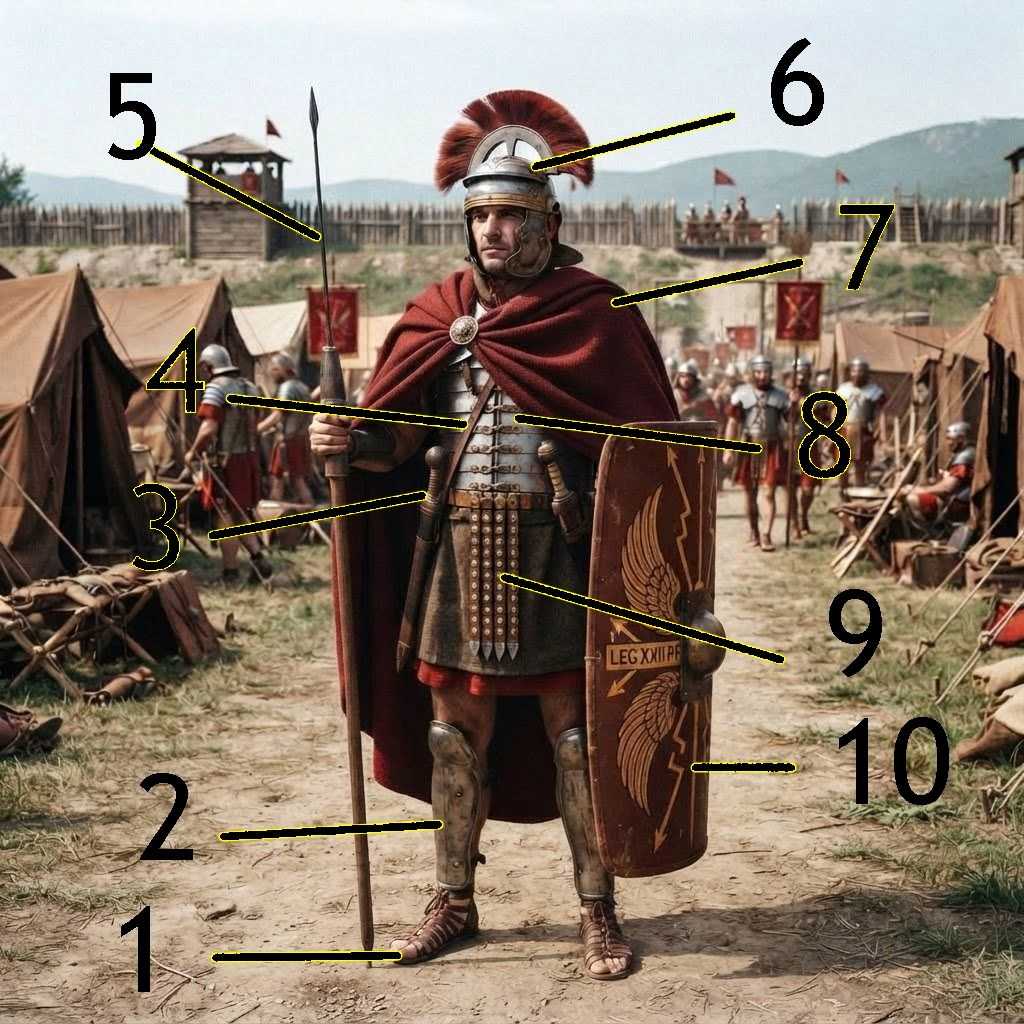
The image shows a selection of equipment used at different times over the centuries by the typical Roman soldier. Match the correct term to the number indicated on the image of the legionary.
Last 3 plays: jimhutch13 (4/10), lethisen250582 (10/10), C30 (8/10).
Click on image to zoom
GaleaGreaveLoricaSagumCaligaeCingulum militarePilumGladiusScutumBalteus* Drag / drop or click on the choices above to move them to the answer list. View Image Attributions for This Quiz
Caligae were the standard-issue military sandal-boots worn by the rank and file Roman legionary soldiers and cavalry. Caligae had heavy-duty soles, often hobnailed, with an openwork leather uppers laced up the middle of the foot to above the ankle. The Emperor Gaius acquired the nickname 'Caligula' ('little boots') when as a small child wearing a miniature soldier's outfit he accompanied his father during campaigns in Germania.
2. Greave
A greave was worn to protect the shinbone, which is vulnerable to a disabling wound. Greaves were worn as early as the Bronze Age. Made of metal, padding between the greave and the shin was essential to cushion a blow. There is evidence to suggest that many wore just one greave, perhaps to protect the leading leg in a fight.
3. Gladius
The gladius originally referred to a type of sword used between the 3rd century BCE and 3rd century CE. The name came to mean a sword generally, regardless of type. In the 3rd century BCE the Romans moved from a Greek-style thrusting sword to a slashing and thrusting sword based on a two-edged sword made by the Celtiberian tribe of Hibernia. From around the 3rd century CE, the longer spatha gradually took over.
4. Balteus
The balteus is the Latin name for a baldric, a belt worn over one shoulder and used to carry a sword. The balteus was made of leather and sometimes decorated with precious stones or metal. The shoulder-worn belt was more supportive of a sword weight than a waist-worn belt.
5. Pilum
Pilum was the Latin word for a heavy javelin, although the word was also used generally to refer to throwing javelins. The hasta, a thrusting spear, was replaced by throwing javelins such as the pilum, verulum and lancea. With a pyramidal iron head, when thrown pila would often penetrate shields and armour.
They would be difficult to remove and make the enemy's shield effectively unusable, thereby creating weak points in the enemy lines. The spiculum displaced the pilum.
6. Galea
The galea was the metal helmet worn by heavy infantry in the legions. The various designs tended to be bowl-shaped with neck guard, hinged cheek plates and a deflector band to increase protection of the forehead. Any crests were often red-coloured and made of horse hair.
Some crests were transverse-mounted, some longitudinally. Rank seemed to be the determining factor for crest orientation.
7. Sagum
The sagum was typically a red-coloured woollen cloak worn over the soldier's armour and fastened by a fibula (brooch). Rectangular in shape, it was doubled-up when worn and could serve as a full-length sleeping wrap. The lanolin in the wool helped waterproof the material.
8. Lorica
Body armour was expensive but where worn, there were three types: mail made with linked metal rings (lorica hamata), broad overlapping ferrous strips fixed to internal leather strips (lorica segmentata) and a type of scale armour made from metal scales sewn to a fabric backing (lorica squamata).
The hamata mail was cheaper to produce however the segmentate provided better protection. The image shows the latter kind.
9. Cingulum militare
Cingulum militare was a form of decorated belt which hung from the waist. The hanging leather strips were adorned with metal and were perhaps a reflection of status. Only soldiers were permitted to wear them and they could be worn when out of uniform as a way of signifying status as a legionary.
The waist belt may have started as a sword belt (a balteus) before the sword moved to be hung from the shoulder-mounted balteus.
10. Scutum
The scutum was a shield used when the Romans switched from the hoplite phalanx formation, inherited from Etruscans and Greeks, to using maniples as a tactical unit. The Greeks had used a round shield, called the clipeus by the Romans, however a new shield was developed for the maniple.
The scutum was initially a convex oblong but was developed into a rectangular half-cylindrical shield. There were convex oval versions as well. One novel use of this shield was the testudo (Latin for 'tortoise') where legionaries linked scutum shields together to protect against projectiles from above - hence the quiz title.
This quiz was reviewed by FunTrivia editor ponycargirl before going online.
Any errors found in FunTrivia content are routinely corrected through our feedback system.