
FREE! Click here to Join FunTrivia. Thousands of games, quizzes, and lots more!
Quiz about Eating Europe

Eating Europe Trivia Quiz


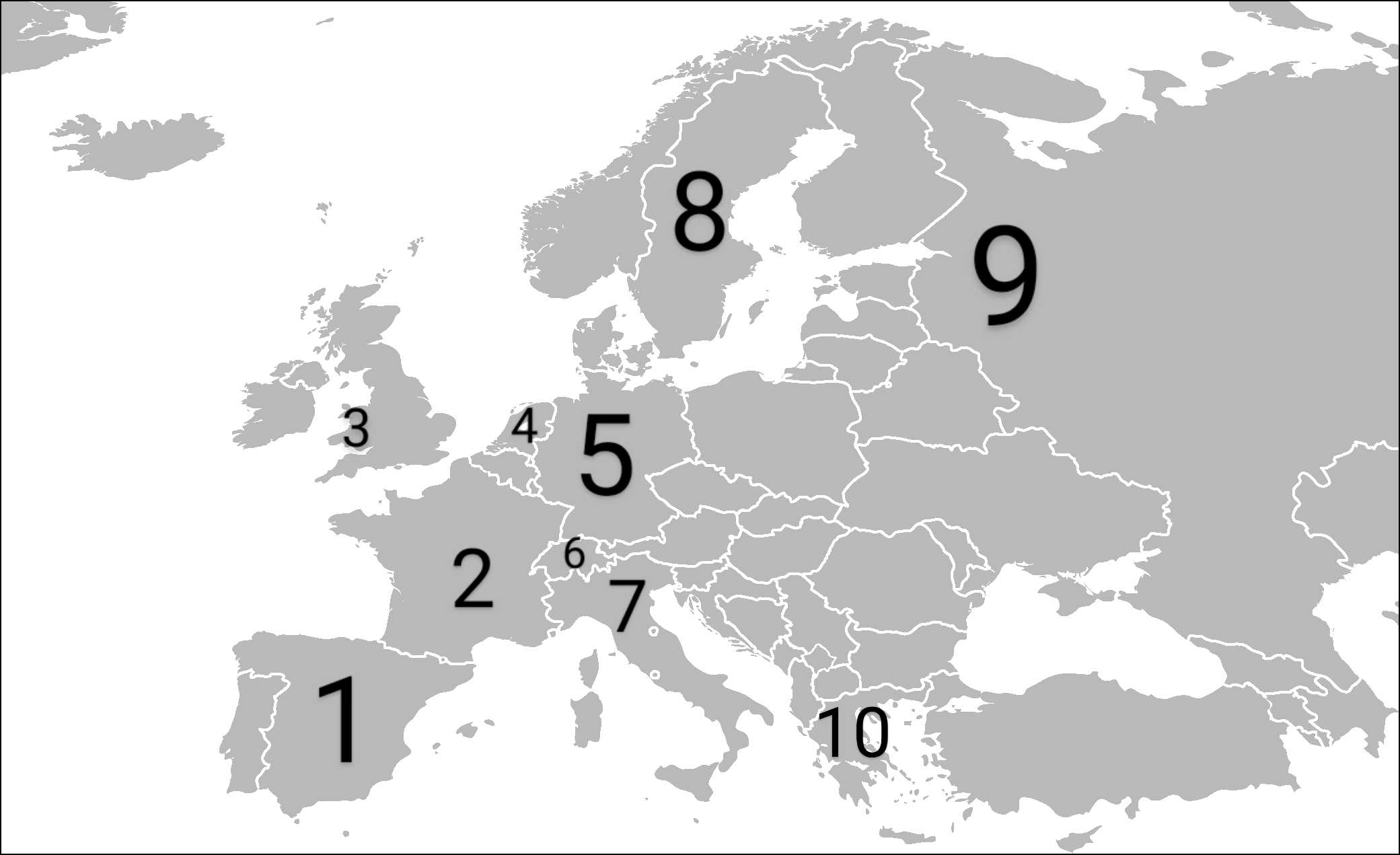
What do these have in common? Swedish Fish, Turkish Delight, English muffin. They're named after their place of origin. This quiz isn't that. Foods here, like Jordan almonds, French toast and Russian dressing, did not originate with their place names.

A label quiz by salami_swami. Estimated time: 3 mins.
  1. Home
  2. »
  3. Quizzes
  4. »
  5. Hobbies Trivia
  6. »
  7. Food & Drink
  8. »
  9. Mixed Food and Drink

Author
salami_swami
Time
3 mins
Type
Label Quiz
Quiz #
423,422
Updated
Mar 12 26
# Qns
10
Difficulty
New Game
Avg Score
6 / 10
Plays
13
Last 3 plays: lethisen250582 (10/10), Guest 174 (10/10), suomy (7/10).
Pair each food with its namesake - but not its origin. You won't find Swiss chocolate or Belgian waffles here!
Click on image to zoom
Rarebit Yogurt Tea Cake Fries Cream Soda Rice Chocolate Cake Cheese Baby Meatballs
* Drag / drop or click on the choices above to move them to the answer list.
View Image Attributions for This Quiz
1. Mexican side dish  
2. Chips?  
3. Toasty!  
4. Pancake  
5. Coconutty  
6. Not quite Emmental  
7. Not your nonna's  
8. IKEA favorite?  
9. Wedding cookies  
10. Strained  

Most Recent Scores
Mar 12 2026 : lethisen250582: 10/10
Mar 12 2026 : Guest 174: 10/10
Mar 12 2026 : suomy: 7/10
Mar 12 2026 : dmaxst: 4/10
Mar 12 2026 : sally0malley: 2/10
Mar 12 2026 : James25: 7/10
Mar 12 2026 : JawnTrivia: 4/10
Mar 12 2026 : runaway_drive: 10/10
Mar 12 2026 : 1995Tarpon: 4/10

Quiz Answer Key and Fun Facts
1. Rice

Mexican rice is a popular side dish in Mexican and Tex-Mex cuisine made from perfectly toasted rice mixed with a tomato and garlic-based sauce. The dish became popular in Tex-Mex cuisine in the United States in the late 19th century. However, it was not called Spanish rice until 1902; a recipe was created for Mexican rice that was more akin to paella, and was considered a Spanish dish, and therefore called Spanish rice.

A similar recipe, yet more like Mexican rice, was released a year later, but still under the name Spanish rice.

The name became colloquial for traditional Mexican rice, and both terms are used in the United States for the same Mexican side dish! Whatever you call it, it's a delicious pairing to your meal.
2. Fries

Ah yes, the French fry - a delicious snack and side dish served around the world in various ways, and one with quite the controversial origin. Though France has claimed the origin of the fry as well, it is unlikely this is the case; and instead, may stem from Spain or Belgium. The term "French fries" originates in the United States, however, and dates back to the 1880s when the term began being used. Using the word "French" for the fried potato goes back even further, however; in 1856 an English recipe by Elizabeth Warren was the first time "French fried potatoes" was seen in print, and back in 1802, Thomas Jefferson had a dinner with "potatoes served in the French manner" (though we cannot be sure that is referring to a French fry as we now know it).

Regardless of who invented the modern-day French fry, one thing can be sure; Chile has documented texts referencing fried potatoes that date back to 1629... well over a century before potatoes even made their way to Europe!
3. Rarebit

Welsh rarebit may be called Welsh, but there is very little evidence that the dish comes from Wales. The earliest recipe of this toasty, cheesy deliciousness is from 1725, where it was originally called Welsh rabbit. The use of the word "rarebit" to avoid confusion was not documented until 1781! Since the dish was so popular, other variations have since been made, such as Scotch rarebit, buck rabbit, and in the United States, Kentucky created the Hot Brown.

As an unfortunate aside, the original name "Welsh rabbit" may have come from the English's disparaging remark that the Welsh were too poor to afford real meat, and would eat this cheese and bread dish in lieu of real rabbit.
4. Baby

A Dutch baby is a type of pancake that is baked instead of fried that originates from a restaurant in Seattle, Washington in the early 1900s. Unlike a traditional pancake fried on a griddle, the Dutch baby (also called a German pancake, Hootenanny, or Hooligan) is baked, and can be sweet or savory. They are very similar to Yorkshire pudding, though Yorkshire pudding tends to lean more towards the savory side (using beef drippings instead of butter) and are typically a smaller, individual treat like popovers.

The Dutch baby does not have Dutch origins; it is based on a German pancake. The name "Dutch baby" is claimed to have been named by Victor Manca's (owner of the Seattle cafe that invented the treat) daughter, who was trying to say "Deutsch", given its German origin. The name stuck, and Manca's Cafe claimed it owned the trademark for Dutch babies back in 1942.
5. Chocolate Cake

German chocolate cake is a delicious dessert, but it is by no means European in origin at all! In fact, this cake variation was simply named after chocolate maker Samuel German. You see, Samuel German created a new type of dark baking chocolate back in 1853, and was a popular dark variety of baking chocolate for the Baker's Chocolate Company (well known for their varieties of baking chocolates).

The first recipe for the cake came in 1956, when this new cake used German's chocolate, and was therefore called "German's chocolate cake". What really makes this cake sing, however, is the use of a frosting made from coconut and pecans; delicious!
6. Cheese

Swiss cheese is a term first used in North America for any cheese that resembles Emmental, though does not include Emmental itself. The idea was that if a cheese's fermentation process created eyes in the cheese like Emmental, it would be a "Swiss" cheese.

Other countries have since began making their own Swiss cheeses; some places use Emmental and Swiss cheese interchangeably, others added the phrase Swiss-style cheese to avoid confusion, and others simply refer to the cheese as Emmental or Emmentaler. Regardless of whether it's a true Emmental or a Swiss-style variety of cheese, the origin of the name "Swiss cheese" is anything but Swiss!
7. Cream Soda

Italian soda is a wonderful summer refresher of carbonated water and flavored syrup. Flavor possibilities are endless, since carbonated water has very little flavor, any flavoring can be used to make delicious combinations (I have tried a chocolate and pumpkin flavored Italian soda, though, and can confirm that not ALL combinations are a winning pair). Adding cream to the soda makes for a smoother, and in my opinion, a more delicious drink, though now under the name Italian cream soda (or, for some reason, French soda).

As for the origin of the name, it is believed that the Torani syrup company is to blame. The Italian syrup makers arrived to the United States to market their product in 1925, and introduced the idea of adding syrups to soda water in San Francisco, and these drinks became known as Italian sodas. Torani's tactic worked; as now the syrup is commonly used in the United States for all sorts of drinks and dishes that use syrup flavorings.
8. Meatballs

Swedish meatballs; an absolutely fabulous dish, and the national dish of Sweden. One would believe the dish to have Swedish origins, but this is in fact not the case. Though modern recipes known today DO come from Swedish cuisine, the origin is actually Turkish.

It is said that King Charles XII brought back meatballs from the Ottoman Empire back in the 18th century, though not with the traditional gravy and lingonberries. What he brought was a traditional meatball, kofte. Swedish meatballs are known throughout the world, and became extremely popular with the founding of IKEA; a furniture store that also sells.... Swedish meatballs.
9. Tea Cake

Russian tea cakes are delicious cookies made primarily with ground nuts, and adding in butter, flour, and water. They are traditionally coated in powdered sugar, once when still warm to get a layer to stickily adhere to the cookie, and a second layer later to keep it powdery. These cookies are also called snowballs or Mexican wedding cookies.

The origin of the "Russian" aspect of these cookies is unknown, as the cookie itself is not Russian. It is believed, however, that the cookies were derived from European shortbread when brought over to Mexico, or that the name was associated with the cookie as it was served next to Russian samovars. Though there can be differences between Russian tea cakes and Mexican wedding cookies, the terms are often used interchangeably, and can also vary by region.
10. Yogurt

Strained yogurt is a thicker variation of unstrained yogurt, as it removes most of the whey from the straining process. Strained yogurt is a popular dish throughout the world, especially as it curdles less when being cooked. This makes it quite popular in yogurt heavy cuisines, such as Greek cuisine. The term "Greek yogurt" comes from the 1980s, when the Greek brand Fage introduced strained yogurt to the United Kingdom - since then all yogurt labeled "Greek-style yogurt" is the strained yogurt from Greece.

This is not true in the United States, however. Though Fage influenced the introduction of strained yogurt to the US as well, the US, unlike the UK, does not require the product to be made in Greece to be called Greek yogurt. Most of the world, however, as they make their own strained yogurt, do not necessarily associate strained yogurt with only Greece... this is another example of marketing influencing our foods!
Source: Author salami_swami

This quiz was reviewed by FunTrivia editor Bruyere before going online.
Any errors found in FunTrivia content are routinely corrected through our feedback system.
3/13/2026, Copyright 2026 FunTrivia, Inc. - Report an Error / Contact Us